
Questions loom over Albania's forests after devastating fires / Photo: © AFP

 Nick Harkaway Expands John le Carré’s Spy Universe in 'The Taper Man'

 Rene Eyre Revisits Autobiographical Performance 'Say A Little Prayer' in London
 UAE's HCT Holds Record Graduation and Announces Major Training Expansion

 NASA Awards $10B Lunar Contract Framework to SpaceX, Blue Origin
 Katy Perry Tells Fans Ex-Husband Russell Brand 'Should Be in Jail' During UK Concert

 South African election results renew debate over identity-based voting

 South African voters report smoother local election but declining IEC trust

 Dolly Parton museum and Nashville hotel open after singer’s death
 George and Amal Clooney attend New York political-comedy reading
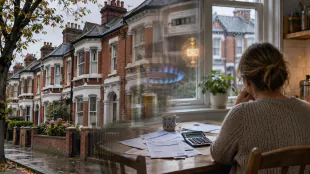 British buyers pay substantial premiums for period-home appearance

 Thomas Markle released to house arrest after child-abuse-image charge

As Albania recovers from a summer of devastating wildfires, locals and experts are eyeing a long road back to save its shrinking forests from intensifying disasters.
In some of the worst blazes to ever hit Albania, nearly 60,000 hectares (nearly 150,000 acres) -- or around two percent of Albania's landmass -- burned when blazes swept across parts of southern Europe earlier this year, according to data from the European Forest Fire Information System.
For the small, developing nation, the toll was hefty -- killing one person, destroying dozens of homes, and reducing vital forests to ash.
"Forests are very important, and they need time to regenerate," Armand Kisha told AFP, standing in the ruins of his carpentry workshop which was destroyed when fires ripped through the central Gramsh region in August.
As he tries to rebuild after also losing his home and livestock, Kisha mourns the pine forest that had surrounded him since his childhood.
"We won't see green pines here like before. It's a catastrophe," he said.
Even as the smell of charcoal lingers, the local fire department is warning of the need to rapidly restore the forest, ahead of the wet winter months.
"This natural disaster could lead to deadly floods," Ilir Llapushi, head of the Gramsh firefighting unit, said.
For years, scientists have warned that the risk of damaging floods is dramatically increased after intense wildfires, as rain struggles to permeate the burnt-out forest floor and flows encounter little resistance from the remaining vegetation.
"We must act quickly to regenerate the forest," Llapushi said.
-'Compound and cascade'-
A 2024 World Bank report noted that Albania is one of the most at-risk European nations to climate disasters.
Nearly all its regions had been affected by floods, wildfires, landslides or earthquakes in the last two decades, the report said.
A boom in informal settlements across most of the Balkans during the 1990s, often built on flood-prone land, means disasters could "compound and cascade" as their frequency increases, the report stated.
As Albania faces more extreme weather driven by climate change, it is essential to reform its forest management, said Abdulla Diku, a forestry engineer and researcher based in Tirana.
Deforestation, reduced river flows from hydroelectric dams, and an exodus of people from rural areas were intensifying the country's wildfires and putting forests at greater risk, Diku said.
"The overall situation is such that we now have at least 30 percent less forest than we did 20 or 25 years ago."
Earlier this month, Prime Minister Edi Rama announced an action plan to revive forests.
His government banned construction on land affected by the blazes, and pledged harsher penalties for arsonists.
Ten people were arrested in August, accused of lighting fires. They have since been released.
But Diku said that Albania was a laggard in forest restoration projects, investing the lowest amount in Europe.
-'Fire-filled bombs'-
As replanting efforts continue, locals and experts are pushing to change the type of trees in their forests.
When the flames swept through the Gramsh region, they devoured the pines, whose cones turned into "fire-filled bombs," said Kujtim Palloci, a resident of the hard-hit village of Skenderbegas.
Efforts to make the forests more disaster resilient are underway, according to environmental non-government organisation PPNEA.
Biologist Melitjan Nezaj said the NGO was working with the International Union for Conservation of Nature on implementing a restoration plan that includes mixing in tree types that better resist "extreme conditions like fires, floods, and landslides".
In Gramsh, the municipality is exploring options to alternate pines with other trees, especially deciduous species.
But for Palloci, the changes were too late to save his home. In less than 30 minutes, his house was reduced to ashes, his goats burned alive, and his family memories —- photos of his children —- consumed by fire.
"This house was all we had. This house is my love, my life, my family, my hard work. This house really is everything to me."
A.Gasser--BTB
