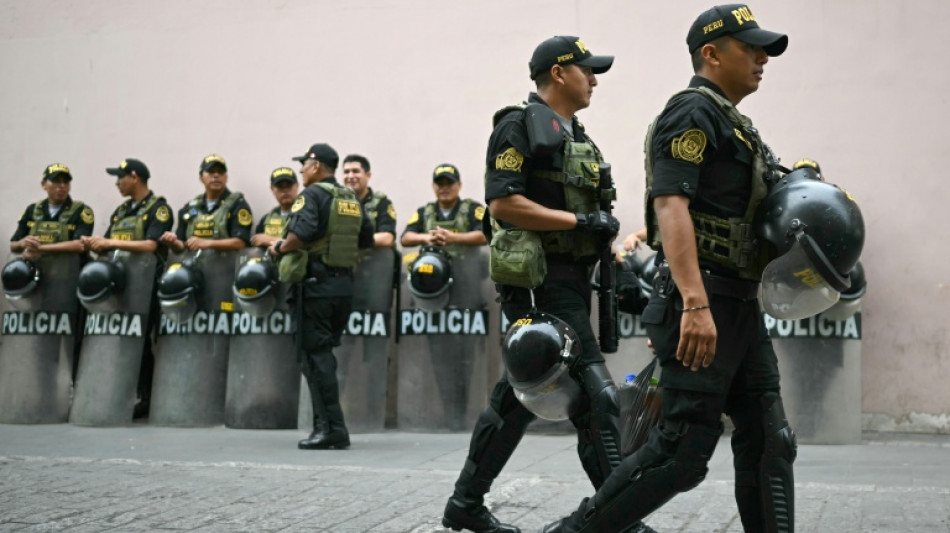
In crime-hit Peru, candidates vie to be 'meanest sheriff' / Photo: © AFP

 Inside the Venezuelan prison meant to 'drive you insane'
 UK king braces as memoir by Diana's brother goes on sale
 No green light to lift EU sanctions on Russian oligarchs, talks to resume

 UK agrees support for Saudi in struggle with Houthis: reports

 EU foreign policy chief calls for continued sanctions on Russia

 Flights scrapped, evacuations urged as Typhoon Dujuan wallops Japan

 Fonseca to take break from tennis

 A Cuban zoo, and its animals, in epic battle for survival

 Infantino proposes consulting federations to reform FIFA

 El Nino weather pattern enters record territory: scientist
 OpenAI calls for US to lead global effort on AI standards

 South African ostriches plucked alive for luxury fashion: report

 US networks halt Trump coverage in revolt over White House ban

 Paramount settles with US states to clear Warner Bros. mega-merger

 Climate crisis a job for world leaders, not just activists: UK FM

 US networks halt Trump coverage over White House ban
 French singer accuses Miley Cyrus of plagiarism

 EU fines Google 403 mn euros for location data breach

 'Best is yet to come,' says De la Fuente after Spain extension

 Why diesel prices are rising more than crude oil

 COP31 host says AI's climate footprint to be a summit priority

 Renewables hit record in 2025, but world must move faster: report

 US media outlets to sue Trump administration after White House ban

 Global stocks rally on lower oil prices, US-China hopes

 EU proposes energy rating for data centres

Peruvian presidential hopefuls are touting cash bounties for killing criminals and jungle prisons encircled by Amazonian vipers as they look to tap widespread public anger over rising violence ahead of the April 12 election.
Extreme ideas are shaping a campaign which features a record 35 candidates, as Peru confronts soaring extortion and a homicide rate that has more than doubled since 2018.
Public frustration is high: "Even the police are corrupt," says Karen Santiago, a 29-year-old engineer in Lima's San Isidro district, echoing the sense of impunity driving support for hardline promises.
In an effort to stand out and make it through to a June runoff, many candidates are amping up the rhetoric.
Frontrunner Rafael "Porky" Lopez Aliaga recently toured one poor district where he was greeted by a giant stuffed snake.
The ultraconservative says criminals "must be flown by helicopter to the deepest jungle to build prison colonies" ringed by the world's largest vipers he said.
"They will take care of security," he said smiling.
The would-be ally of US President Donald Trump also proposes allowing the United States to arrest foreign criminals wanted by Washington on Peruvian soil.
Extortion and violence have become commonplace in Peru as transnational crime groups exploit corrupt and undertrained police forces.
Even schools have been targeted by gangs demanding protection money.
In the face of such a crisis, leftwing candidates are also offering populist policies as possible solutions.
Ronald Atencio, has promised something resembling police death squads, although he insists they would avoid extrajudicial killings.
Paul Jaimes, a low-polling contender, goes further, offering $29,000 and a promotion to any police officer who captures or kills a criminal.
"We don't care about criminals' human rights," he told Caretas magazine.
TV comedian Carlos Alvarez, polling between fourth and fifth, demands that Peru leave international rights conventions so the country can apply the death penalty to hitmen.
"Those miserable people don't deserve to live," he told AFP during a tour of Callao.
Some voters embrace the rhetoric. "I agree that all criminals should serve their sentences in the jungle," says 54-year-old vendor Lili Luna.
Others remain skeptical. "It's easier to sell those solutions than long-term plans," says 20-year-old student Samuel Cossio.
– Forced labor –
Right-wing candidate Keiko Fujimori, who leads recent surveys, used this week's presidential debate to propose reinstating faceless courts -- secret tribunals where judges' identities are hidden behind screens.
The system, created during her father Alberto Fujimori's term in office, was widely criticized for unfair trials that later forced the state to pardon hundreds of prisoners.
"To fight crime, if we have to withdraw from the Inter-American Court of Human Rights, we will do so to bring back faceless judges," she said, promising a "mano dura" (iron fist).
Sociologist Jorge Nieto, fourth in polls, said laws backed by Fujimori's party weakened criminal-investigation tools, according to prosecutors.
Fujimori also wants to make inmates earn their meals. "We will force prisoners to work for their food, for their protein," she told reporters.
Security experts warn the proposals will not work.
"Punitive proposals like these are not effective against organized or transnational crime," said criminologist Erika Solis of the Catholic University of Peru.
Javier Llaque, former head of the National Penitentiary Institute, said Peru already has some of Latin America's harshest sentences.
"We don't need more laws or higher penalties. Just action, but tactical action," he said. Insecurity "must be addressed, but technically, not emotionally."
"Candidates should not try to be the meanest sheriff."
C.Kovalenko--BTB