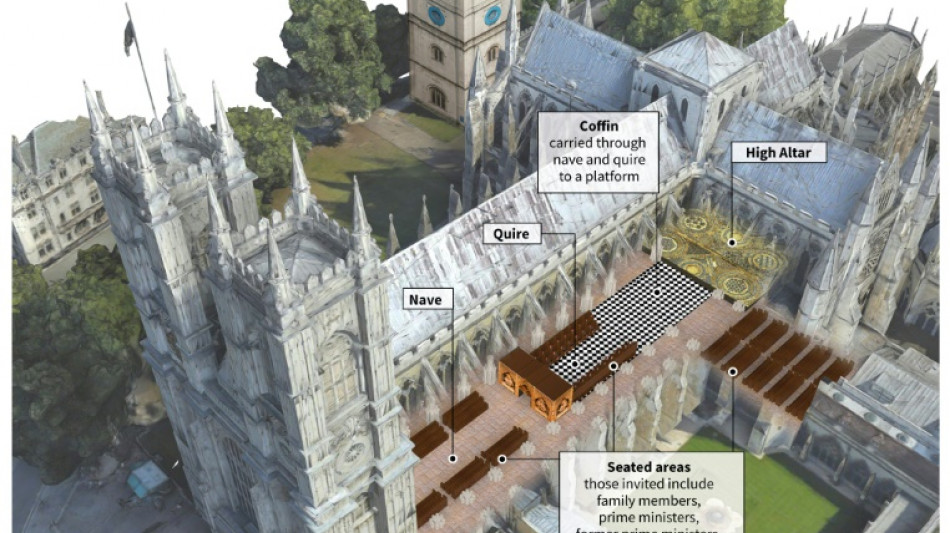
Westminster Abbey: a millennium entwined with royalty / Photo: © AFP

 Indonesia traps monkey to end rampage that wounded 18 people

 Food security fears mount as UK farmers battle drought
 Houthi missile attacks kill 58 Saudi-backed Yemeni govt forces
 Chinese activist held in Bangkok finds Canada refuge
 Kiss takes reins as Wallabies face Japan

 North Korea touts dog soup and other home-cooked recipes to beat the heat

 UK observatory nervously watches growing space junk threat
 Meta ordered to pay US state $567 mn to abate 'public nuisance' and child harm
 Houthi missile attacks kill 58 Saudi-backed Yemeni govt forces: source

 No.1 Sabalenka and Pegula advance at Toronto
 China missile test top of agenda as Pacific diplomats meet in Fiji
 Most UK teens to opt out of planned social media curfew: poll

 Venezuela's political transition talks launch in Caracas

 2 killed, 13 wounded in bus blast near Syrian capital: state media

 All Blacks skipper Taylor cautiously recovering from calf strain

 UN chief denounces Russia, Ukraine for civilian deaths

 UEFA turn up the pressure on Infantino and repeat boycott threat
 Rodri approves Barcelona transfer talks with Man City: Barca source to AFP

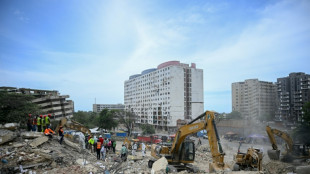 Venezuela unable to tally missing from cataclysmic quakes

 Le Court sprints to stage six Tour de France Femmes win

 Doping body says Parker's positive cocaine test caused by nutritionist

 UEFA says boycott of World Cups stands despite FIFA backdown on private investment

 Rheinmetall sales keep surging despite cancelled naval frigate project

 Pogacar teammate Del Toro gets new UAE deal after Tour podium

 Stocks tread water with earnings, tech in focus

Westminster Abbey, the setting for Queen Elizabeth II's funeral, has been paramount for Britain's royal family for nearly a millennium.
In the 1040s, King Edward the Confessor built a stone church on the site of a Benedictine monastery founded around 960, in a major enlargement.
Construction began on the imposing Gothic abbey of today under the orders of King Henry III in 1245.
It was designed as a place for the coronation and burial of monarchs.
- Coronations -
William I was the first king crowned in the abbey in 1066 -- a tradition which has endured throughout the centuries.
In 1953, Elizabeth II was crowned on the Coronation Chair, as her eldest son Charles will be.
The chair was made in 1300-1301. It enclosed the Stone of Scone, which was used for centuries to crown the kings of Scotland.
The stone was temporarily stolen in an audacious raid by Scottish students in 1950, who accidentally broke it in two.
In 1996, with nationalist sentiment rising, it was symbolically returned to Scotland but will come back from Edinburgh Castle to Westminster for coronations.
The abbey has hosted 38 coronation ceremonies for reigning monarchs.
- Weddings -
The church has also been the scene of royal weddings -- most of them since World War I. The first was when King Henry I married princess Matilda of Scotland on November 11, 1100.
Queen Elizabeth's parents, prince Albert -- later King George VI -- and Elizabeth Bowes-Lyon, wed in the church in 1923.
And Queen Elizabeth married Philip Mountbatten in the abbey in 1947, bringing some royal colour to the post-World War II recovery years.
Queen Elizabeth's sister, Princess Margaret, and her children Princess Anne and Prince Andrew all got married in the abbey.
The last royal wedding was that of Charles's eldest son Prince William, who wed his university sweetheart Kate Middleton in 2011.
Only 14 years earlier in 1997, William attended his mother Diana's funeral in the abbey following her death in a Paris car crash.
- Famous burials -
The abbey is the final resting place of 30 kings and queens, starting with Edward the Confessor. King George II was the last, in 1760.
Around 3,330 people are buried at the abbey, including some of the great figures of British history.
They include Charles Dickens, Geoffrey Chaucer, Samuel Johnson, Rudyard Kipling, Alfred Tennyson, Henry Purcell, William Wilberforce, Laurence Olivier, Thomas Hardy and eight prime ministers.
The ashes of astrophysics giant Stephen Hawking were interred in 2018 between the graves of Isaac Newton and Charles Darwin.
Other notable personalities have memorials in the abbey, including Jane Austen, Benjamin Britten, Noel Coward, Francis Drake, Edward Elgar, Martin Luther King Jr and Oscar Wilde.
There is a memorial stone to wartime prime minister Winston Churchill inside the west entrance.
It sits near the Tomb of the Unknown Warrior, whose body was brought from continental Europe after World War I. The grave represents all Britain's fallen troops.
Queen Elizabeth and her mother before her left their wedding bouquets on the tomb.
- Royal peculiar -
The abbey -- or to give it its full name, the Collegiate Church of St Peter, Westminster -- is a "royal peculiar" which means it is exempt from any ecclesiastical jurisdiction other than that of the monarch.
The British sovereign is the supreme governor of the Church of England.
The abbey can regularly seat around 2,200 people, though most will not be able to see Queen Elizabeth's funeral service due to the screen separating the nave from the choir.
The royal family will sit closest to the coffin.
Around 8,250 squeezed in for Queen Elizabeth's coronation, in specially erected tiers.
The central London church played a major role in Queen Elizabeth's life: besides her wedding, it staged her mother's funeral and celebrations of major landmarks in her record-breaking reign.
At services in the church, Queen Elizabeth and Prince Philip nearly always sat in specially made birch chairs presented by the Canada Club in memory of Canadians who fell in World War II.
The monarch has left her mark on the abbey.
Queen Elizabeth's record reign is celebrated in a stained-glass window unveiled in September 2018. Designed by David Hockney, it represents the Yorkshire countryside in the spring.
The sovereign opened The Queen's Diamond Jubilee Galleries in June 2018. About 16 metres (52 feet) above the abbey floor, they display treasures and tell the story of the church's history.
The abbey is still a working church and holds regular services open to the public.
K.Thomson--BTB