Sri Lanka's war widows and the long search for the missing / Photo: © AFP

 Winds of change: Laos looks up for renewables push
 Sri Lanka's war widows and the long search for the missing

 'Air-con nation' Singapore eyes alternatives to cool down

 US judge dismisses Trump lawsuit against Wall Street Journal over Epstein letter
 Slave or not? US gallery shows early photos of African Americans

 France's Aymoz wins Skate Canada men's crown

 Pope Leo readies for 'intense' South America homecoming

 Antonelli admits to feeling tense of eve of potential F1 title decider

 FBI says North Korea behind $6 billion crypto theft from Binance

 'Canelo' Alvarez wins back WBC title from Mbilli in Riyadh

 'Canelo' Alvarez wins back WBC title from Mbilli

 Sovereignty wins Breeders' Cup Classic
 Hamilton grabs pole position for Mexican Grand Prix

 Benvenuto Cellini wins Breeders' Cup Turf
 Roma thrash Udinese ahead of Milan derby

 Kane laments Dortmund draw after 'incredible high' of Ballon d'Or
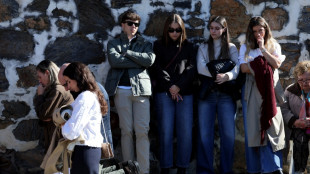 Spanish village holds memorial mass for train crash victims

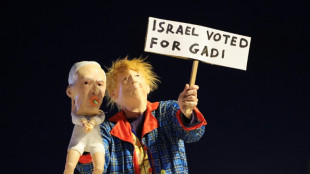 Israeli protesters demand opposition ally with Arab parties to oust Netanyahu
 De Minaur upsets Zverev and will face Alcaraz in Vienna final

 Kane misses penalty as Bayern held by Dortmund
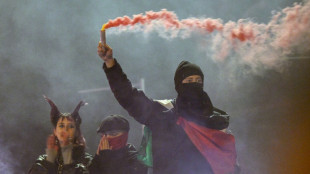
 In Mexico City, Day of the Dead parade inspired by 007

 Rubio flags challenges in finding consensus as G20 talks wrap

 Zaman's century foils Sri Lanka as Pakistan win tri-series

 Bordeaux edge Bayonne to keep pressure on Toulouse

 Spanish village gathers for memorial Mass for train crash victims
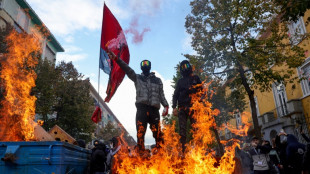
Seated outside a church, Saradhadevi Thadcanamoorty recites four handwritten pages of names -- 124 husbands, fathers and brothers who vanished during Sri Lanka's civil war.
The Tamil woman, in her 60s, then picked up a placard and with three others started a "march for justice" in the busy eastern city of Batticaloa -- their 1,604th consecutive day of protest.
From 1983 to 2009, Sri Lanka was ravaged by war between government forces representing the Sinhalese majority and Tamil separatist rebels, members of a largely Hindu minority.
Over 100,000 people were killed, including many civilians, according to UN estimates.
Tens of thousands also disappeared, or were abducted, tortured or killed by security forces or the Liberation Tigers of Tamil Eelam (LTTE).
More than 15 years after the war ended, the fate of most remains unknown.
Complaints, court appeals, protests, international pressure and repeated government promises have brought little progress.
- 'Never seen again' -
Thadcanamoorty's story reflects the horrors of the war and the families' long search for answers.
In July 1992, her husband Nallathambi, 34, was found dead in his field, shot in the head.
Witnesses said a soldier had killed him. His wife immediately reported the soldier to the police.
"They told me, 'If you say your husband was killed by a soldier, they will never give him back to you'," she said.
"So I ended up filing a complaint against an unknown person. I recovered his body, received compensation of 50,000 rupees ($151, at current rates), and the investigation stopped."
In January 2000, her son Navaneethan, 19, disappeared. She believes Tamil rebels abducted him to force him into their ranks.
"I never saw him again," she said. "In 2016, I filed a request for information with the authorities. They replied that his fate was unknown. All I was given was a certificate of disappearance -- not the truth."
Lakshmi Silva has found little more certainty.
In July 1990, her husband disappeared while travelling by bus to Colombo. Armed men took him away at a checkpoint.
"Witnesses told me they were 'Tigers'," she said, referring to the rebels.
Her appeals to police and the separatists went unanswered. Those she approached warned her not to make trouble.
In 1994, a magistrate issued a death certificate. The cause of death was listed as "unknown". Since then, nothing.
"I no longer think he will come back," Lakshmi Silva admitted. Now in her 60s, she has tried to move on.
"I live only for my children now," she said.
Others refuse to accept the silence.
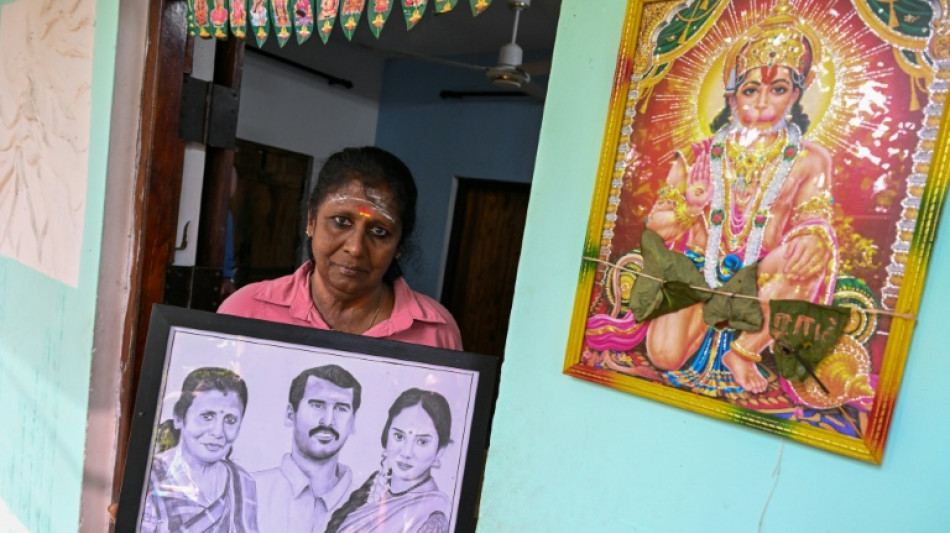
"I have always kept hoping," said Rajeshwari Chithiravadivel, 61.
On her wall hangs a charcoal portrait of a smiling, moustachioed man, pictured between his wife and daughter. Her husband disappeared in February 1989, abducted by masked men while shopping.
The authorities issued her a death certificate in 1998. Two years later, the Red Cross presented her with the body of a man for identification, saying it might be her husband.
"He was unrecognisable," she said. "So I continue to believe."
It is for cases like this that the women continue their daily protest, echoing Argentina's Mothers of the Plaza de Mayo, who marched for years demanding answers about the children who disappeared under the country's 1976-1983 dictatorship.
- 'A great silence' -
"We secretly hoped thousands of people would join us, but clearly that is not the case," said Sarala Emmanuel, one of the most regular marchers and a campaigner.
"But nothing has changed -- there is still a great silence," she said.
Since 2009, Sri Lankan civil society, international rights groups and the United Nations have repeatedly urged successive governments to investigate wartime crimes and bring those responsible to justice.
The election of Anura Kumara Dissanayake as president in 2024 rekindled hopes.
In his election manifesto, the country's first left-wing president promised to probe "political assassinations, disappearances and assaults" and open an independent national prosecutor's office.
Two years on, some progress had been made, Human Rights Watch (HRW) said in September, but the government had failed to address "the urgent need to end impunity".
The Ministry of Justice did not respond to AFP's questions about the proposed independent prosecutor's office.
"On one or two emblematic cases, there seem to be some investigation... But on the question of enforced disappearances or missing persons, there is zero movement," said Rasamanikham R. Shanakiyan, a Tamil opposition MP.
"Successive governments are worried to take any steps," he said, noting most are Sinhala Buddhists, and that top security officials were reluctant.
"They know that it'll come back to them", he said.
- 'Urgency' -
In 2018, the government established the Office on Missing Persons (OMP), tasked with determining the fate of those who disappeared.
It says it has now 22,000 cases on its books, while the United Nations has cited figures of up to 100,000 disappearances.
In the past three years, it has traced just 24 people.
"For families who have been waiting for two, sometimes three decades, it is clear that things are not moving fast enough," acknowledged Mirak Raheem, a member of the office.
"It is becoming difficult to find witnesses," he said. "Many documents have disappeared, and people have reconstructed their memories."
Exhausted but determined, Thadcanamoorty vows to keep marching.
"We don't want money, just the truth and justice," she said. "I refuse to let our suffering be passed on to the next generation."
A.Gasser--BTB