
'Alive': Uruguay plane crash survivors savor life 50 years on / Photo: © AFP

 Fleming 'like me, but better': McCullum on new England Test coach

 European stocks rise before US jobs report
 Meta ordered to pay $567 mn in US over 'public nuisance' child harm

 Saudi Arabia, Turkey and Pakistan to sign defence pact amid regional violence
 PU Prime Expands Gold Trading with the Launch of XAUUSD247

 Oil extends gains and stocks mostly down on fresh Hormuz worries
 Four dead, 15 injured in Thailand school shooting: deputy minister
 Military shake-up poses little threat to Ukraine's drone revolution

 Camels find unlikely home in outback Australia

 Pacific nations fail to agree on statement condemning China missile test

 Anguish and hope: why a Tibetan set himself on fire in New York
 Oil extends gains and stocks fall on fresh Hormuz worries

 Venezuela's political transition talks wrap first day in Caracas

 South Africa coach Erasmus wary of struggling Argentina

 Actress, engineer, jihadist's widow among Syria's new women MPs

 Battling Norrie survives match point to oust de Minaur

 US firm takes on backyard mosquitoes -- with 600,000 mosquitoes
 Thousands protest private property legislation in Argentina

 Battling Norrie survives match point to oust de Minaur at Montreal

 Venezuela's political transition talks start: AFP
 Real Madrid extend Vinicius deal, sign Diomande in title bid boost

 PSG sign France midfielder Akliouche from Monaco
 CONMEBOL 'expresses concern regarding repeated unilateral actions' by FIFA

 Warren coy over whether Fury-Joshua will be in UK or US

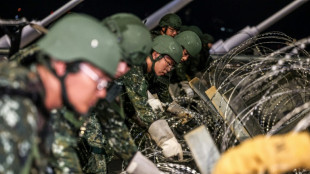 Taiwan blocks key bridge in drill for potential Chinese invasion

The first night was the worst, Roy Harley recalls of the ten weeks he and other survivors of a plane crash 50 years ago managed to cling to life on an Andean glacier without food or shelter, and very little reason for hope.
Of the plane's 45 occupants, 16 made it home from the 72-day ordeal that became known as the "Miracle of the Andes."
The only way to survive was to eat the flesh of the dead. But for Harley, a retired engineer now aged 70, that was not the worst of the nightmare made famous by the 1993 film "Alive."
After the initial shock of their plane crashing into the Andes mountains on that fateful Friday the 13th of October 1972, Harley and 31 other survivors found themselves in the pitch dark in minus 30 degrees Celsius (-22 Fahrenheit) at an altitude of some 3,500 meters.
Many of them not yet 20 -- the plane was flying an amateur Uruguayan rugby team and family members to a match in Chile -- none were dressed for the cold.
Several were badly injured.
Those who could squeezed into what remained of the fuselage between dead bodies and the screams of the wounded.
"That night, I experienced hell," Harley told AFP.
"At my feet was a boy who was missing a part of his face and... choking on blood.
"I didn't have the courage to reach out to him, to hold his hand, to comfort him. I was afraid. I was very afraid."
By morning, four more were dead, and so started a seemingly relentless torment that would eventually whittle the number of survivors down to 16.
- 'No words' -
There were too many dark moments to list.
"I don't have words to describe how cold it was," said Harley's former rugby teammate, fellow survivor and friend Carlos Paez, 68. "We were so cold, it was so difficult, that I have no words to describe it."
Many times they thought it was the end.
On Day 10, the survivors heard on the plane radio that the search for them had been called off.
"One of the most painful things was... to realize that the world was going on without us," said Paez, who today travels the world as a motivational speaker.
But it was also the jolt the survivors needed to take matters into their own hands and start trying to find a way off the glacier, he recalled.
Another tribulation was having to broach the topic of anthropophagy -- the eating of human flesh.
There was barely any food on the plane that was to have made a short flight from Mendoza in Argentina, where it had a stopover, to Santiago, Chile.
There was no sustenance to be found anywhere in the desolate, ice-covered landscape, and soon the survivors were starving.
A majority voted "yes" to eating their dead friends.
"We had tried to eat leather, we tried to eat cigarettes, we tried to eat toothpaste," Harley recalled at Paez's home in Montevideo.
"We were dying. When you have this choice: to die or to use the only thing you have... we did what we did in order to live."
On Day 16, disaster struck yet again.
An avalanche buried the mangled fuselage, the survivors' only shelter, as they slept.
Eight were killed, leaving only 19 of the original 32 crash survivors. Three more would die in the coming days.
"The avalanche was as if God had stabbed us in the back," said Paez.
- 'We are lucky' -
Displaying incredible ingenuity and tenacity, the survivors learnt, with no tools, to use plane debris to fashion bonnets, mittens, snow shoes, quilts and dark glasses against snow blindness.
They found a way to melt ice and snow for drinking water in spite of the sub-zero temperatures.
And finally, help did arrive.
In a last, desperate effort that almost cost them their lives, survivors Roberto Canessa and Fernando Parrado walked for 10 days into the unknown, hostile terrain, guided by nothing but instinct.
Finally, they came to a river and spotted men on horseback on the other side.
Over the noise of the water they could not make themselves heard, but the next day one of the men was back with a piece of paper wrapped around a stone that he threw to the pair.
On it, Parrado wrote a plea for help that started with the words: "I come from a plane that fell in the mountains."
The next day, the first helicopters came.
When he had boarded the ill-fated Uruguay Air Force plane for Chile, Harley weighed 84 kilograms. By the time he was rescued, there were a mere 37 kilograms on his 1.8-meter (5.9-foot) frame.
On average, the survivors lost 29 kilograms, according to Andes 1972 Museum records.
Harley and Paez insist they are not victims; their tale is one of resilience and teamwork.
"An extraordinary story starring ordinary people," said Paez.
"In the end, life triumphed."
J.Horn--BTB