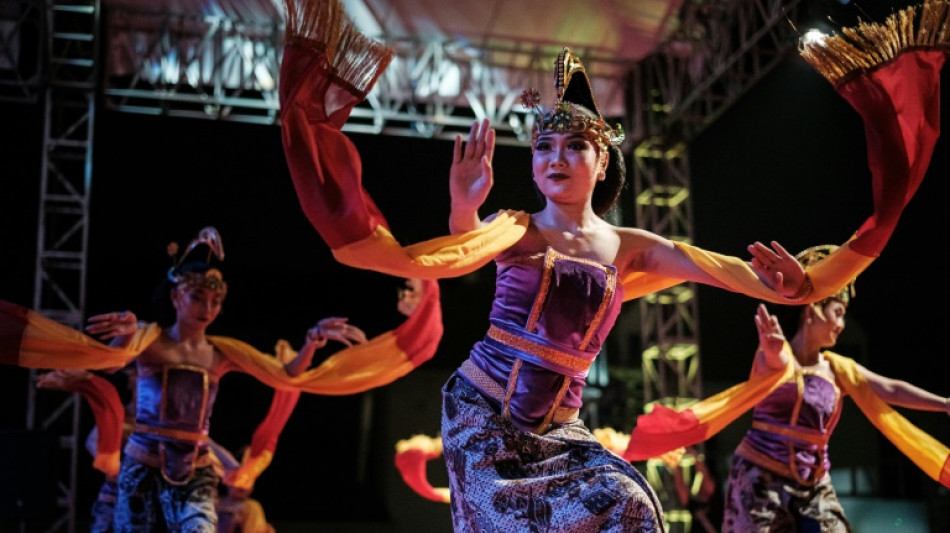
Indonesian dancers keep the beat for ancient drag tradition / Photo: © AFP

 UN to hold fourth informal poll of secretary-general candidates
 Who are the Emiratis behind crisis-hit Manchester City?

 Singer Angelique Kidjo urges Africans to 'create together'

 Alleged Rihanna mansion shooter mentally fit for trial, says judge

 Mystery over UK airbase scare as police find petrol not explosives

 OpenAI unveils low-cost AI model, a day after shelving Astra upgrade

 Premier League confirms Man City guilty of serious financial breaches

 Brazil's Lula turns to Bad Bunny tune to criticise Trump ahead of polls

 Nigerian dancer eyes world record after seven-day marathon

 Swiss regulator concludes Julius Baer bank probe

 Brazil's patron saint pulled into latest election scrap

 Football overload leaves players near 'breaking point', warns Tebas
 Paris Eiffel Tower says chief to step down after uproar over removing women staff

 Amaze Holdings (NYSE: AMZE) Executes Binding LOI to Acquire BullionFX | Alchemy, a Decentralized Gold-Backed Financial Ecosystem for Valued at US$155 Million

 Clashes between French teens, police as school blockades intensify

 Stocks move sideways despite oil moving lower

 African leaders to gather in Egypt for business summit

 UK decides against charging foreign visitors for museums

 Dallaglio to sell England World Cup winners' medal

 Brazil come from behind to beat Australia 4-2 in friendly

 Ruthless An retains Asian Games badminton crown as Kunlavut triumphs

 Alonso to stay with F1 team Aston Martin in 2027

 China badminton 'still strong' despite Asian Games slump

 'Exceptional' Turner painting shown in Rome before sale

 European stocks climb as oil dips

Indonesian dancer Rianto moves gracefully in front of a crowd of thousands in the capital Jakarta, whipping his orange sash and in full make-up as he performs a centuries-old folk dance frowned upon by conservatives.
The Lengger Lanang dance tradition is rooted in 16th-century fertility and harvest rituals from Central Java province.
It has since evolved into an art form that challenges rigid beliefs around masculinity in a deeply conservative and religious society.
Lengger Lanang is performed by men dressed as Javanese princesses, wearing tight, colourful batik dresses and ornaments woven into their fake hair bun updos.
But the tradition is close to disappearing in the Muslim-majority country, with fewer than 100 performers courageous enough to take part in shows.
"Lengger is still looked down on and negatively stigmatised," 42-year-old dancer and choreographer Rianto told AFP.
"People still see men dancing as going against the norm," said Rianto, who like many Indonesians has one name.
Backed by lively Javanese beats and melodies, the dancers sway their hips, flick their fingers and throw seductive glances at the audience in a Jakarta theatre.
The performers crack jokes in deep baritone voices, reminding their audience that, while they are wearing dresses, they are male.
"Lengger Lanang is where masculine and feminine meet inside one body and it is aimed to create peace within oneself," said Rianto, who is married to a Japanese woman.
- Vanishing art -
Lengger was once a highly revered folk art where performers were idolised and respected as performers able to embody both genders.
But it is being challenged as prejudice grows against anything perceived as queer-related.
A 2018 movie about a Lengger Lanang dancer loosely based on Rianto's life story received critical acclaim but was banned in several Indonesian cities after conservatives said it promoted homosexuality.
In the Central Javan town of Banyumas where Lengger Lanang was born, an art festival held in September is one of the few places where the art form can be celebrated openly.
The dance was once considered a sacred tradition in the town.
"It was a post-harvest ritual to express gratitude to the goddess of fertility, later adapted into a form of entertainment, sometimes to welcome a grand guest," said Lynda Susana Ayu Fatmawati, cultural researcher at Jenderal Soedirman University.
Even today, in order to become a Lengger Lanang dancer, one must undergo several cleansing rituals such as fasting, bathing in springs, and meditation.
Before each performance, the dancers light incense, and lay out flower petals and coconuts as offerings to God.
- 'Chosen ones' –
Even though the dance is rooted in tradition, some conservative Muslims say men should not dress or act like women.
"In Islam, it's clear that a man should not dress or act like a woman, and vice versa. It was condemned by the prophet," said Taefur Arofat, chairman of Banyumas Ulema Council, the town's top Islamic body.
For Rianto and other dancers, that perception has made everyday life hard.
"Being a male dancer is very difficult. The stigma from the public is very negative because dancing is associated with femininity," said Rianto.
Another dancer Torra Buana said he had to keep his dancing a secret.
"I once hid it from my family. Some people viewed it as a negative thing," the 47-year-old said.
"But not all men can do this," he said, referring to his dance form. "Only the chosen ones who have been blessed by God."
Not all Indonesians have a problem with the tradition.
"It's art and we need to prevent it from disappearing," spectator Hendro Utomo said after the Jakarta show.
Rianto has established Rumah Lengger, a centre where young dancers can practice and learn the philosophy behind the art.
One of the young prodigies is Ayi Nur Ringgo, who fell in love with the tradition after watching videos at university.
After taking it up, he was forced to confront negative comments from classmates.
"I have made peace with myself and my strength," he said.
"I no longer care."
Under Rianto's wing, he and fellow dancers are working to keep the tradition alive.
"I want to continue and regenerate this culture," said Rianto.
"Don't let this fade away."
O.Bulka--BTB