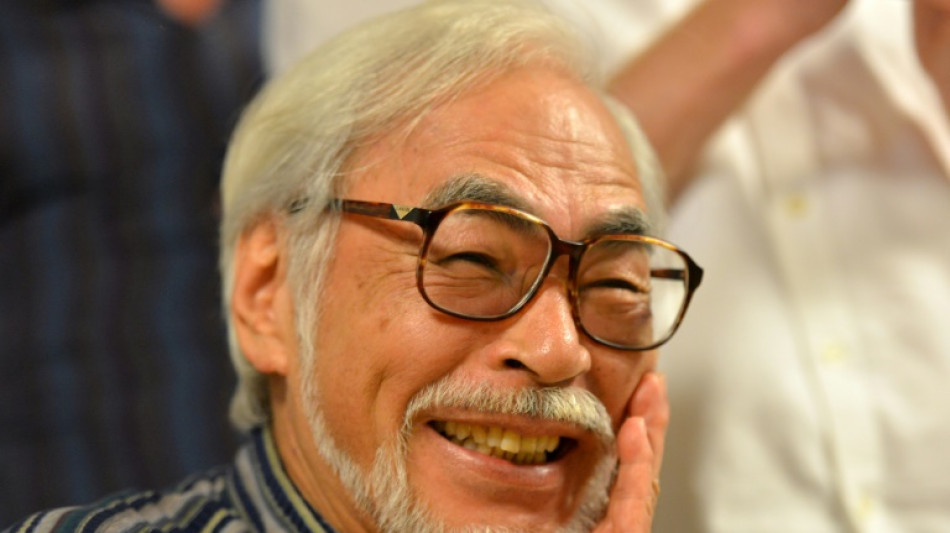
Hayao Miyazaki: anime great behind Studio Ghibli / Photo: © AFP/File

 Japan win marathon penalty shootout to set up South Korea gold-medal clash

 Djokovic grinds out opening-round win at China Open

 Northern Ireland police probe blockade of disputed parade
 UK PM Burnham reopens divisive debate on rejoining EU

 Man City future in doubt after guilty verdict

 'Do something,' begs Iranian woman after death sentence over protests

 China extends 52-year unbeaten record as Games organisers say sorry

 In Manchester, people say City scandal is 'shame for football'

 Stocks lacklustre as inflation data weighs on sentiment

 Israel-bound plane rerouted, pilots wounded in reported fight

 Truth commission on Sweden's Sami people seeks redress

 Energy costs spark inflation surges in France, Italy

 South Korea break China hearts to reach Asian Games football final

 Eala storms into Asian Games semi-finals to thrill adoring fans

 Turkey freezes ex-minister's assets as fund crisis grows

 What we know about the North Korean POW dispute

 Most equities rise after oil price plunge, US data in focus

 Polar oceans transformed as warming melts ice habitats: research

 Lost shark becomes viral star in South Korea

 Dangote to launch $16bn refinery in Kenya

 North Korean leader 'extremely obese': Seoul spy agency
 Yankees and pope-backed White Sox start MLB playoffs with wins

 Malaysia's ex-PM Mahathir in hospital for observation

 'No limits': Marathon world record holder Sawe chasing history

 Countdown begins to biggest-ever Rugby World Cup

An Oscar win two decades ago introduced the world to Japanese anime great Hayao Miyazaki, and now the Studio Ghibli co-founder, aged 83, has done it again.
Miyazaki's "The Boy and the Heron" -- potentially his last film -- took the Academy Award for best animated feature on Sunday, the same category won by Ghibli classic "Spirited Away" in 2003.
Enthralling viewers of all ages with his extraordinary imagination, the animator has built a cult following through films depicting nature and machinery in fantastical detail.
The beloved characters dreamt up by Miyazaki include cuddly yet mysterious spirit creature Totoro -- the mascot of his celebrated production house.
But despite becoming one of Japan's top cultural exports and helping take anime mainstream, he describes his work as an agonising struggle and has retired several times, albeit unsuccessfully.
Miyazaki's 1997 breakout feature "Princess Mononoke", the tale of a girl raised by wolves in a forest threatened by humans, set him apart from rivals such as Disney, who tend to focus on the battle between good and evil.
The director said at the time that he "didn't want to say what's right and what's wrong" in the film.
On another occasion, the aviation-loving pacifist said that making a film was not a logical process.
"I start to descend into the well of my unconscious. Then a lid at the bottom of the brain opens. This allows new directions to emerge, which were unimaginable when I was thinking with just the brain's surface," he told reporters in France.
"But it's better not to open it. It'll almost always pose problems to your family and social life."
- 'Fantasy is necessary' -
Born in 1941 to a well-heeled Tokyo family, Miyazaki grew up an avid fan of manga comics. He was at high school when Japan's first colour anime film came out, and said he was so moved by it he cried all night.
After studying politics and economics at university, he launched his career as a staff animator at Toei, a major studio.
His debut feature "The Castle of Cagliostro" was released in 1979, and told the story of the grandson of fictional French thief Arsene Lupin. Miyazaki's fame grew with "Nausicaa of the Valley of the Wind" in 1984.
The following year, he and fellow animator Isao Takahata founded Studio Ghibli, which grew into Japan's premier anime studio, revered by fans worldwide.
The studio's name Ghibli is an Italian word derived from the Arabic for a hot Saharan wind. It is also the name of a type of military plane and was chosen to symbolise their desire to breathe new life into the animation world.
Miyazaki reached global stardom with "Spirited Away", about a girl who gets lost in a mysterious world and tries to save her parents who are turned into pigs.
Like many Miyazaki films, "Spirited Away" features a female protagonist, and blends themes of nostalgia, greed and interaction with the natural world.
"Fantasy is necessary for children in order to escape from the tough reality they face," he told the Asahi Shimbun that year.
- Perfectionist -
Miyazaki is a prominent liberal figure in Japan, and made headlines in 2015 when he criticised then-prime minister Shinzo Abe for saying future generations need not apologise for the country's war record.
He urged Japan's leaders "to say clearly that aggressive war was completely wrong, having brought enormous damage to the Chinese people".
The heavy smoker announced in 2013 he would no longer make feature-length films as he could not maintain the hectic intensity of his perfectionist approach to work, citing "various" health problems.
However, in an about-turn four years later, Miyazaki's production company said he was coming out of retirement to make "his final film, considering his age".
That movie -- "The Boy and the Heron", originally titled "How Do You Live?" in Japanese -- was released last year.
It tells the story of a boy who moves to a countryside during World War II after the death of his mother in the fire-bombing of Tokyo, and struggles to accept his new life with his father and pregnant stepmother, who goes missing.
Everything changes when he meets a heron and embarks on a journey to an alternate universe where the living and the dead appear to co-exist.
"The truth about life isn't shiny, or righteous. It contains everything, including the grotesque," Miyazaki said in a recent NHK documentary, in which he was visibly affected by the 2018 death of Ghibli co-founder Takahata.
"It's time to create a work by pulling up things hidden deep within myself."
G.Schulte--BTB