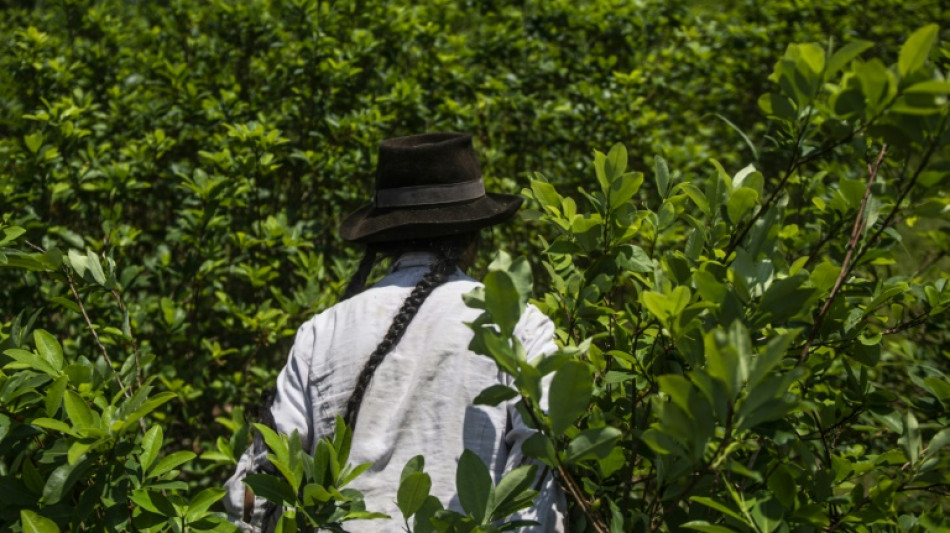
Peru to buy illegal coca crops to battle drug trafficking / Photo: © AFP

 Man City chairman defiant over reported Premier League charges

 Germany ready to 'walk through fire' for Klopp, says Tah

 At least 16 killed in Russian and Ukrainian strikes

 Powerful storm pummels US Northeast

 Bangkok declares disaster after homes flooded, roads submerged by heavy rain

 Norris calls for errant Colapinto to be banned for causing Baku crash

 Russell finds himself again and prepares to heap pressure on Antonelli

 South Korea hold nerve to win Asian Games basketball gold

 Russell holds off Verstappen to claim imperious victory in Baku

 Russell holds off Verstappen to win Azerbaijan Grand Prix

 India's Kohli says 2027 ODI World Cup will be his last

 Huge crowds cheer Pope Leo along Champs-Elysees ahead of Paris mass

 Putellas wants to bring 'winning culture and mentality' to London City

 Rare Italian opera returns to Moscow after nearly 120-year hiatus

 Pope to celebrate giant Paris mass after 'peace' appeal

 Homes flooded, roads submerged: Bangkok declares disaster over heavy rains

 Ahead of Paris mass, pope urges life together in 'dignity and peace'

 Austria 'ghetto' language classes leave children to repeat school

 S.African women runners arm themselves after string of killings

 'I felt embarrassed': Japan eSports whizz-kid, 11, wins Games gold

 Indonesia fires threatens critically-endangered orangutan: IUCN

 Bangkok declares flood disaster across city

 'World records not enough': North Korea weightlifters target Olympic gold rush

 Iran proposes Hormuz plan, Trump reportedly refuses
 El Nino rewrites the menu in the world's top restaurants
Peru's government has announced a plan to buy the nation's entire supply of illegal coca leaf -- the primary ingredient in cocaine -- for at least a year, as part of its battle against drug trafficking.
The South American country is one of the world's three largest producers of cocaine, alongside neighbors Colombia and Bolivia, according to the United Nations.
Peru currently produces an estimated 160,000 tons of coca leaf a year with 62,000 hectares of land dedicated to the crop.
But the vast majority of that, some 95 percent, is produced illegally and sold to drug-traffickers who turn it into about 400 tons of cocaine a year.
All legally grown coca must be sold to the state coca company ENACO but that amounts to only 2,500 tons a year.
Legal coca leaf producers are on a register that includes 95,000 growers. However, the government wants to create a new register for the other 400,000 unregistered producers.
"It is imperative, for at least a year, to buy coca leaf from existing registered producers and from those that will make up the newly created register," Cabinet Chief Anibal Torres said on Wednesday when presenting the initiative.
The plan would also see the demilitarization of Peru's main coca leaf growing valley, known by the acronym VRAEM.
Soldiers have been stationed in the south-central area since 2006, due to the continued presence of the Shining Path Maoist guerrilla movement, which is allied with drug trafficking groups.
Government opponents have criticized the new plan, saying it will increase drug trafficking.
"The message from the government is that it is legalizing coca leaf and it will buy illegal coca leaf. The message is grow coca, and that's very dangerous because we are talking about a primary material used in drug trafficking," former interior minister Ruben Vargas told AFP.
The coca leaf bought by ENACO is used to make sweets, herbal infusions, flour and for chewing like gum, which is an Andean tradition to help combat fatigue.
"By promoting the growing of coca leaf peasants will obviously have two markets: the state and drug traffickers," added Vargas.
"It will cause immeasurable damage not just to the environment but also the governability of the country."
Peru created the register of coca leaf producers in 1978 as part of a state policy to combat drug trafficking that also included the destruction of illegal crops.
Earlier this month, authorities began a weeks-long process of incinerating the 16.3 tons of illegal drugs already seized this year.
O.Bulka--BTB