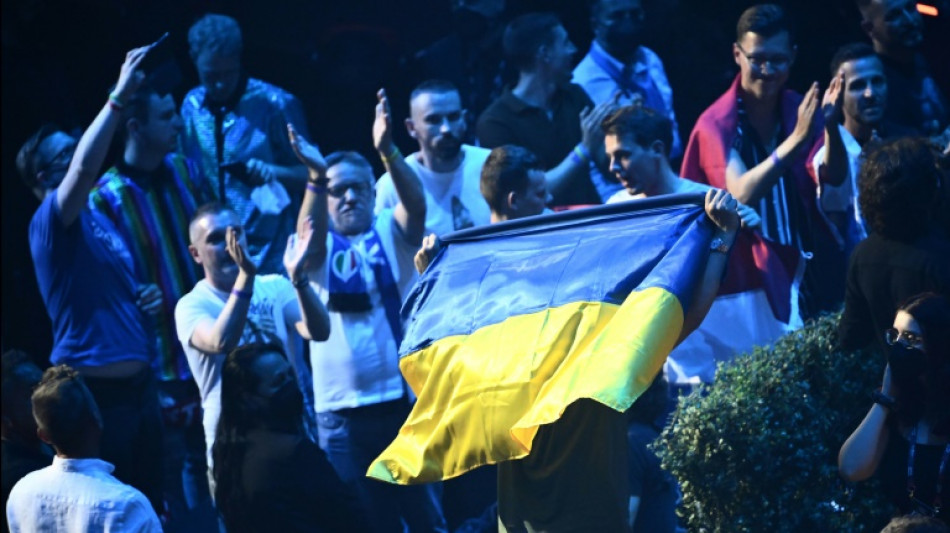
Ukraine's Kalush Orchestra throws down motherland's beats at Eurovision / Photo: © AFP

 Far-Right Extremists Claim Opportunity to Seize Control of GOP After Midterms

 New Campaign Highlights Knowledge Gaps on Carbon Monoxide Safety Among Americans

 JR East Launches 'teppay' to Integrate Suica Balance with Mobile Payments

 Phil Spencer on Housing Market Fairness: How Buyers and Sellers Navigate Falling Prices

 Beirut Cinema Festival Draws Thousands Despite War Fatigue

 AMD Forecasts First-Ever Revenue Lead Over Intel on AI Chip Surge

 GoodData.AI Launches the Agentic Serving Plane, a New Category of Enterprise Data Infrastructure for AI Agents

 Abu Dhabi Demand Response Project Achieves 401 MW Peak Reduction in 2025

 Panthers expected to begin 2027 NRL season away from new stadium
With their infectious musical fusion of roots and rhythm, Ukrainian folk hiphop band Kalush Orchestra is riding a wave of goodwill at the Eurovision Song Contest this year -- while eyeing the contest's top prize.
Tapping traditional Ukrainian folk music but mashing up an invigorating hiphop beat with a haunting, lullaby refrain, "Stefania" was written last year by the band's frontman, 27-year-old rapper Oleh Psiuk, as a tribute to his mother.
But the song selected to represent Ukraine at Eurovision -- just days before Russia's invasion -- has taken on outsized meaning for a country nearing its third month of war. It contains nostalgic lyrics such as "I'll always find my way home even if all the roads are destroyed" and celebrates cultural identity and the motherland.
Standing out in the competition long cheered for its flamboyance and camp, the band received a standing ovation on Tuesday after passing the semifinals. It is considered by bookmakers a favourite to become Eurovision's outright winner at the finale on Saturday.
"My mum is in Ukraine and many of my relatives are in Ukraine but there is really no safe place in Ukraine at the moment," Psiuk told AFP through an interpreter.
"It's really like a lottery, where you cannot know where exactly you'll get in danger. So we are very worried about everyone and our relatives that are in Ukraine."
Such worries have fuelled the band's drive during Eurovision, he said.
"We feel here as if on a mission because at the moment, as we speak, Ukrainian culture is being destroyed," Psiuk said.
"But it is our role to show it is alive and it has a lot to offer. It's unique. It really represents every Ukrainian who is now suffering in the world today."
- Flutes and fusion -
Although considered nonpolitical, the world's biggest song contest, watched by millions of people, inevitably reflects greater geopolitical tensions.
This year, the European Broadcasting Union banned Russia from the contest a day after it invaded Ukraine on February 24. Russia had competed in Eurovision since 1994.
Perhaps the most original and energising act at this year's competition, the six-member all-male Kalush Orchestra sprang from Psiuk's original hiphop group Kalush, named for his hometown in western Ukraine.
The band is made up of Psiuk, Ihor Didenchuk, Tymofii Muzychuk, Vitalii Duzhyk, Oleksandr Slobodianyk and MC KylymMen ("CarpetMan").
Its new sound incorporates traditional folk instruments, including the telenka, which is played with one hand controlling the pipe's open end, and another flute-like instrument, the sopilka.
Performing in richly embroidered traditional garb, the band is also instantly recognisable for Psiuk's bubblegum pink bucket hat and the carpet-like bodysuit worn by the breakdancing MC CarpetMan.
But it is Kalush Orchestra's sound that makes the band unique. It "mixes old ancient folk, even forgotten sounds, with super modern and understandable-for-everyone hiphop rap elements", Psiuk told journalists last week.
- 'Fighting age' -
To win Eurovision, Kalush Orchestra will have to be chosen above 24 other finalists competing on Saturday. Votes are cast by a mix of music industry professionals and the public from each country -- who are not allowed to vote for their own nation.
Were Ukraine to win, next year's Eurovision would be held in the country, which Psiuk vowed would be a "new, integrated, well developed, flourishing Ukraine".
Although one band member who joined the army three days after the invasion remains in Ukraine defending Kyiv, Ukraine's government gave the group special dispensation to travel abroad to compete at Eurovision.
"That's why we want to be as useful to our country as we can be," Psiuk told journalists.
"Representing your country is responsible anytime but representing it in a time of war is... a maximum responsibility for us."
Psiuk says the band will return to Ukraine directly after Eurovision.
As their press release written ahead of the contest explains: "They will be allowed to leave for the final on 14th May but must return as men of fighting age the day after."
E.Schubert--BTB
