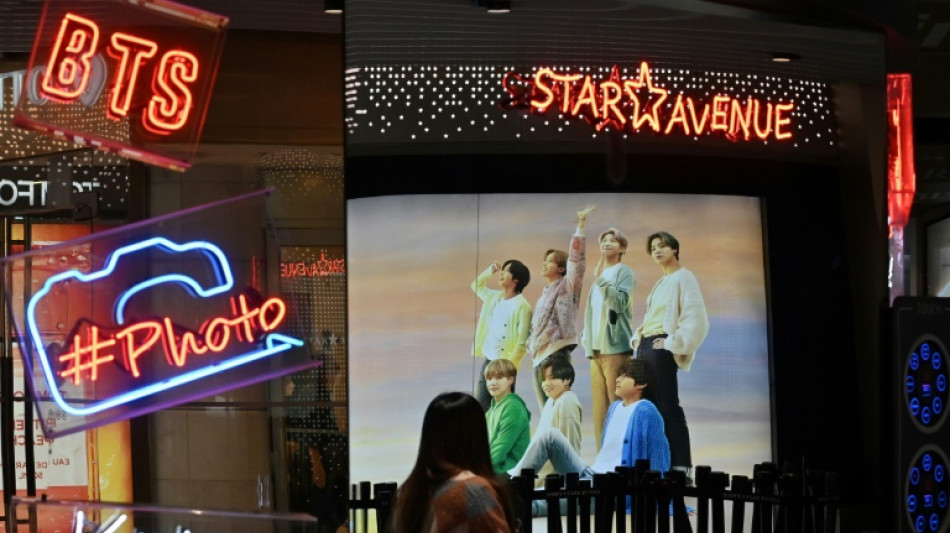
Hello Hallyu: why is South Korean culture sweeping the globe? / Photo: © AFP/File

 Spain brush aside Croatia in Nations League, England down Czechs

 Trump hails 'morally binding' AI self-regulation pledge
 Yamal inspires Spain to Croatia romp on World Cup homecoming

 UN to hold fourth informal poll of secretary-general candidates

 Who are the Emiratis behind crisis-hit Manchester City?

 Singer Angelique Kidjo urges Africans to 'create together'

 Alleged Rihanna mansion shooter mentally fit for trial, says judge

 Mystery over UK airbase scare as police find petrol not explosives
 OpenAI unveils low-cost AI model, a day after shelving Astra upgrade
 Premier League confirms Man City guilty of serious financial breaches

 Brazil's Lula turns to Bad Bunny tune to criticise Trump ahead of polls

 Nigerian dancer eyes world record after seven-day marathon
 Swiss regulator concludes Julius Baer bank probe

 Brazil's patron saint pulled into latest election scrap

 Football overload leaves players near 'breaking point', warns Tebas

 Paris Eiffel Tower says chief to step down after uproar over removing women staff

 Amaze Holdings (NYSE: AMZE) Executes Binding LOI to Acquire BullionFX | Alchemy, a Decentralized Gold-Backed Financial Ecosystem for Valued at US$155 Million
 Clashes between French teens, police as school blockades intensify

 Stocks move sideways despite oil moving lower

 African leaders to gather in Egypt for business summit

 UK decides against charging foreign visitors for museums

 Dallaglio to sell England World Cup winners' medal

 Brazil come from behind to beat Australia 4-2 in friendly

 Ruthless An retains Asian Games badminton crown as Kunlavut triumphs

 Alonso to stay with F1 team Aston Martin in 2027

It's won Oscars. Its television shows and K-pop stars dominate global charts. Its leading novelist just won the Nobel literature prize. How did South Korea become such a global cultural powerhouse?
AFP takes a look at what we know:
What is Hallyu?
From the late 1990s, Korean dramas and K-pop idols started gaining traction in neighbouring Asian countries like China and Japan, marking the start of Hallyu, or the Korean Wave.
It wasn't until Psy's breakout hit "Gangnam Style" that Hallyu hit the West.
In the decade that followed, "Babyshark" broke YouTube records, K-pop megastars BTS topped the charts, Bong Joon-ho's "Parasite" won an Oscar, and Squid Game became Netflix's most-watched non-English television show.
Cultural exports were worth some $13.2 billion to South Korea in 2022, more than home appliances or electric cars -- but the bulk of that was made up of video games, such as Battlegrounds Mobile which are wildly popular in India and Pakistan.
The government is targeting $25 billion by 2027 -- so expect more K-culture, especially in new markets such as Europe and the Middle East.
Why South Korea?
For Oscar-winning "Parasite" director Bong Joon-ho, the key to the East Asian country's cultural success is that everyone has lived through "dramatic times".
The 1950s Korean War -- which left Seoul locked in conflict with its nuclear-armed northern neighbour -- military dictatorship, sweeping economic transformation, and a democratic transition.
In the South, many have "experienced turbulence and extreme events," Bong has said. As a result "our movies can't help but different."
South Korea "provides creators with ample inspiration and stimulation. It's such a dynamic and turbulent place," he said.
Renowned South Korean filmmaker Park Chan-wook had a similar answer when asked for the secret of his country's cinematic success. "Why don't you try living in 'dynamic Korea?'" he replied.
And K-literature?
Turning contemporary history into art is what 53-year-old novelist Han Kang, who won the literature Nobel Thursday, excels at.
Han has spoken of the transformative experience of learning about a 1980 massacre in her native Gwangju, when South Korea's then-military government violently repressed a democratic uprising.
Han said her father showed her photographs including the scattered bodies of victims, and citizens lining up to donate blood in the chaos -- which later inspired her book "Human Acts".
While many South Korean authors have delved into the themes of the country's traumatic past, Han established her own "striking literary aesthetic" while addressing challenging subjects, said Oh Hyung-yup, a Korean literature professor at Korea University and literary critic.
Women first?
South Korea has some of the worst rates of female workforce participation among advanced economies, but for cultural exports women have been trailblazers.
Han's Booker-winning novel "The Vegetarian", which follows a woman who stops eating meat, is regarded as a landmark ecofeminism text. But it was outsold internationally by Cho Nam-Joo's "Kim Ji-young, Born 1982" about a married South Korean woman who quits her job to raise her child.
As the first Asian woman to win a Nobel for literature, it is appropriate that Han Kang's work addresses violence in ways that male authors have not in the past, Kang Ji-hee, a South Korean literary critic, told AFP.
"Han Kang reinterpreted this type of internal struggle," Kang said, documenting behaviours "that were previously considered to be simply passive, and gave them a whole new meaning."
So was it the government?
With the growing success of K-culture exports across the board -- from film to food, with Korean staples like kimchi and bibimbap soaring in popularity overseas -- it seems like part of a masterplan.
But while the South Korean government has ploughed millions into supporting cultural industries, experts say success has come largely despite, not because, of the state.
When former-president Park Geun-hye was in power from 2013 to 2017, Nobel-winner Han was one of over 9,000 artists "blacklisted" for criticising her government, along with Bong.
Some government initiatives, for example the government-affiliated Literature Translation Institute of Korea (LTI Korea), may have paid off, helping to bring works like Han's to a global audience.
But a growing number of translators, who are more adventurous with their choice of works, have also helped to bring edgier offers to the international market.
Success also breeds more success, cultural export-wise: The reading habits of K-pop megastars have boosted K-literature.
When BTS member Jungkook was seen reading the self-help book "I Decided to Live as Me" it sparked a sales frenzy, with hundreds of thousands of copies flying off shelves.
But Bong also believes that his compatriots' hard drinking habits helped spur creativity.
"We are a very workaholic country. People work too much. And, at the same time, we drink too much. So every night, very hardcore drinking sessions and everything is very extreme."
H.Seidel--BTB