Society centred around women in UK during Iron Age: scientists / Photo: © AFP/File

 Spain to cap gas price hikes, extend fuel discounts
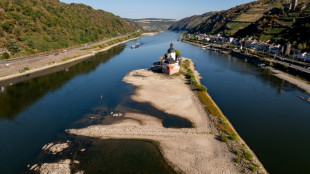 'We just need rain': Germany's Rhine river hits new low
 Yemen health system at 'breaking point': WHO
 Ireland undecided on second Israel match: coach
 France's Le Pen defiant after top ally hit by antisemitism claims

 Tom Cruise trades stunts for satire as toxic tycoon 'Digger'

 MEXC Unveils "WE SEE YOU" Brand Visual Refresh, Putting People Behind Every Trade in Focus

 Thai capital cleans up after deadly floods

 NATO, EU allies rally to Estonia after 'sabotage' blamed on Russia
 Families demand justice for Cameroon's 'nightmare' wave of murdered women
 Tebas says Man City should face 'most severe' sanctions if guilty of rule breaches
 Pochettino calls Man City success 'a period of deception'

 Settler attack on West Bank village injures Israeli forces, drawing rare rebuke

 Mystery over UK airbase scare after reports no explosives found
 Spanish govt races to adopt housing law under protest pressure

 Estonia slams Russian 'sabotage' after arson attack on defence company

 Slovenia sees surge in '.si' sites after Trump hypes 'super intelligence'

 'Like a dream' for An as Games organisers 'sorry' for latest mix-up
 Tokyo suffers longest streak of rainy days on record

 Indonesia charges train driver over crash that killed 16 women
 Ruthless An makes history to retain Asian Games badminton crown

 Australian central bank lifts key interest rate to 15-year high
 Polo makes landfall in Mexico as Category 3 hurricane
 South Korea team latest to be bussed to wrong Asian Games venue

 Bears thrash Eagles 27-7 as third-string QB Keenum shines
Scientists analysing 2,000-year-old DNA have revealed that a Celtic society in the southern UK during the Iron Age was centred around women, backing up accounts from Roman historians, a study said Wednesday.
When historians such as Tacitus and Cassius wrote about Rome conquering Britain from around AD 44 to 84, they described women holding positions of power.
These include the famous warrior queen Boudica, who started an uprising against Roman occupation, sacking and burning several cities including Londinium -- which would one day become London. There was also Cartimandua, the 1st-century queen of the Brigantes people in northern England.
Julius Caesar, in his account of the Gallic Wars written more than more than century earlier, also described Celtic women participating in public affairs, exercising political influence -- and having more than one husband.
"When the Romans arrived, they were astonished to find women occupying positions of power," said Miles Russell, an archaeologist at Bournemouth University and co-author of the new study in Nature.
Some had doubted these accounts, suggesting "that the Romans exaggerated the liberties of British women to paint a picture of an untamed society," he told AFP.
"But archaeology, and now genetics, implies women were influential in many spheres of Iron Age life," he said.
"Indeed, it is possible that maternal ancestry was the primary shaper of group identities."
- Men moved on, women stayed put -
For the study, the team of researchers analysed more than 50 genomes extracted from burial sites in the village of Winterborne Kingston in southern England's Dorset county, which was populated before and after the Roman conquest.
Iron Age cemeteries with well-preserved burial sites are rare in Britain, perhaps because the dead were often cremated, stripped of their flesh and organs, or simply "deposited in wetlands", the researchers wrote.
However the Durotriges tribe, which occupied the southern central coastal region of England between 100 BC and AD 100 -- and gave their name to Dorset -- were an exception, burying their dead in cemeteries.
Excavations carried out at these sites since 2009 had already yielded some clues about the high social status women held in the tribe.
The "well-appointed graves across the Dorset Iron Age" containing drinking vessels, mirrors, beads and other goods were all female -- except for one that included a sword, said Russell, who led the excavations.
The DNA analysis showed that most of the people buried at the site were related through their maternal line, going "back to a single woman, who would have lived centuries before", said lead study author Lara Cassidy of Trinity College Dublin.
However there were almost no connections down the paternal line.
"This tells us that husbands moved to join their wives' communities upon marriage, with land potentially passed down through the female line," Cassidy said in a statement.
Societies centred around women -- which ethnographers call a "matrilocality" -- are rare throughout this period of history.
Yet the researchers trawled through previous research and "found signatures of matrilocality in a number of cemeteries across Britain dating to the Middle and Late Iron Age," from around 400 BC onwards, Cassidy said.
"However, it is quite possible this system was also common in the early Iron Age or perhaps even earlier."
H.Seidel--BTB