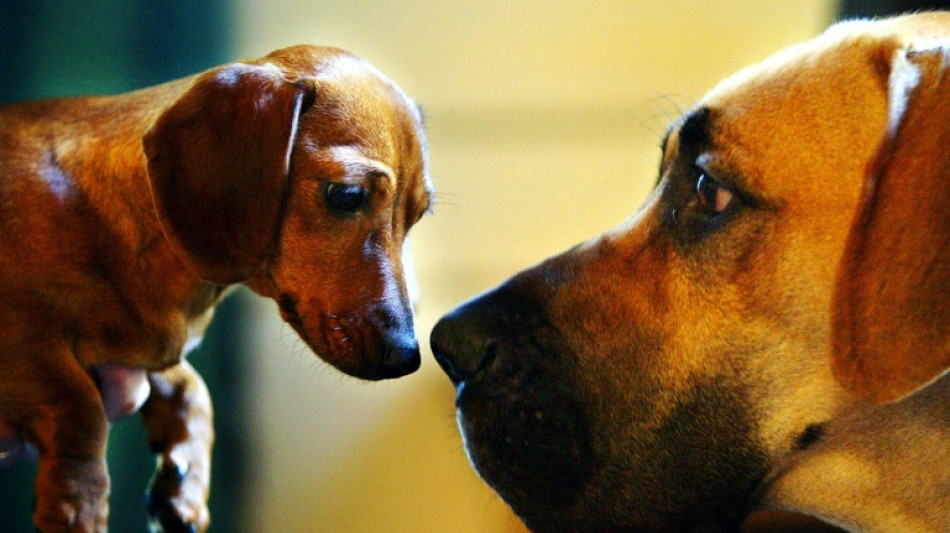
Oldest dog DNA suggests 16,000 years of human companionship / Photo: © AFP/File

 'He's here with me': Japan cycle queen dedicates gold to late brother

 Japan Olympic chief says 'lot more' athletes at Games than expected

 Asian carmakers besting US rivals at home, China poised to strike

 Widgets & Web Offers All-Inclusive Investor Relations Websites for Public Companies, IPOs and SPACs

 Adams named new US captain to 2030 World Cup

 China a better influence in Latin America than US: poll

 Judge pauses construction of border project in Texas national park

 Belgium's De Bruyne fires double to sink Turkey, France held by Italy

 US jobs data boosts stocks as oil prices dip

 US Supreme Court to hear high-stakes climate case

 Trump expected to name intel chief Clayton as AI czar: reports

 Argentina unveils passports-for-investment scheme

 Brazil election debate chaos sparks censorship row

 England's Carse charged by cricket body over nightclub incident

 Amazon vows $1 bn for data center towns, decries 'myths'

 Oil prices drop on G7 fuel release, US jobs data boosts stocks

 G7 agrees deal to ease global energy supply concerns

 Spain's government dealt blow as lawmakers reject housing bills

 Food, medicine shortages deepen in Russian-occupied Oleshky

 Man City whistleblower Rui Pinto facing 'dire consequences' - lawyers

 Russia 'tearing Kyiv apart', mayor says, as strikes paralyse traffic

 Taiwan boxer Lin wins Games gold as Japan edge North Korea on penalties

 Japan tame North Korea to win Games gold after shootout drama

 US posts weak job growth data in September

 Ethiopia's conflict: the regional dimension

The discovery of the oldest ever dog DNA suggests they have been our best friends for nearly 16,000 years -- 5,000 years earlier than had previously been thought, new research said Wednesday.
Despite being ubiquitous in the homes, backyards and hearts of people across the world, surprisingly little is known about where dogs come from.
"It's just an interesting mystery," Swedish geneticist Pontus Skoglund of the UK's Francis Crick Institute told reporters.
Dogs are most likely a mix of two types of grey wolves, he said. However exactly when dogs diverged from wolves has been difficult to trace, partly because their ancient bones are tricky to tell apart.
That is why scientists behind two new studies published in the journal Nature sequenced the genomes from archaeological remains, shedding light on the elusive origins of our furry friends.
The first study revealed that the world's oldest canine DNA was discovered in a piece of a skull in Pinarbasi in what is now Turkey.
The female puppy, which was perhaps "a few months old", probably looked like a small wolf when it lived roughly 15,800 years ago, according to study co-author Laurent Frantz of the Ludwig Maximilian University of Munich.
Before Wednesday, the oldest-known dog DNA was from 10,900 years ago.
Also breaking that record was genetic evidence the team found in southwest England dating back 14,300 years, which illustrated how early dogs had spread across Europe.
Frantz said scientists could not prove exactly what role these dogs had among humans living during the last Ice Age.
"But I think we can assume that they must have played a role because they would have been expensive to feed," he said.
Perhaps the dogs were used for hunting or protection, he speculated.
Even if these dogs were not treated the same as pets are today, there was likely still a strong bond, he said, adding that "kids will still have played with puppies".
Another sign of a close relationship was that puppies had been found buried above human graves in Pinarbasi.
- 'Search for the missing link' -
For the other study, a large team of researchers compared the genomes of 216 dog and wolf remains from across Europe.
This allowed them to chart how dogs evolved on the continent.
Starting around 10,000 years ago, there was a huge migration of people from southwest Asia to Europe during what is known as the Neolithic agricultural revolution.
This mass arrival of farmers resulted in human genetic mixing as people from different areas met and had children.
However, this genetic mixing did not happen at the same time with dogs, the researchers were surprised to find.
It seems the hunter-gatherers who had been living in Europe before the farmers arrived had already been keeping dogs.
"Dogs were clearly important to our ancestors, as the first farmers seem to have adopted previous hunter-gatherer dogs into their groups as they moved into Europe," said study co-author Skoglund.
This suggests that dogs must have been domesticated well before that point.
And there is still a "genetic abyss between dogs and wolves", Skoglund added.
"The search for the missing link continues."
O.Bulka--BTB