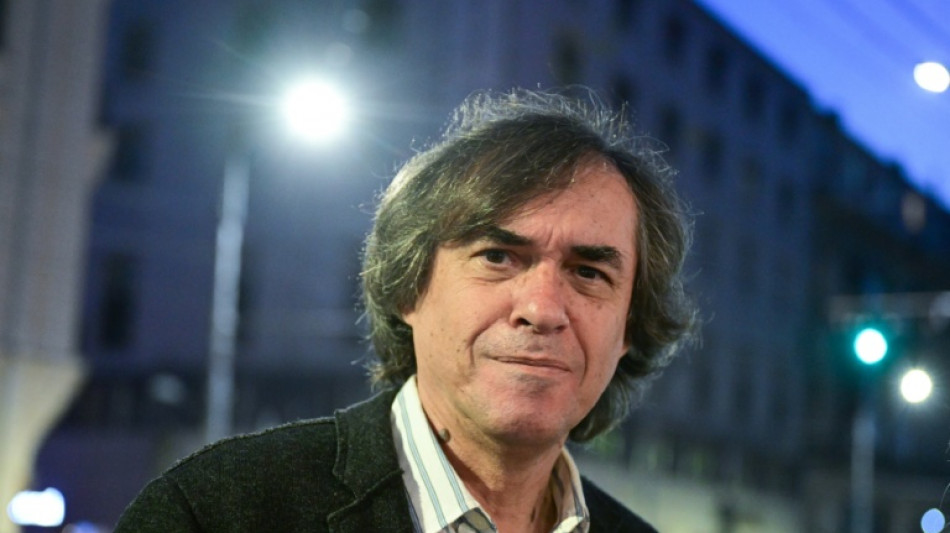
Romanian writer Cartarescu hails books as balm in turmoil / Photo: © AFP

 Malta Stuns Sweden with Late Penalty Comeback in Rugby Europe Trophy
 BingX: Major Announcement of Far-Reaching Significance

 Élan Opens as Late-Night Wine Bar in Honolulu

 Shiv Sena (UBT) Criticizes NCP Merger Talks as 'Ridiculous Laughing Stock'

 Dell Announces AI-Integrated PC Lineup for 2026 with Wi-Fi 7 Support
 Rocky Fans Break Guinness World Record at Philadelphia Museum Steps

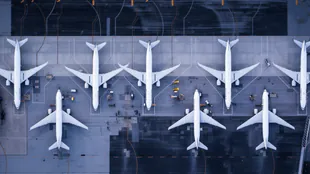 FAA Grounds All US Flights Amid Nationwide Air Traffic Control Communication Failure

 Argentina vs Uruguay Kick-off Time, TV Channels & Free Streaming Guide

In an age of "overwhelming evil" and "generalised lies", Romanian novelist Mircea Cartarescu, a weaver of literary fantasies born from a childhood under a totalitarian regime, bets on writing to resist.
Literature is "like a bandage on a wound" in "frightening" times, Cartarescu told AFP at the launch of his latest book, a collection of aphorisms on writing, in Romania.
"These are times when we are threatened from so many sides that we no longer know what to guard against," he said, mentioning wars, social unrest, global warming and "ideological confusion".
Cartarescu, who turned 70 this year, is the most translated contemporary Romanian writer and has won many accolades, including the International Dublin Literary Award in 2024.
Real life and the imaginary merge in his novels, creating a universe that Cartarescu admits is an exercise in navel gazing.
"I write to be able to understand who I am," he has said.
- Childhood trauma -
Cartarescu, whose favourite writers are J. D. Salinger and Franz Kafka, has likened his writing process to termites building their nests without knowing the result in advance.
"I never wrote literature to publish books, but to live in them," he once said about his most recent novel, the 632-page "Theodoros", published in 2022.
Set in the 19th century, "Theodoros" tells the story of a servant's son who rises to become emperor.
Cartarescu has since been in no rush to finish another novel, but he has started on one -- though he told AFP it is "not a novel in the strict sense".
"It's something I've never written before, and I don't think anyone else has either," he said, refusing to go into further details.
Born in Bucharest in 1956 during a period he has previously described as "marked by poverty and terrible famine", the introverted boy was fascinated by literature from an early age.
As a student and then a teacher at the University of Bucharest, he lived only "through and for literature".
A huge fan of Bob Dylan, Cartarescu has translated 100 of the US folk singer's songs into Romanian and has described himself as a "beatnik, a liberal in the widest sense of the term".
But it was his childhood that marked him most and that he tries to rediscover, if not to relive, in his writings.
"It is the most obscure period, that which intrigues me most," he has said, pointing to the trauma of losing his twin brother at the age of 18 months.
"Nearly all that I write is linked to that. I have always felt that something was missing, as if I looked in a mirror and saw no one," he said in an interview with the Adevarul newspaper.
He blamed that death on the "awful conditions" in which his family lived -- they had just moved into a single filthy room in a working-class district of Bucharest.
- 'Collective madness' -
After years of deprivation, Cartarescu said December 22, 1989, when the totalitarian regime of Nicolae Ceausescu was overthrown, was "for all Romanians the happiest day".
Later, Cartarescu often advocated for the independence of the justice system, and took part in protests.
But in time he said he lost hope, especially after the pandemic, so he now prefers to stick to his writing.
In a published journal, he criticised the surge of a far-right candidate in the 2024 Romanian presidential elections as "collective madness".
He likens current times worldwide to those before World War II, but with added risks related to artificial intelligence, "the greatest threat to humanity".
He told AFP he would never use AI in his literature, nor read a book written with it, as his interest lies in exploring what is human.
"Why would I read the work of an insectoid or an alien?"
Dozens of his readers gathered in a Bucharest bookstore in October, listening in church-like silence to the novelist talk about his latest published work.
"We gather around a book to protest against a world that no longer resembles us," he told them.
W.Lapointe--BTB