
Cuban worker exodus a 'catastrophe' for island's businesses / Photo: © AFP

 Indonesia traps monkey to end rampage that wounded 18 people

 Food security fears mount as UK farmers battle drought
 Houthi missile attacks kill 58 Saudi-backed Yemeni govt forces

 Chinese activist held in Bangkok finds Canada refuge

 Kiss takes reins as Wallabies face Japan

 North Korea touts dog soup and other home-cooked recipes to beat the heat

 UK observatory nervously watches growing space junk threat

 Meta ordered to pay US state $567 mn to abate 'public nuisance' and child harm

 Houthi missile attacks kill 58 Saudi-backed Yemeni govt forces: source

 No.1 Sabalenka and Pegula advance at Toronto

 China missile test top of agenda as Pacific diplomats meet in Fiji

 Most UK teens to opt out of planned social media curfew: poll

 Venezuela's political transition talks launch in Caracas

 2 killed, 13 wounded in bus blast near Syrian capital: state media

 All Blacks skipper Taylor cautiously recovering from calf strain

 UN chief denounces Russia, Ukraine for civilian deaths

 UEFA turn up the pressure on Infantino and repeat boycott threat

 Rodri approves Barcelona transfer talks with Man City: Barca source to AFP

 Venezuela unable to tally missing from cataclysmic quakes
 Le Court sprints to stage six Tour de France Femmes win

 Doping body says Parker's positive cocaine test caused by nutritionist

 UEFA says boycott of World Cups stands despite FIFA backdown on private investment

 Rheinmetall sales keep surging despite cancelled naval frigate project

 Pogacar teammate Del Toro gets new UAE deal after Tour podium
 Stocks tread water with earnings, tech in focus

Like other businesses across Cuba, Nel Paradiso is grappling with a worker shortage amid unprecedented levels of people fleeing the island nation.
In just over a year, the central Havana restaurant has seen 50 employees leave.
"There wasn't enough time to replace the personnel," said hiring manager Annie Zuniga, 26.
After being forced to close its doors due to the Covid-19 pandemic, Nel Paradiso had been open for only two months when Nicaragua, an ally of Havana, abolished visa requirements for Cubans.
That move in November 2021 kicked off the island's largest exodus since the Communist regime came to power over six decades ago.
"Nicaragua's opening was a blow... from 50 workers, in one week we were left with 30," Zuniga told AFP.
Of the 60 employees recruited during the last 14 months, only 10 still live on the island.
Replacing employees that emigrate has become a time-consuming and costly task.
"We haven't been able to create a united and lasting team because when we think, 'good, this is the team'... one of them comes to me and says, 'this is my last week, next week I'm leaving.' It's a catastrophe," said Zuniga.
- 'Incalculable grief' -
In 2022, US border authorities intercepted more than 313,000 Cubans who entered the country illegally, according to official data.
Most Cubans fleeing the island attempt to reach the United States, usually via Central America.
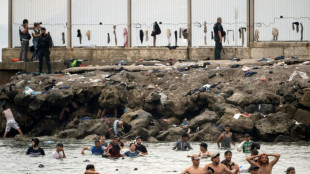
However, sea crossings between Cuba and the US state of Florida -- a treacherous 140-kilometer (87-mile) journey often in unsuitable vessels -- have also soared.
The wave of emigration comes at a time when the 11.1 million Cuban population is aging and the country is wrangling with its worst economic crisis in three decades.
Inflation is rampant and daily queues to buy food and fuel are interminable, while it is near impossible to find many medicines and power cuts are frequent.
The lack of staff "puts us in difficulty," said Nel Paradiso head waiter Norberto Vazquez.
Also a sommelier professor, Vazquez says he has trained more than 50 people who are no longer in Cuba.
"Some students tell me, 'professor, the only thing I'm thinking about is how I will leave,' and that gives me incalculable grief," he said.
Most Cubans that emigrate are highly educated and between 19 and 49 years old, according to Havana University.
Many industries are affected by the exodus, including tourism, a vital part of the country's economy that was badly hit by the pandemic.
Some 30 percent of employees at the Parque Central hotel, a business part-owned by the government and by Spanish group Iberostar, emigrated and its executives were forced to contract students to cover the vacancies, a source told AFP under the condition of anonymity.
- 'Feel you have no future' -
Frenchman Stephane Ferrux has been running a travel agency in Havana since 1995.
He said 60 of the agency's service providers emigrated in one year.
And it was not just for economic reasons as some of them earned $1,500 a month, a sum 45 times the average in the island nation.
"When you cannot find anything" due to shortages of most products, "and you feel you have no future, even if you have the means, that triggers the fleeing," said Ferrux.
Even embassies and universities have been affected.
In January, the "desperate cry" of a university science professor went viral on social media.
"The laboratories are emptying... the best ones are leaving," the professor complained.
President Miguel Diaz-Canel admitted in October that "emigration is high in Cuba," and blamed US laws for encouraging it.
"Every young person who abandons their studies and work to emigrate" represents "a defeat" for the country, he said.
O.Bulka--BTB