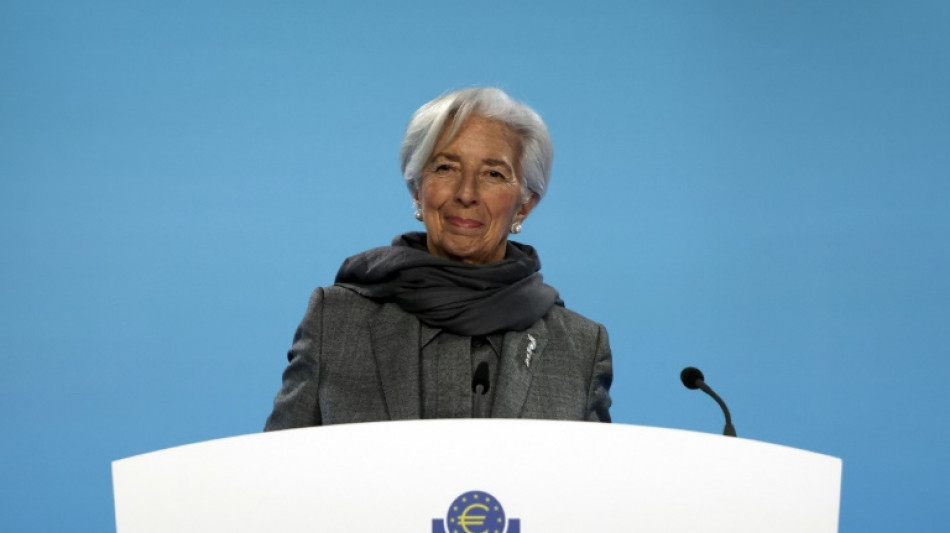
'Premature' to talk rate cuts, says ECB after pausing again / Photo: © AFP/File

 Palmeiras beat Fluminense 2-1 in Libertadores semi-final first leg
 Brewers blasts leave Dodgers on brink
 Tech stock lead rout after US inflation fuels rate hike bets

 Al-Fayed survivors say UK police missing 'bigger picture'

 Online 'witch hunt' sweeps up Asians misidentified as US rape accused

 Prospect of Bolsonaro win looms large over Brazil's Indigenous

 Freed from Belarus, founder of Lady Gaga's biggest fan site tells his story
 Behind AI's carbon footprint, a potential climate tool

 Trump's new press secretary faces scrutiny over credentials

 PSG 'got lucky' to win Man City thriller, says Luis Enrique

 Real Madrid comeback stuns Roma as Mourinho enjoys happy reunion

 Shakhtar make winning start at new Champions League 'home'

 Hat-trick hero Barcola primed to shine for Liverpool: Iraola

 Villa put six past Fenerbahce in record rout
 US stocks fall after hot inflation report as leading AI shares tumble

 Government buildings torched in violent Albanian protests

 Wall Street grills Bank of America over money laundering fine

 Mekies extends contract as Red Bull team principal until 2031

 Indonesia rescues starved orangutan from fires: officials

 Real Madrid's Vinicius banned for Clasico after red card

 Restrictions expose Ukraine's Starlink dependency in Russia war: observers

 Espada out as Astros manager while Mattingly stays with Phillies

 Houthis say targeted Saudi oil giant Aramco, vow more attacks

 Govt takes control of Turkey's most-watched news channel

 FIFA to offer members $6.35-billion development fund windfall

The European Central Bank froze borrowing costs again on Thursday and expressed caution on inflation, with president Christine Lagarde saying it was still too early to consider rate cuts.
The third consecutive pause since October leaves the ECB's benchmark deposit rate at a record high of four percent, following a historic run of hikes to tame prices that shot up after Russia's war in Ukraine.
The pause was widely expected but with inflation steadily slowing and the eurozone economy stuttering, investors were hoping Lagarde would give clues on when the bank might start lowering borrowing costs.
But Lagarde gave little away.
There was "consensus" at Thursday's meeting that it was "premature to discuss rate cuts," she told reporters in Frankfurt.
The ECB believes rates are currently at levels that "maintained for a sufficiently long duration, will make a substantial contribution" to returning inflation to the two-percent target.
Financial markets have been betting on rate reductions as early as April, but ECB officials have pushed back against those expectations.
Lagarde herself told Bloomberg television at Davos last week that the first cut would "likely" come only by the summer -- and only if the latest economic data supported such a move.
"I stand by what I have said," Lagarde said when asked about the timeline.
The disinflationary process "is working", she added, but "we need to be further along" before changing course.
She stressed that the ECB's next moves would be "data dependent", with policymakers keeping a close eye on wage growth and geopolitical risks.
Some analysts said Lagarde had nevertheless left the door open to rate cuts before the summer.
"She could have pushed back more strongly" against market bets of cuts in April, said Pictet analyst Frederik Ducrozet.
"That she decided not to is an important signal in itself."
- Eurozone weakness -
Like other central banks, the ECB has been walking a tightrope between raising borrowing costs enough to convincingly rein in inflation without squeezing demand so hard it crashes the economy.
After peaking at more than 10 percent last year, eurozone inflation has declined in recent months. Consumer price growth picked up slightly in December however, to reach 2.9 percent.
The increase was expected and mainly due to the comparison effect with a year earlier, when governments provided exceptional support to help households after Russia's invasion of Ukraine pushed energy prices higher.
Overall, the ECB sees inflation on the right path and has forecast a return to target in 2025.
The ECB's higher rates have curbed demand for loans and mortgages, contributing to a weakening of the eurozone economy.
"Tight financing conditions are dampening demand, and this is helping to push down inflation," the ECB said.
Output in the 20-nation currency club shrank by 0.1 percent in the third quarter of 2023, and Lagarde said the economy had likely stagnated in the fourth quarter.
- Risk factors -
She said the ECB was closely monitoring several risk factors that could drive inflation up again, including wage negotiations as workers seek pay rises to compensate for higher living costs.
ECB officials have said it would take several months to get a clearer picture of euro area wage agreements, bolstering the case for a rate cut at the June meeting at the earliest.
But Lagarde sounded less concerned about salary increases than in the past, saying the evolution of wage growth was "directionally good".
The ECB was also keeping a close eye on energy costs and supply chains, Lagarde said, in a nod to Middle East unrest and shipping disruptions in the Red Sea.
"Upside risks to inflation include the heightened geopolitical tensions especially in the Middle East which could push energy prices and freight costs higher in the near term and hamper global trade," she said.
C.Kovalenko--BTB