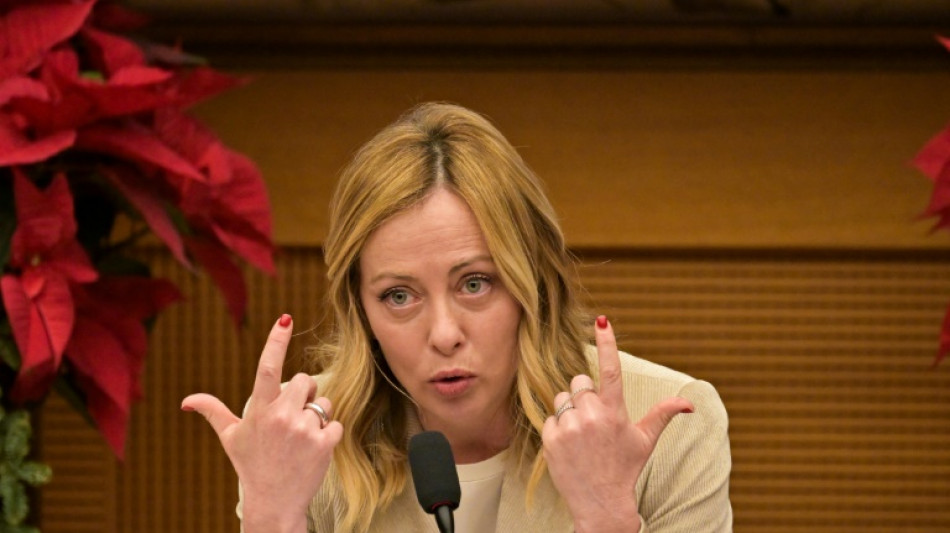
Buried in massive debt, Italy puts crown jewels up for sale / Photo: © AFP/File

 Palmeiras beat Fluminense 2-1 in Libertadores semi-final first leg
 Brewers blasts leave Dodgers on brink
 Tech stock lead rout after US inflation fuels rate hike bets

 Al-Fayed survivors say UK police missing 'bigger picture'

 Online 'witch hunt' sweeps up Asians misidentified as US rape accused

 Prospect of Bolsonaro win looms large over Brazil's Indigenous

 Freed from Belarus, founder of Lady Gaga's biggest fan site tells his story

 Behind AI's carbon footprint, a potential climate tool

 Trump's new press secretary faces scrutiny over credentials

 PSG 'got lucky' to win Man City thriller, says Luis Enrique

 Real Madrid comeback stuns Roma as Mourinho enjoys happy reunion
 Shakhtar make winning start at new Champions League 'home'

 Hat-trick hero Barcola primed to shine for Liverpool: Iraola

 Villa put six past Fenerbahce in record rout
 US stocks fall after hot inflation report as leading AI shares tumble

 Government buildings torched in violent Albanian protests
 Wall Street grills Bank of America over money laundering fine

 Mekies extends contract as Red Bull team principal until 2031

 Indonesia rescues starved orangutan from fires: officials

 Real Madrid's Vinicius banned for Clasico after red card
 Restrictions expose Ukraine's Starlink dependency in Russia war: observers

 Espada out as Astros manager while Mattingly stays with Phillies

 Houthis say targeted Saudi oil giant Aramco, vow more attacks

 Govt takes control of Turkey's most-watched news channel

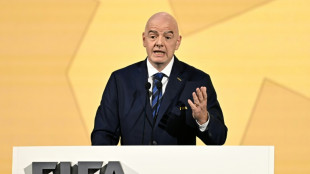 FIFA to offer members $6.35-billion development fund windfall

Prime Minister Giorgia Meloni once declared Italy's postal service a "crown jewel" that must stay in state hands, but she is now selling a stake as part of a privatisation programme to tackle a huge public debt.
Meloni's hard-right government aims to raise 20 billion euros ($21.6 billion) by 2026 by selling off a stake in Poste Italiane, which turns big profits through its insurance and banking operations, as well as stakes in rail company Ferrovie dello Stato and energy giant Eni.
Analysts, however, say that the sales will likely do little to reduce a debt mountain that exceeds 2.8 trillion euros ($3 trillion) -- the second highest in the eurozone as a proportion of gross domestic product.
"Our approach will be light-years away from what we have seen in the past, when privatisation rhymed with gifts for lucky entrepreneurs," Meloni said last week.
The leader of the post-fascist Brothers of Italy party, who won 2022 elections on a populist, nationalist ticket, has also vowed to maintain state control.
"We can sell some stakes in public companies without compromising public control," Meloni said.
Nevertheless, the decision to sell a stake in the postal service to foreign investors marks a shift from a statement she made in 2018, four years before becoming prime minister.
"No to the privatisation of Poste Italiane. It is a crown jewel that must remain in the hands of Italians," she said on Facebook at the time.
The government originally planned to hold a 51-percent majority in Poste Italiane, but Finance Minister Giancarlo Giorgetti said Friday that its stake could fall to as low as 35 percent.
The economy ministry has a 29.3 percent stake in the postal service while the state investment bank, Cassa Depositi e Prestiti (CDP), owns another 35 percent.
Selling the ministry's stake could raise as much as 3.9 billion euros, according to the postal service's current capitalisation.
- 'Selling the homeland' -
Opposition parties have rounded on Meloni's coalition -- which also includes Matteo Salvini's far-right League party -- for its plans to sell state assets.
The government "always claims to be for the homeland and today it is starting to sell the homeland", Andrea Orlando, a lawmaker from the centre-left Democrat Party, said on Sunday.
"We think that the homeland cannot be sold."
The partial privatisation campaign kicked off in November when the government decided to sell a quarter stake in bailed-out lender Monte dei Paschi di Siena, the world's oldest bank, for 920 million euros.
Rome sold the share to investors as it could not find a suitor to take over the bank, which must be privatised under the bailout conditions agreed with the European Commission.
Another privatisation required by Brussels -- the sale of a stake in ITA Airways to German airline Lufthansa -- is under investigation by the commission over fears it could hurt competition.
Giorgetti boasted last week that foreign investors are "all very interested" in the stakes owned by the Italian state.
- 'Drop in the ocean' -
The government has a long way to go to reduce a debt that amounts to 140.2 percent of GDP.
The government expects the asset sales to reduce the ratio to 139.6 percent in 2026. Without the move, it would rise to 140.6 percent.
"These partial privatisations are just a drop in the ocean, they do not reduce the risk of seeing the debt increase," Nicola Nobile, chief Italian economist at Oxford Economics, told AFP.
"They are not a structural remedy, they don't alter the big picture," Nobile said.
Faced with sluggish growth and high interest rates, the government is struggling to cut a debt that has swelled due to generous green subsidies.
With the sales, the government wants "to give a signal to the markets that they tackle the debt problem", Nobile said.
Lorenzo Codogno, the Italian Treasury's former chief economist, said the government was giving up a steady stream of hefty dividends by renouncing its stakes in the companies -- as much as hundreds of millions of euros per year from Poste Italiane.
"The stakes they give up are costly as generally these companies like Eni are well managed and pay good dividends," Codogno told AFP. "They give up some dividends in exchange for a lump sum."
He also that the government's 20-billion-euro target was "a very ambitious goal that will be very difficult to reach."
J.Fankhauser--BTB