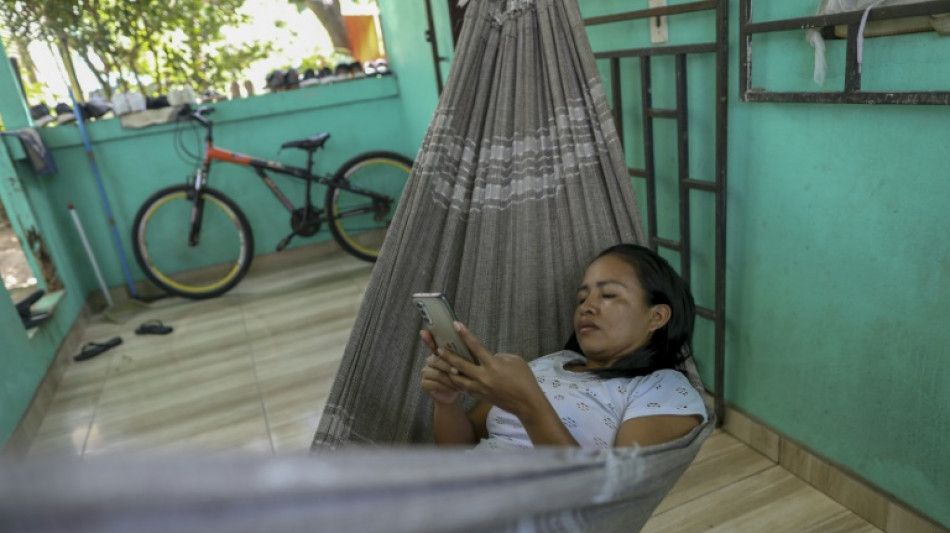
App lets Indigenous Brazilians connect in own languages / Photo: © AFP

 Palmeiras beat Fluminense 2-1 in Libertadores semi-final first leg
 Brewers blasts leave Dodgers on brink
 Tech stock lead rout after US inflation fuels rate hike bets
 Al-Fayed survivors say UK police missing 'bigger picture'

 Online 'witch hunt' sweeps up Asians misidentified as US rape accused

 Prospect of Bolsonaro win looms large over Brazil's Indigenous

 Freed from Belarus, founder of Lady Gaga's biggest fan site tells his story

 Behind AI's carbon footprint, a potential climate tool

 Trump's new press secretary faces scrutiny over credentials

 PSG 'got lucky' to win Man City thriller, says Luis Enrique

 Real Madrid comeback stuns Roma as Mourinho enjoys happy reunion
 Shakhtar make winning start at new Champions League 'home'

 Hat-trick hero Barcola primed to shine for Liverpool: Iraola

 Villa put six past Fenerbahce in record rout
 US stocks fall after hot inflation report as leading AI shares tumble
 Government buildings torched in violent Albanian protests
 Wall Street grills Bank of America over money laundering fine

 Mekies extends contract as Red Bull team principal until 2031
 Indonesia rescues starved orangutan from fires: officials

 Real Madrid's Vinicius banned for Clasico after red card

 Restrictions expose Ukraine's Starlink dependency in Russia war: observers
 Espada out as Astros manager while Mattingly stays with Phillies

 Houthis say targeted Saudi oil giant Aramco, vow more attacks

 Govt takes control of Turkey's most-watched news channel

 FIFA to offer members $6.35-billion development fund windfall
For Indigenous communities in the Brazilian Amazon, getting online is a challenge. Now, a smartphone app is making it easier to connect by allowing them to use their own native languages.
Hyper-connected Brazil has more cell phones than people -- over 250 million, for a population of 203 million, according to communications consultancy Teleco.
But even when they have smartphones and internet connections, the sprawling country's 1.7 million Indigenous inhabitants have often been excluded from the connectivity revolution, since devices typically have keyboards in Brazilian Portuguese and not Indigenous languages.
"Linklado," an app developed by two young friends from the Amazon region, offers a fix: It is a digital keyboard enabling native communities to write with the mix of Latin letters, bars, swoops, accents and other marks used in many Indigenous alphabets in Brazil.
Launched in 2022, it is helping Indigenous users communicate with each other and the world, whether from far-flung villages deep in the Amazon or the cities and towns that dot the region.
"Linklado has done so much good for Indigenous peoples, including me," says Cristina Quirino Mariano, 30, a member of the Ticuna people.
"Before, we couldn't write on our phones. Now we can," she told AFP, speaking Portuguese, Brazil's official language.
The original inhabitants of the land now known as Brazil had oral traditions before Portuguese colonizers arrived in the 16th century.
When Europeans began writing down these languages, they denoted the different sounds by adapting the Latin alphabet with symbols known as "diacritics."
But these alphabets were unavailable on cell phones -- until now.
The situation "left Indigenous people sending audio messages on their phones, because they couldn't write exactly what they wanted to say," says Noemia Ishikawa, Linklado's project coordinator.
The 51-year-old biologist had trouble getting her own research translated.
"I spent 14 years complaining we needed a keyboard to fix this problem," she says.
- Four-day challenge -
Today, "the app works for every Indigenous language in the Amazon," around 40 in all, says Juliano Portela, who developed it with a friend, Samuel Benzecry, when he was just 17.
Both natives of the Amazon region in northern Brazil, the pair are now studying in the United States.
Benzecry, who knew about the difficulties some of their Indigenous neighbors had writing on their phones, enlisted Portela, a programming whiz, to find a solution.
"At first, I was going to make a physical keyboard. But then I realized it wouldn't be practical, because some Indigenous people don't have computers," Portela told AFP.
"It took us four days to make the app. We had no idea it would be so fast."
They began testing their creation in May 2022, then launched the official version that August.
It has been downloaded more than 3,000 times since.
But the number of users is higher.
"A lot of Indigenous people are still using the test version we sent out on WhatsApp, which people forwarded to each other," Portela says.
- Getting paid to translate -
Linklado is free.
But it offers an option for non-speakers to pay to have texts translated into Indigenous languages.
The revenue-generating project is helping Indigenous women -- who are often left out of Latin America's biggest economy -- earn income with their knowledge of local languages.
Rosilda Cordeiro da Silva, a 61-year-old Indigenous languages teacher, is part of the app's pool of translators.
"It's been very positive for me," she says.
Having the digital keyboard, she adds, "has made me surer of myself when I translate."
The app is also helping the effort to save Indigenous languages at risk of dying out.
Vanda Witoto, a 35-year-old Indigenous activist, hopes it will help "save the Bure language, which is spoken by the Witoto people."
"This keyboard means we don't have to use characters that don't belong to our language," she says.
Beyond the Amazon, saving endangered languages is a global challenge.
Fully half the world's languages -- mostly Indigenous ones -- are at risk of disappearing by the turn of this century, according to a 2018 report by the United Nations.
K.Thomson--BTB