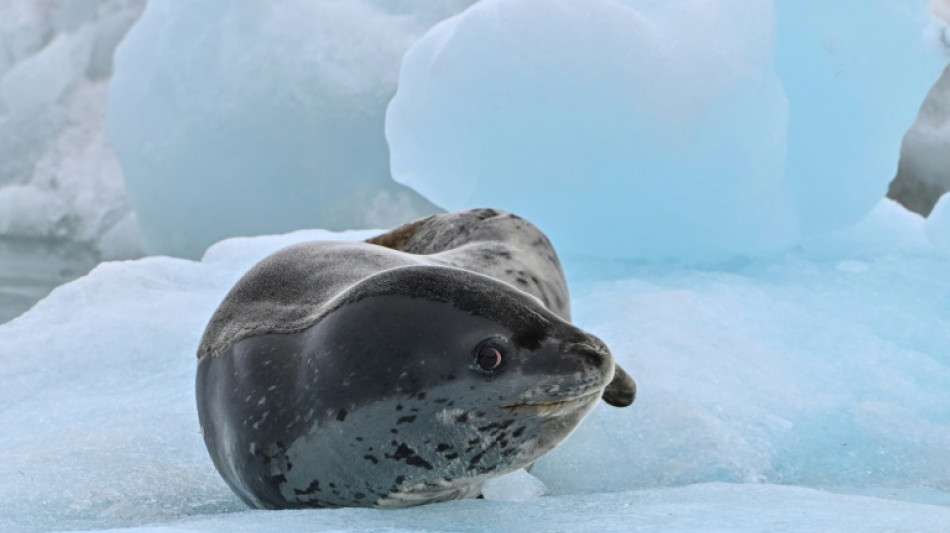
Scientists study levels of toxic mercury in Antarctic seals, whales / Photo: © AFP

 School roof collapse kills teacher, 27 children in NW Pakistan

 Haze turns Indonesia skies orange, shuts schools in East Timor
 California puts first US billionaire tax to the vote

 School headscarf ban meets resistance in Austria

 World's top cocoa producer aims for a climate-tough bean

 Why is Shell facing lawsuits over climate disasters in Brazil and the Philippines?

 New four-lane bridge opens between China, North Korea

 Tech stocks lead rout after US inflation fuels rate hike bets

 'No time to recover': UNDP chief sounds alarm on growing poverty after Iran war shock

 Australia says won't let big tech have 'unfettered' access to kids

 Mobile clinics battle Mongolia's childhood dental 'disaster'

 Wallabies back Meredith as playmaker for second New Zealand Test

 Messi's Inter Miami book playoffs with 2-0 win over New York City

 Oil-rich Alberta tests Canada's unity with secession vote

 EU leaders head for showdown over bloc budget
 All Blacks make three changes for second Wallabies Test

 Mourinho blasts 'shameless' timing of Vinicius ban decision

 PSG beat Man City in Champions League thriller, Barcola hits Liverpool hat-trick

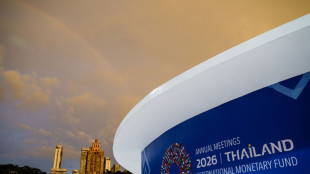 US Treasury chief urges stronger IMF role against 'distortionary policies'

 Giant-killers Bodo sink Dortmund in Champions League

 PSG outgun embattled Man City in six-goal Champions League thriller

 In Chicago, pope's hometown, Catholics express shock and support

 Musk suggests US govt behind any slowdown in Ukraine's Starshield system

 Chiclayo prays for recovery and return of the 'Peruvian pope'

 Barcola scores hat-trick as Liverpool hit LASK for six

A gunshot interrupts the peaceful sleep of a leopard seal, lying nonchalantly on a small piece of ice floating in the shadow of an Antarctic glacier.
Researcher Diego Mojica lowers his rifle.
The mammal, one of the largest predators on the White Continent after the orca, flinches from the impact of the remote biopsy -- a small red pipette that bounces off its skin, taking with it a piece of flesh -- and swims away.
Mojica, a Colombian marine biologist, descends from his boat alongside Livingston Island, in the South Shetland archipelago, to retrieve his sample.
Excitedly, he explains to an AFP team accompanying him on a day of research amid the glaciers, how rare it is to get so close to a leopard seal -- a solitary and usually aggressive species that feeds on penguins.
Mojica is studying the impact of mercury, used in activities such as mining thousands of kilometers away, on Antarctica's large mammals.
The toxic heavy metal is believed to reach the ocean through rivers or rain, after it "evaporates into the air," said Mojica, who works for Colombia's Malpelo Foundation, which specializes in the study of marine fauna.
Scientists at Spain's University of Murcia have previously found mercury in the feathers of chinstrap penguins on King George Island, the closest point in Antarctica to the Americas.
The pollution appears to extend south to Livingston Island and the Gerlache Strait, a natural channel off Antarctica.
The United Nation's Global Mercury Partnership warns that marine mammals, because they are "at the top of the food chain, are particularly susceptible to contamination" by the metal.
Later on his voyage -- a Colombian scientific expedition to Antarctica -- Mojica finds himself surrounded by humpback whales.
When a tail or back pokes out of the rough waters, he carefully takes aim with his rifle.
This time, he retrieves his sample of skin and fat from the freezing waters using a net.
Humpback whales consume large quantities of krill, small crustaceans susceptible to mercury contamination.
Mojica will study the samples to determine if "mercury has been transmitted from one link to the next in the food chain."
According to UN environmental agency UNEP, if an animal consumes mercury, it may suffer "reproductive failure, behavioral changes and may even (die)."
In 2013, 140 countries signed the Minamata Convention to reduce the use of mercury, which can cause severe health problems.
Some 9,000 tons of the toxic substance are released into the atmosphere every year.
Artisanal mining is the main source of mercury emissions, where the element is used to collect gold by binding to it.
Coal combustion is another major source. But mercury is also present in many household products like batteries, some lightbulbs and even mascara.
"We want to do our part to be able, as much as possible, to propose credible measures for the conservation and protection of these emblematic mammals," said Mojica.
P.Anderson--BTB