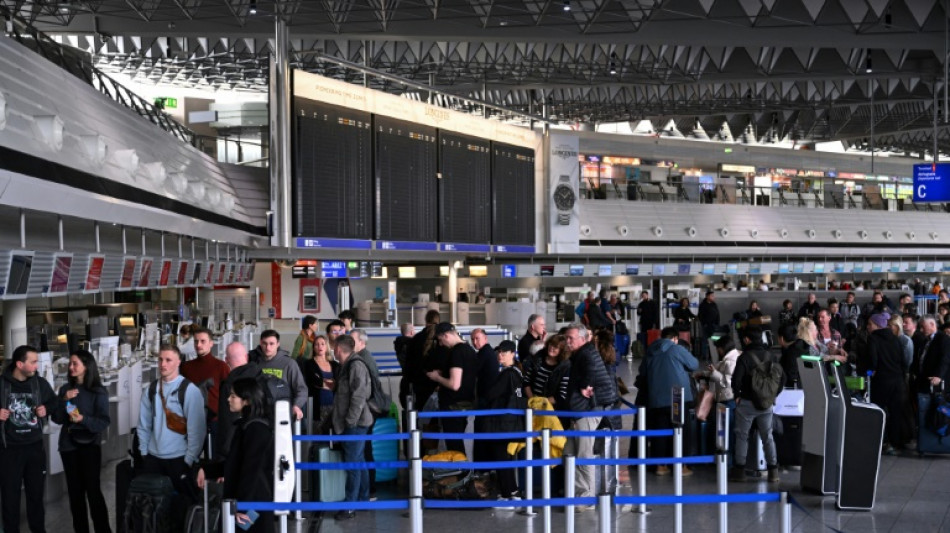
Why Germany is being hit by strikes almost every day / Photo: © AFP

 France charges teen shooter citing revenge for bullying in school
 Martinez blames 'anger' for dig at Man Utd hierarchy
 Crowds build as Albanian PM tours protest aftermath
 China-North Korea bridge opens, 12 years late
 Asian Cup in Saudi Arabia could be postponed but 'no hurry' to decide: AFC

 Conrad wields axe after South Africa loss to Australia

 School roof collapse kills teacher, 27 children in NW Pakistan

 Haze turns Indonesia skies orange, shuts schools in East Timor
 California puts first US billionaire tax to the vote
 School headscarf ban meets resistance in Austria
 World's top cocoa producer aims for a climate-tough bean

 Why is Shell facing lawsuits over climate disasters in Brazil and the Philippines?

 New four-lane bridge opens between China, North Korea

 Tech stocks lead rout after US inflation fuels rate hike bets

 'No time to recover': UNDP chief sounds alarm on growing poverty after Iran war shock
 Australia says won't let big tech have 'unfettered' access to kids
 Mobile clinics battle Mongolia's childhood dental 'disaster'

 Wallabies back Meredith as playmaker for second New Zealand Test
 Messi's Inter Miami book playoffs with 2-0 win over New York City

 Oil-rich Alberta tests Canada's unity with secession vote

 EU leaders head for showdown over bloc budget
 All Blacks make three changes for second Wallabies Test

 Mourinho blasts 'shameless' timing of Vinicius ban decision

 PSG beat Man City in Champions League thriller, Barcola hits Liverpool hat-trick

 US Treasury chief urges stronger IMF role against 'distortionary policies'

A wave of strike action has brought Germany to a standstill in recent weeks, as Europe's largest economy has struggled for growth and consumers have felt the pinch from sky-high inflation.
Rail, bus and airport workers have walked out one after another amid bitter salary negotiations in a country that usually prides itself on good labour relations.
The latest industrial action by airport ground staff has forced Lufthansa to cancel nine out of every 10 flights for Wednesday.
How did the strikes start to pile up? Here are five things to know:
- When did the strikes start? -
Since the end of 2022, Germany has seen growing labour unrest, while real wages have fallen by four percent since the start of the war in Ukraine.
A clutch of sectors received pay rises last year -- sometimes up to 10 percent -- but the new settlements did not ease tensions as inflation stayed high at 5.3 percent last year.
The continued price pressure has strained pay talks and led to the number of strikes multiplying.
At the end of January, train drivers staged a five-day walkout, before workers at airports and local transport services followed with their own industrial action.
- Why now? -
"Workers have really felt the loss of income, they have less money in their pocket at the end of the month," Alexander Gallas, a political science professor at the University of Kassel, told AFP.
At the same time, the unions' bargaining power is strengthened by serious labour shortages plaguing German businesses.
But union demands are clashing with "the fact that many businesses are in crisis and do not have much to distribute", making a quick resolution complicated, according to Hagen Lesch from the IW economic think tank.
- Labour relations on edge? -
The proliferation of strikes has called into question the future of Germany's otherwise consensus-driven labour relations.
"It is the moment of truth for the German model," Lesch said.
"Unions were more willing to compromise during the coronavirus pandemic. That is over."
Germany has historically been among the countries in Europe where workers went on strike the least.
Between 2012 and 2021, just 18 out of every 1,000 work days were disrupted by industrial action, compared with 92 out of every 1,000 in France.
- What support do the strikes have? -
Collective agreements, which long undergirded the system, now cover just 43 percent of workers compared with 56 percent in 2010.
But the current wave of strikes has enjoyed strong support among workers, according to experts, even if a single figure is not available.
"We are seeing high rates of participation, which is leading to an increase in union membership," Thorsten Schulten, a researcher at the WSI institute, told AFP.
- What next? -
Few decisive agreements have yet been found between unions and management, meaning the wave of strikes could carry forward.
"Everything is possible," said Claus Weselsky, head of the GDL rail workers union, which is behind much of the transport disruption.
And other industries might yet join the fray. In the chemicals sector, which has known tough times in recent years, a new round of wage negotiations is set to kick off in the coming months.
K.Thomson--BTB