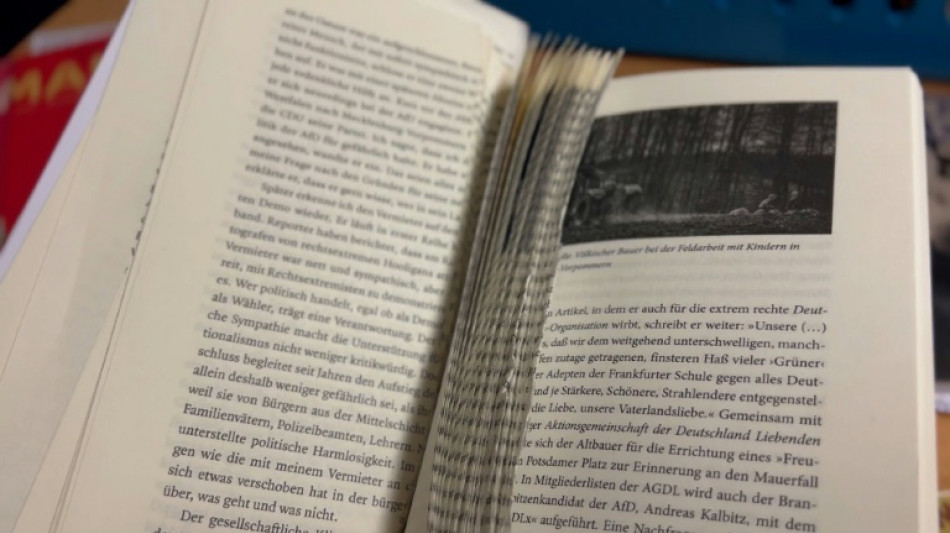
German libraries up defences against far-right attack / Photo: © AFP

 France charges teen shooter citing revenge for bullying in school

 Martinez blames 'anger' for dig at Man Utd hierarchy
 Crowds build as Albanian PM tours protest aftermath
 China-North Korea bridge opens, 12 years late
 Asian Cup in Saudi Arabia could be postponed but 'no hurry' to decide: AFC

 Conrad wields axe after South Africa loss to Australia

 School roof collapse kills teacher, 27 children in NW Pakistan
 Haze turns Indonesia skies orange, shuts schools in East Timor

 California puts first US billionaire tax to the vote
 School headscarf ban meets resistance in Austria
 World's top cocoa producer aims for a climate-tough bean

 Why is Shell facing lawsuits over climate disasters in Brazil and the Philippines?

 New four-lane bridge opens between China, North Korea

 Tech stocks lead rout after US inflation fuels rate hike bets

 'No time to recover': UNDP chief sounds alarm on growing poverty after Iran war shock

 Australia says won't let big tech have 'unfettered' access to kids

 Mobile clinics battle Mongolia's childhood dental 'disaster'

 Wallabies back Meredith as playmaker for second New Zealand Test
 Messi's Inter Miami book playoffs with 2-0 win over New York City

 Oil-rich Alberta tests Canada's unity with secession vote

 EU leaders head for showdown over bloc budget

 All Blacks make three changes for second Wallabies Test

 Mourinho blasts 'shameless' timing of Vinicius ban decision

 PSG beat Man City in Champions League thriller, Barcola hits Liverpool hat-trick

 US Treasury chief urges stronger IMF role against 'distortionary policies'

Defaced and destroyed, books torn up and political messages scrawled across their pages: the evidence of an alleged far-right vandalism spree at a city library in Berlin covers an entire table.
"The first reaction was confusion, then outrage, when we realised what had happened here," Boryano Rickum, chief librarian for Tempelhof-Schoeneberg district, told AFP.
The incident -- the work of a single suspect -- was not however a one off.
The library at Berlin's Technical University is also thought to have been targeted by far-right vandalism, while elsewhere extremists have crashed events and threatened staff.
The cases illustrate what campaigners call a "cultural struggle" as extremist ideas gain purchase and the far-right climbs in the polls.
The increased threat has prompted efforts to better arm public spaces against attack and protect them as a space for dialogue.
Staff at the library in well-heeled Tempelhof-Schoenberg were used to finding the odd scribbled swastika but the vandalism crossed a line, said Rickum.
Destroying books was, in his eyes, tantamount to an "attack on democracy".
"The moment we discovered the damage, it was clear that we couldn't just go back to business-as-usual."
- Critical censorship -
The topics dealt with in the books gave some indication of the possible motivation: the history of feminism, critical analyses of far-right groups and the autobiographies of prominent green politicians.
"We had to assume that it was an attempt to prevent a critical discussion of right-wing extremism and National Socialism," said Rickum.
Acts of violence against books have a particular resonance in Germany, where the Nazis, who ruled up to 1945, ceremonially burnt publications they deemed to be subversive or deviant.
The acts of radical censorship are commemorated in central Berlin on Bebelplatz, the site of such a bonfire in the 1930s.
In recent times, many cultural institutions have had run-ins with extremists, said Bianca Klose from MBR, an advisory group, which offers help dealing with the far-right.
"But now we've noticed that in particular public libraries are increasingly noticing a so-called cultural struggle from the right," said Klose.
By targeting libraries, "the extremist right is trying to change the boundaries of what can be said", according to Klose, whose organisation printed a pamphlet with advice for librarians last year.
The publication details confrontations with the far right, such as threats made last year against a reading to children by two drag queens at a Munich library.
With a growing number of elected officials, the far-right AfD party was "trying to use political power to gain influence over libraries", Klose said.
The party's representatives used their positions to ask "why certain books are not in collections", notably ones from right-wing publishing houses, sometimes framed as a matter of political neutrality.
- 'The right place' -
The pamphlet offers best-practice solutions: how to establish guidelines, how to decide what books to stock and ways to contextualise content in libraries.
In Tempelhof-Schoeneberg, the library's response has been to "put the focus on the books affected", said Rickum.
Many of the authors of the vandalised books have been invited to discuss their ideas and the staff has established a reading group around the issue.
Federico Quadrelli, 37, a volunteer who leads the group, sees it as "a space where people can meet and talk about important, current, political topics".
The suspected vandal at the Tempelhof-Schoeneberg library, a man in his early thirties from Berlin, has been charged with damaging property.
The aim of the attack was to limit debate, said Rickum. "We want to achieve the opposite, namely that people assess it critically."
"Democracy needs a place where people can come together... and we think this is the right place," he said.
"Of course, I also know that as a library we cannot do this alone. We need civil society to save democracy."
T.Bondarenko--BTB