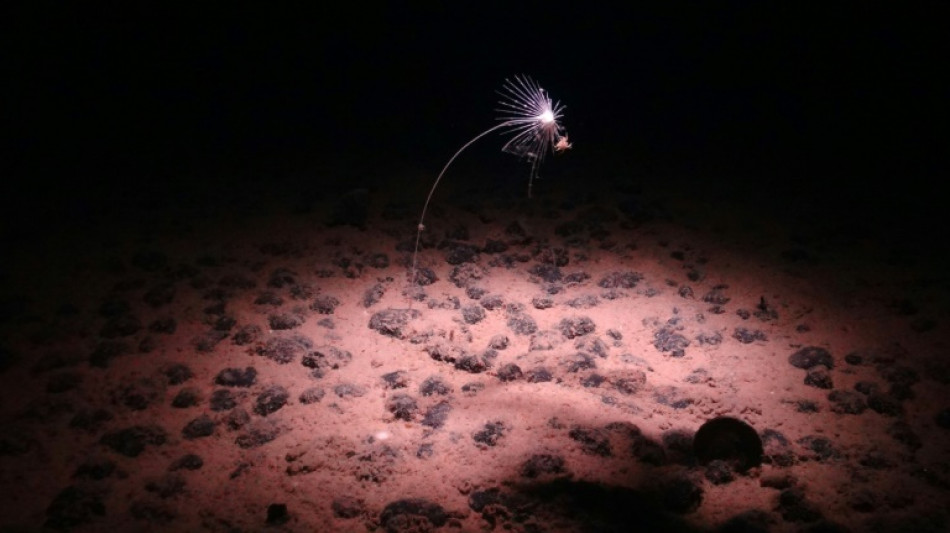
Deep ocean 'dark oxygen' find could rewrite Earth's history / Photo: © National Oceanography Centre / Smartex project (NERC)/AFP/File

 IUX Announces New Web Client Portal Built for Enhanced Browser-Based Trading

 School roof collapse kills teacher, 32 children in NW Pakistan

 Inter skipper Martinez facing month out with thigh injury

 Spanish prosecutors back abuse probe into Julio Iglesias

 Tech sell-off deepens as US inflation sparks AI jitters

 Southgate does not forsee a return to management

 Two dead as Istanbul endures heaviest rainfall in 80 years

 After latest Nepal flood, survivors fear for future

 EU leaders clash over budget as spectre of French elections looms

 'No place to breathe': life in Indonesia's fire epicentre

 'Can't sleep': Spain's housing crunch upends lives

 Musk calls on Ukraine's Zelensky to 'go' after satellite slowdown row

 Still smiling at 117, Albanian may be world's oldest woman

 Pope has 'good night' in hospital: Vatican

 China's economy seen missing target as global shocks bite: AFP poll

 Costa Rica opens jail inspired by El Salvador mega-prison

 Same-sex couple takes fight for equality to Slovakian court
 'High hopes' as Indonesian women get a football league, again

 'Expectations high' for Bordeaux-Begles' Champions Cup hat-trick bid, says Depoortere

 Rennie urges All Blacks to stay focused against 'hurting' Wallabies

 Palmeiras beat Fluminense 2-1 in Libertadores semi-final first leg

 Brewers blasts leave Dodgers on brink

 Tech stock lead rout after US inflation fuels rate hike bets

 Al-Fayed survivors say UK police missing 'bigger picture'

 Online 'witch hunt' sweeps up Asians misidentified as US rape accused

In the total darkness of the depths of the Pacific Ocean, scientists have discovered oxygen being produced not by living organisms but by strange potato-shaped metallic lumps that give off almost as much electricity as AA batteries.
The surprise finding has many potential implications and could even require rethinking how life first began on Earth, the researchers behind a new study said on Monday.
It had been thought that only living things such as plants and algae were capable of producing oxygen via photosynthesis -- which requires sunlight.
But four kilometres (2.5 miles) below the surface of the Pacific Ocean, where no sunlight can reach, small mineral deposits called polymetallic nodules have been recorded making so-called dark oxygen for the first time.
The discovery was made in the Clarion-Clipperton Zone (CCZ), an abyssal plain stretching between Hawaii and Mexico, where mining companies have plans to start harvesting the nodules.
The lumpy nodules -- often called "batteries in a rock" -- are rich in metals such as cobalt, nickel, copper and manganese, which are all used in batteries, smartphones, wind turbines and solar panels.
The international team of scientists sent a small vessel to the floor of the CCZ aiming to find out how mining could impact the strange and little understood animals living where no light can reach.
- No sunlight required -
"We were trying to measure the rate of oxygen consumption by the seafloor," lead study author Andrew Sweetman of the Scottish Association for Marine Science (SAMS) told AFP.
To do so, they used a contraption called a benthic chamber which snatched up a bunch of sediment.
Normally, the amount of oxygen trapped in the chamber "decreases as its used up by organisms as they respire," Sweetman said.
But this time the opposite happened -- the amount of oxygen increased. This was not supposed to happen in complete darkness where there is no photosynthesis.
This was so shocking that the researchers initially thought their underwater sensors must have been on the blink.
So they brought up some nodules to their ship to repeat the test. Once again, the amount of oxygen increased.
They then noticed how the nodules were carrying a startling electric change.
On the surface of the nodules, the team "amazingly found voltages almost as high as are in an AA battery," Sweetman said.
This charge could split seawater into hydrogen and oxygen in a process called seawater electrolysis, the researchers said.
This chemical reaction occurs at around 1.5 volts -- around the charge of a AA battery.
- 'Exciting' -
SAMS director Nicholas Owens said it was "one of the most exciting findings in ocean science in recent times".
The discovery of oxygen produced outside of photosynthesis "requires us to rethink how the evolution of complex life on the planet might have originated," he said in a statement.
"The conventional view is that oxygen was first produced around three billion years ago by ancient microbes called cyanobacteria and there was a gradual development of complex life thereafter," Owens added.
But the team's discovery showed that "life could have started elsewhere than on land," Sweetman said.
"And, if the process is happening on our planet, could it be helping to generate oxygenated habitats on other ocean worlds such as Enceladus and Europa and providing the opportunity for life to exist?" Sweetman asked.
The study was published in the journal Nature Geoscience.
The work was partly funded by Canada's The Metals Company, which is aiming to start mining the nodules in the CCZ next year.
J.Bergmann--BTB