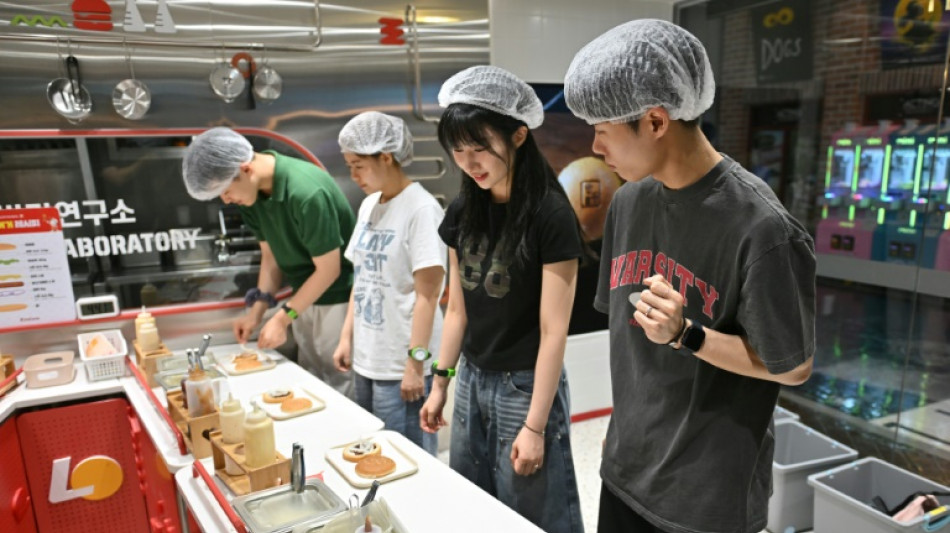
Theme park's novel bid to fix South Korea youth unemployment / Photo: © AFP

 IUX Announces New Web Client Portal Built for Enhanced Browser-Based Trading

 School roof collapse kills teacher, 32 children in NW Pakistan

 Inter skipper Martinez facing month out with thigh injury

 Spanish prosecutors back abuse probe into Julio Iglesias

 Tech sell-off deepens as US inflation sparks AI jitters

 Southgate does not forsee a return to management
 Two dead as Istanbul endures heaviest rainfall in 80 years

 After latest Nepal flood, survivors fear for future

 EU leaders clash over budget as spectre of French elections looms

 'No place to breathe': life in Indonesia's fire epicentre

 'Can't sleep': Spain's housing crunch upends lives

 Musk calls on Ukraine's Zelensky to 'go' after satellite slowdown row

 Still smiling at 117, Albanian may be world's oldest woman
 Pope has 'good night' in hospital: Vatican

 China's economy seen missing target as global shocks bite: AFP poll

 Costa Rica opens jail inspired by El Salvador mega-prison

 Same-sex couple takes fight for equality to Slovakian court
 'High hopes' as Indonesian women get a football league, again

 'Expectations high' for Bordeaux-Begles' Champions Cup hat-trick bid, says Depoortere

 Rennie urges All Blacks to stay focused against 'hurting' Wallabies

 Palmeiras beat Fluminense 2-1 in Libertadores semi-final first leg

 Brewers blasts leave Dodgers on brink

 Tech stock lead rout after US inflation fuels rate hike bets
 Al-Fayed survivors say UK police missing 'bigger picture'

 Online 'witch hunt' sweeps up Asians misidentified as US rape accused

At a kids' role-playing theme park in Seoul, 23-year-old Park Woo-joo is on a very adult mission: the university-educated but unemployed South Korean is searching for his future career.
Part of a Mexican-owned global chain, KidZania typically offers young children the chance to play at dozens of different jobs, from firefighter to dentist, in giant indoor centres, including one in Seoul that receives hundreds of thousands of visitors a year.
But KidZania South Korea has been pioneering a new use for its Seoul venue: helping unemployed young people find their real-life calling, at nostalgia-laced, wildly popular, adults-only events.
Despite labour shortages linked to its super-low birthrate, youth unemployment in South Korea is stubbornly high -- the result, experts say, of a mismatch between the highly educated youth and the realities of the country's labour market.
Park has a degree in business administration but has not been able to find a job he wants, so last month he was one of 500 people who bought a ticket for the sold-out "Kids-ania" event for adults -- the name is a pun in Korean, effectively meaning "Not Kids".
At the sprawling indoor theme park, while people dressed as police officers and Supreme Court judges role-played in purpose-built areas, Park told AFP he was eager to "experience as much as possible".
He's hoping that, by testing out a bunch of potential careers, he might have a "lightbulb" moment and discover what he should be doing with his life.
"I think it's a great way for people who are unemployed to have fun and learn at the same time," he told AFP.
- Nostalgia tour -
The adult events were the brainchild of Kang Jae-hyung, president of KidZania South Korea, who told AFP he wanted to help the young people who might have come to the park when it first opened in 2010.
"The kids who were seven years old when they first came here are now 21," Kang said.
His colleagues were skeptical about the idea and he initially faced internal opposition, he said, but tickets for the first event sold out immediately.
Kang said that many young South Korean adults need to tap into their innate sense of fun, and not take working life too seriously.
"I just want them to remember what they wanted to do when they were young," said Kang, adding that it was important "not to crush children's dreams".
Lee Soo-min, 20, has memories of going to KidZania -- and said the place seemed the same when she returned over a decade later.
"But it seems I've changed," she said.
Standing in line at a radio studio to try her hand at being a DJ, Lee, a university student who said she was trying to figure out what to do with her life, told AFP: "Now, I begin to take these experiences seriously."
- Aspirations vs reality -
With the world's lowest birthrate, South Korea's population has long been shrinking.
The country's working-age population will begin falling off from 2028, official projections show, and many sectors of the economy, from agriculture to restaurants and care homes, already suffer from widespread labour shortages, with immigration tightly limited.
Even so, the country has persistently high youth unemployment, currently at 6.2 percent, more than double the overall rate of 2.9 percent, official figures show.
The number of young people classified as "resting" -- neither employed nor actively seeking work -- hit 426,000 last month, the second-highest rate since records began in 2003. The highest was during the pandemic.
The problem, experts say, is that young South Koreans would rather not work than work in a job perceived as unpopular or beneath them.
For example, nearly half of young South Koreans are reluctant to join small or medium-sized enterprises (SMEs), official figures show -- even though such businesses make up some 98 percent of the economy, with high-profile corporations such as Samsung just 2 percent.
This mismatch between the aspirations of highly educated young people and the realities of the labour market "gradually deepens unemployment among highly educated youth," said Hwang Gwang-hoon, an associate research fellow at the Korea Employment Information Service.
South Korea has turned to automation of production lines and even CCTV to ease labour crunches -- with, for example, many convenience stores now unmanned -- but the country also needs to create more "quality jobs", Hwang said, especially in SMEs.
For KidZania's Kang, unemployed young people need to let go of the fears and embarrassments that may be holding them back in the job market.
"Do what you want to do. Don't be self-conscious," he said.
A.Gasser--BTB