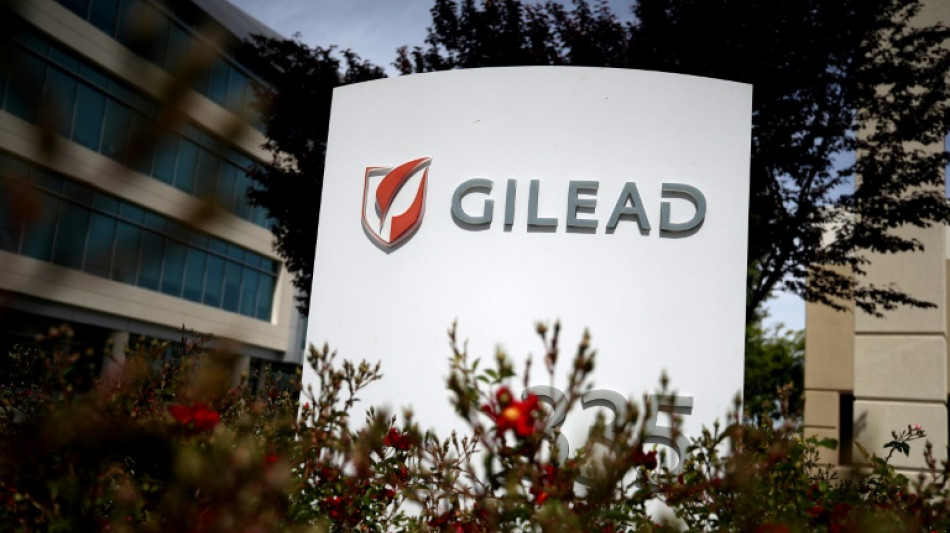
New 'vaccine-like' HIV drug could cost just $40: researchers / Photo: © GETTY IMAGES NORTH AMERICA/AFP/File

 IUX Announces New Web Client Portal Built for Enhanced Browser-Based Trading
 School roof collapse kills teacher, 32 children in NW Pakistan
 Inter skipper Martinez facing month out with thigh injury

 Spanish prosecutors back abuse probe into Julio Iglesias

 Tech sell-off deepens as US inflation sparks AI jitters

 Southgate does not forsee a return to management

 Two dead as Istanbul endures heaviest rainfall in 80 years

 After latest Nepal flood, survivors fear for future

 EU leaders clash over budget as spectre of French elections looms

 'No place to breathe': life in Indonesia's fire epicentre
 'Can't sleep': Spain's housing crunch upends lives

 Musk calls on Ukraine's Zelensky to 'go' after satellite slowdown row

 Still smiling at 117, Albanian may be world's oldest woman
 Pope has 'good night' in hospital: Vatican

 China's economy seen missing target as global shocks bite: AFP poll
 Costa Rica opens jail inspired by El Salvador mega-prison

 Same-sex couple takes fight for equality to Slovakian court
 'High hopes' as Indonesian women get a football league, again
 'Expectations high' for Bordeaux-Begles' Champions Cup hat-trick bid, says Depoortere
 Rennie urges All Blacks to stay focused against 'hurting' Wallabies

 Palmeiras beat Fluminense 2-1 in Libertadores semi-final first leg
 Brewers blasts leave Dodgers on brink
 Tech stock lead rout after US inflation fuels rate hike bets
 Al-Fayed survivors say UK police missing 'bigger picture'

 Online 'witch hunt' sweeps up Asians misidentified as US rape accused

A new "vaccine-like" HIV drug that currently costs over $40,000 per person a year could be made for as little as $40, researchers estimated on Tuesday.
The antiretroviral drug Lenacapavir, developed by US pharmaceutical giant Gilead, has been hailed as a potential game-changer in the fight against HIV.
Early trials have found the treatment is 100 percent effective in preventing HIV infection. And it only needs to be injected twice a year, making the drug far easier to administer than current regimens requiring daily pills.
"It's like having a vaccine basically," Andrew Hill, a researcher at the UK's Liverpool University, told AFP.
The treatment currently costs patients over $40,000 a year in a range of countries including the United States, France, Norway and Australia.
New research, which Hill presented at the International AIDS Conference in Munich on Tuesday, looked into how much the cost of making the drug could come down if Gilead allowed for cheaper generic versions to be manufactured.
A year's worth of the drug could be made for as little as $40 -- 1,000 times less than the current price -- according to the research, which has not been peer reviewed.
This price was based on production volumes equal to treating 10 million people.
If the drug was given to people at high risk of contracting HIV -- such as gay or bisexual men, sex workers, prisoners or notably young women in Africa -- it could "basically shut down HIV transmission," Hill emphasised.
"We could actually control the epidemic."
There were 1.3 million new HIV infections last year, while 39 million people are living with the virus, according to the World Health Organization.
- 'Opportunity to save the world' -
To estimate the cost, the researchers studied shipments of raw materials of the drug, and spoke to large generic manufacturers in China and India that already make its "building blocks," Hill said.
The international team of researchers has been proven right about similar estimates in the past, he added.
A decade ago, the team said that the cost of making Gilead's hepatitis C drug -- then priced at $84,000 a patient -- could plummet to $100 if generics were allowed.
"Now it costs just under $40 to cure Hepatitis C," Hill said.
The new research was announced a day after UNAIDS chief Winnie Byanyima called on Gilead to "make history" by opening up Lenacapavir to the UN-backed Medicines Patent Pool, which would allow generics to be sold under licence in low- and middle-income nations.
"Gilead has an opportunity to save the world," she told AFP.
A Gilead spokesperson told AFP that the firm is still waiting on phase 3 clinical trial data on using Lenacapavir to prevent HIV, so "it is too early to state" what it could have in the future.
The firm has a strategy to "supply high-quality, low-cost versions of Lenacapavir" in countries "where the need is greatest," the spokesperson said.
It is also "moving with urgency" to negotiate contracts for a voluntary licencing programme to "expedite access to those versions of lenacapavir in high-incidence, resource-limited countries," the spokesperson added.
K.Thomson--BTB