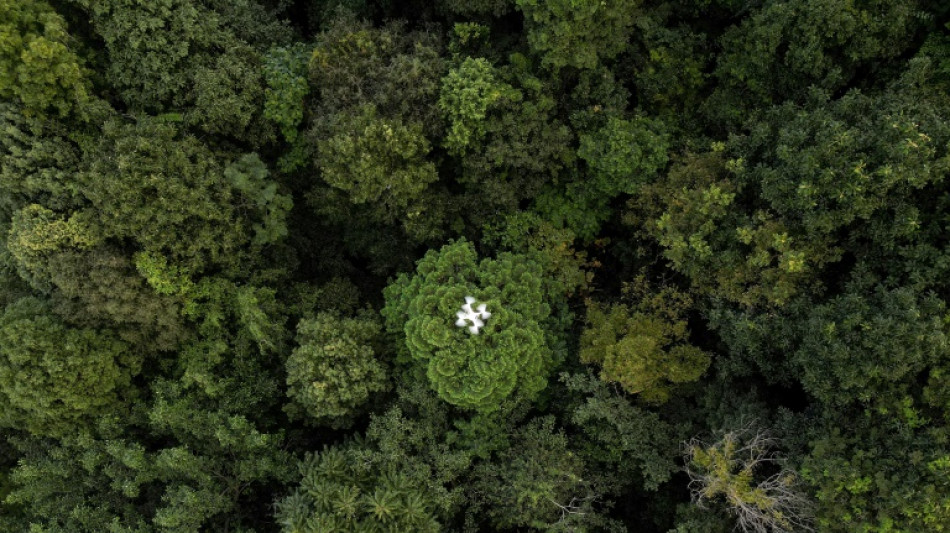
Natural forest regrowth can be better than planting trees: study / Photo: © AFP

 IUX Announces New Web Client Portal Built for Enhanced Browser-Based Trading

 School roof collapse kills teacher, 32 children in NW Pakistan

 Inter skipper Martinez facing month out with thigh injury

 Spanish prosecutors back abuse probe into Julio Iglesias

 Tech sell-off deepens as US inflation sparks AI jitters

 Southgate does not forsee a return to management

 Two dead as Istanbul endures heaviest rainfall in 80 years

 After latest Nepal flood, survivors fear for future

 EU leaders clash over budget as spectre of French elections looms

 'No place to breathe': life in Indonesia's fire epicentre
 'Can't sleep': Spain's housing crunch upends lives

 Musk calls on Ukraine's Zelensky to 'go' after satellite slowdown row

 Still smiling at 117, Albanian may be world's oldest woman

 Pope has 'good night' in hospital: Vatican
 China's economy seen missing target as global shocks bite: AFP poll

 Costa Rica opens jail inspired by El Salvador mega-prison

 Same-sex couple takes fight for equality to Slovakian court
 'High hopes' as Indonesian women get a football league, again

 'Expectations high' for Bordeaux-Begles' Champions Cup hat-trick bid, says Depoortere
 Rennie urges All Blacks to stay focused against 'hurting' Wallabies

 Palmeiras beat Fluminense 2-1 in Libertadores semi-final first leg

 Brewers blasts leave Dodgers on brink

 Tech stock lead rout after US inflation fuels rate hike bets

 Al-Fayed survivors say UK police missing 'bigger picture'

 Online 'witch hunt' sweeps up Asians misidentified as US rape accused

Countries have pledged to plant billions of trees to tackle climate change, but half the time letting forests regenerate naturally would be a better option, a major study said Wednesday.
"There are places where it makes sense to plant trees, and there are places where it makes sense to naturally regenerate forests," Jacob Bukoski, one of the authors of the study told AFP.
"If you want to sequester carbon at the lowest cost, some combination of natural regeneration and plantations makes a lot of sense," said the researcher at Oregon State University in the United States.
Restoring forests has massive potential to help limit rising global temperatures because trees absorb heat-trapping carbon dioxide emissions from the atmosphere.
The study, which spanned 138 countries and was published in the journal Nature Climate Change, compared the cost and climate benefits of planting one tree species in an area or allowing natural forest regrowth -- two common reforestation approaches --- over a 30-year period.
It found that in 46 percent of the studied areas, letting forests grow back naturally was the more cost-effective option. The rest of the time, plantations were found to be cheaper.
- 'Missed opportunities' -
"It suggests that the current heavier emphasis on plantations within national reforestation programmes could be leading to missed opportunities for cost-effective climate mitigation," the study said.
Previous research has shown that as much as two-thirds of reforestation commitments in the tropics are plantations, said Bukoski.
In recent years there has been "a proliferation of single species plantations to try to meet climate goals," he added.
Fast-growing single species plantations -- also called monoculture -- are more costly to implement but provide revenue from the production and sale of wood products.
When the wood is harvested, a portion of the carbon stored in the trees is released into the atmosphere -- but the rest is trapped in the timber.
Naturally regenerated forests grow more slowly but are more biodiverse and store a greater amount of carbon over a longer time period.
The researchers said their mapping could help guide international initiatives and countries' plans to cut emissions by presenting a more nuanced approach to reforestation.
They found that natural regeneration was especially cost-effective in much of western Mexico, the Andean region, the Southern Cone of South America, west and central Africa, India, southern China, Malaysia, and Indonesia.
Conversely, plantations proved the better option in large parts of the Caribbean, Central America, Brazil, north, east and southern Africa, northern China, mainland Southeast Asia and the Philippines.
The study used machine learning to analyse costs and carbon sequestration data from observations from thousands of sites suitable for reforestation.
Mixed species plantations and agroforestry, which integrate trees in agricultural landscapes, were left out because of a lack of good data.
The researchers added that factors such as demand for timber, the creation of economic opportunities and biodiversity restoration also needed to be taken into account when deciding on a reforestation method.
L.Janezki--BTB