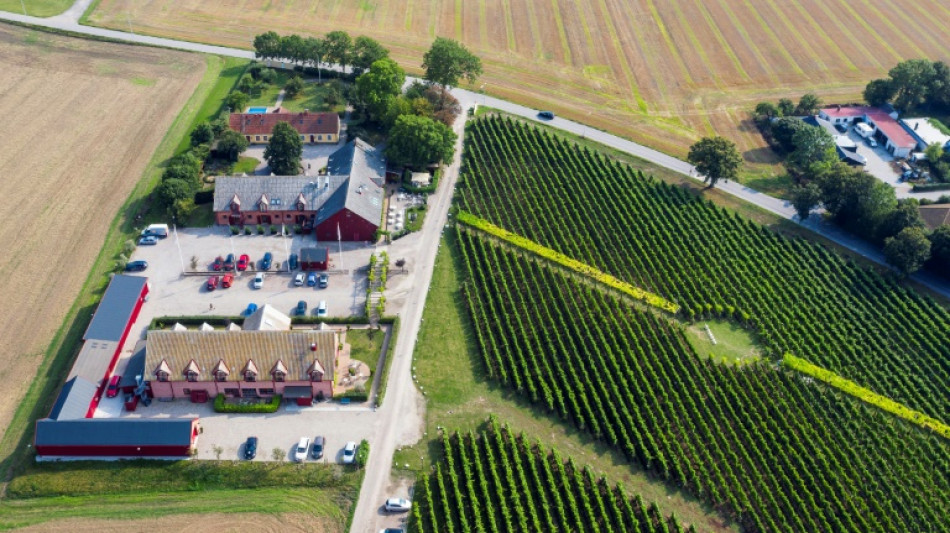
Sweden seeks to be winemaking's next frontier / Photo: © AFP

 IUX Announces New Web Client Portal Built for Enhanced Browser-Based Trading

 School roof collapse kills teacher, 32 children in NW Pakistan

 Inter skipper Martinez facing month out with thigh injury

 Spanish prosecutors back abuse probe into Julio Iglesias

 Tech sell-off deepens as US inflation sparks AI jitters

 Southgate does not forsee a return to management

 Two dead as Istanbul endures heaviest rainfall in 80 years

 After latest Nepal flood, survivors fear for future

 EU leaders clash over budget as spectre of French elections looms

 'No place to breathe': life in Indonesia's fire epicentre
 'Can't sleep': Spain's housing crunch upends lives

 Musk calls on Ukraine's Zelensky to 'go' after satellite slowdown row

 Still smiling at 117, Albanian may be world's oldest woman
 Pope has 'good night' in hospital: Vatican
 China's economy seen missing target as global shocks bite: AFP poll

 Costa Rica opens jail inspired by El Salvador mega-prison

 Same-sex couple takes fight for equality to Slovakian court
 'High hopes' as Indonesian women get a football league, again

 'Expectations high' for Bordeaux-Begles' Champions Cup hat-trick bid, says Depoortere
 Rennie urges All Blacks to stay focused against 'hurting' Wallabies

 Palmeiras beat Fluminense 2-1 in Libertadores semi-final first leg

 Brewers blasts leave Dodgers on brink
 Tech stock lead rout after US inflation fuels rate hike bets
 Al-Fayed survivors say UK police missing 'bigger picture'

 Online 'witch hunt' sweeps up Asians misidentified as US rape accused

Far north of iconic wine regions like Bordeaux and Tuscany, Sweden is seeing a burgeoning industry of vineyards and a first generation of winemakers trying to carve out a niche.
"There are millions of techniques, and I don't have a grandfather or grandmother to ask. So we need to figure it out ourselves," Lena Magnergard, 64, told AFP as she walked through the short rows of grapevines at the Selaon vineyard an hour west of Stockholm.
The former communications professional started the vineyard, the most northern Swedish site to have produced its own wine according to Magnergard, together with her farmer husband Erik Bjorkman in 2019 on the family farm.
They produced their first wine in 2021 but Magnegard, a trained sommelier, is quick to admit that as keepers of some 1,000 vines they are still learning.
"Of course you can read up in books, but that is nothing like generational knowledge," she said, adding that they mostly look to France and its centuries of winemaking tradition as the gold standard.
According to Magnergard, the emergence of wineries this far north is largely thanks to the development of new breeds of grapes in the 1960s and 70s, such as Solaris -- which was developed to be resistant to disease and is the main grape grown at Selaon.
- Resistance to cold -
"What they then discovered about these grapes, by pure chance, was two things -- they need less time between blooming and harvesting and they can handle cold very well," Magnergard said.
That combination was perfect for the Nordic region, where summers are both shorter and colder.
In the south of Sweden, on the Bjare peninsula, Solaris also dominates the 11-hectare Thora Vineyard -- started in 2015 by a Swedish-American couple.
But it also features more well-known grapes such as Pinot noir -- which is less expected so far north due to it requiring more heat.
For French-born winemaker Romain Chichery, who started working on the vineyard together with colleague Emma Berto three years ago, Sweden is "a new playground".
The 27-year-old wine specialist admitted to AFP that they "didn't expect so many varieties to take.
"Once we had analysed the climatic data, we realised that there was potential for many varieties and not just hybrid varieties, which are interesting but not the only solution" for Swedish soils, he added.
As a warmer climate is disrupting harvests in traditional wine-growing areas, professional wine growers have begun to look further north.
However, the Scandinavian country is not exempt from the variations of the climate.
"We have extremes, just like everywhere else in Europe," Chichery noted.
At the same time, exploring a new frontier of wine also frees winemakers from old established rules.
"We're free to do what we want. If I want to make a red with a little residual sugar, so a slightly sweet red, I can do that," he said.
In Sweden, the industry has picked up speed in recent years and the country is now home to some 50 commercial vineyards of varying sizes.
According to industry group Svenskt Vin, 200 hectares are now being cultivated, which while twice as many as five years ago is little compared to the 800,000 hectares devoted to viticulture in France.
For Murat "Murre" Sofrakis, the figure is still unimpressive, and the 56-year-old foresees much greater things in the future.
Sofrakis runs a small vineyard in the far south of Sweden but is a champion of Swedish winemaking.
- Equal terms -
"There are two kinds of people. One is the entrepreneur that sees opportunity here... and for the other people, it's like a lifestyle," he told AFP.
For him, the aim is to invigorate the industry, and he believes a recent liberalisation of the Swedish strict alcohol monopoly should help.
In June, Sweden's government announced it wanted to allow breweries, distilleries and winemakers to sell alcoholic beverages directly to customers visiting their operations.
Apart from bars and restaurants, Swedes can only buy beverages with an alcohol content above 3.5 percent at state-run outlets called Systembolaget, and some authorised retailers in rural areas.
The proposal to allow winemakers to sell three litres of wine to visitors is currently being reviewed but the government said it hopes to see it implemented in the first half of 2025.
"It's the first time we've been able to compete on equal terms with the rest of the wine world, and that's very important," Sofrakis said.
He started in 2001, just two years after the European Union gave permission for vines to be grown commercially in Sweden.
"If we'd had this 20 years ago, Swedish winegrowing would be much bigger," he said.
N.Fournier--BTB