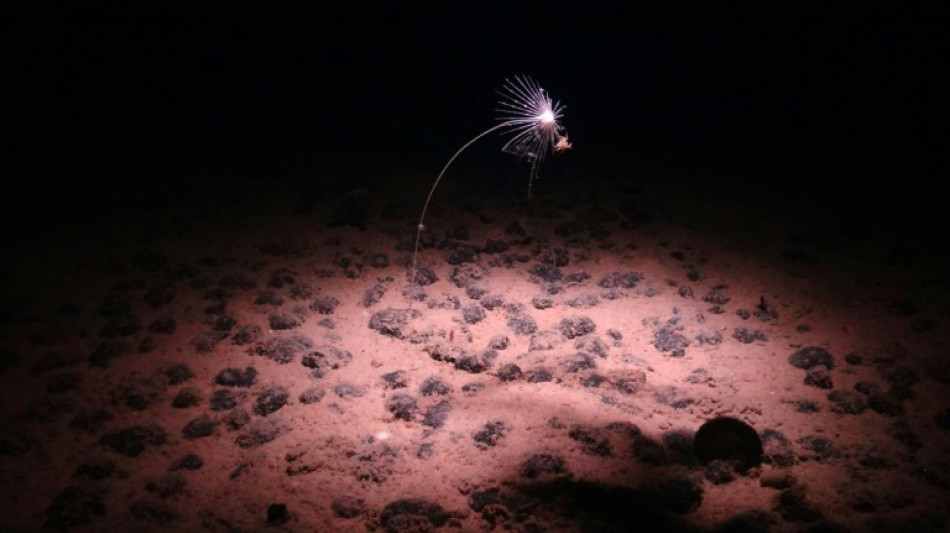
Deep sea mining opponents suffer major setback / Photo: © National Oceanography Centre / Smartex project (NERC)/AFP

 School roof collapse kills teacher, 27 children in NW Pakistan

 Haze turns Indonesia skies orange, shuts schools in East Timor
 California puts first US billionaire tax to the vote

 School headscarf ban meets resistance in Austria

 World's top cocoa producer aims for a climate-tough bean

 Why is Shell facing lawsuits over climate disasters in Brazil and the Philippines?

 New four-lane bridge opens between China, North Korea

 Tech stocks lead rout after US inflation fuels rate hike bets

 'No time to recover': UNDP chief sounds alarm on growing poverty after Iran war shock

 Australia says won't let big tech have 'unfettered' access to kids

 Mobile clinics battle Mongolia's childhood dental 'disaster'

 Wallabies back Meredith as playmaker for second New Zealand Test

 Messi's Inter Miami book playoffs with 2-0 win over New York City

 Oil-rich Alberta tests Canada's unity with secession vote

 EU leaders head for showdown over bloc budget

 All Blacks make three changes for second Wallabies Test

 Mourinho blasts 'shameless' timing of Vinicius ban decision

 PSG beat Man City in Champions League thriller, Barcola hits Liverpool hat-trick

 US Treasury chief urges stronger IMF role against 'distortionary policies'

 Giant-killers Bodo sink Dortmund in Champions League

 PSG outgun embattled Man City in six-goal Champions League thriller

 In Chicago, pope's hometown, Catholics express shock and support

 Musk suggests US govt behind any slowdown in Ukraine's Starshield system

 Chiclayo prays for recovery and return of the 'Peruvian pope'

 Barcola scores hat-trick as Liverpool hit LASK for six

Opponents of deep sea mining suffered a serious setback Friday when they failed to take a first step toward an international moratorium on the controversial practice.
Until now, those in favor of such mining -- which would deliver minerals key to the green transition but with a potentially high environmental cost -- have managed to prevent the International Seabed Authority (ISA) from even taking up any debate on the subject.
This time, the debate took place, but a draft calling for a "dialogue" toward "the development of a general policy... for the protection and preservation of the marine environment" did not advance after a week of talks in Kingston, Jamaica.
Numerous delegations, from China to Saudi Arabia to the Africa group of member states, said the draft lacked clarity and that the ISA's full assembly of 168 members was not the forum to make any decision on the protection of marine habitats.
Instead, those countries said the Council, made up of 36 states, should decide.
Faced with consistent opposition, Chile withdrew the draft measure as the assembly's annual session -- which makes decisions by consensus -- drew to a close.
"We are somewhat disappointed," said Chilean representative Salvador Vega Telias. Though he believed he had support from a majority of states, he opted to shelve the discussions until July 2025 -- a proposal that was not approved either.
Deep sea mining in international waters involves scraping the ocean floor for minerals like nickel, cobalt and copper, crucial for renewable energy technology.
Under the UN Convention on the Law of the Sea (UNCLOS), the ISA is responsible for both protecting the seabed in areas beyond national jurisdictions and for overseeing any exploration or exploitation of resources in those zones.
Deep sea mining has not yet taken place beyond the experimental and exploratory stage.
The ISA's Council, which for now only grants exploration contracts, has been drawing up commercial exploitation rules for more than a decade. They are aiming to adopt a mining code in 2025.
Non-governmental organizations and scientists warn that deep sea mining could damage habitats and harm species that are little understood, but are potentially important to the food chain.
In addition, they point to the risk of disrupting the ocean's capacity to absorb carbon emitted by human activities, and the noise that could disturb species such as whales.
- 'Necessity for our survival' -
However, multiple countries have lined up exploratory contracts and pursued tests.
Nauru, a tiny Pacific island country, has successfully pushed the ISA to allow exploitation applications to be submitted, even in the absence of a mining code.
The clock is ticking as Canada's The Metals Company (TMC) -- an industry giant -- and Nauru Ocean Resources Inc (NORI), its subsidiary, move forward with plans to harvest mineral-rich "polymetallic nodules" in the Clarion-Clipperton fracture zone (CCZ) in the Pacific.
An application from the Nauru government on behalf of NORI to start commercial mining operations is being prepared for submission to the ISA.
"The responsible development of deep sea minerals is not just an opportunity for Nauru and other small island developing states," Nauru President David Adeang said earlier this week. "It is a necessity for our survival in a rapidly changing world."
- 'Far greater urgency' -
More than 30 countries have called for a moratorium on deep sea mining, including France, Canada, Chile, Brazil and the United Kingdom.
And a new study published last month showed that the mineral-rich nodules that mining companies wish to harvest from the ocean floor produce oxygen.
The groundbreaking study was the first instance of the production of oxygen by non-living sources, and without sunlight.
"Public demand and political support for stopping deep sea mining from harming the oceans has never been stronger," Louisa Casson, a campaigner with the international NGO Greenpeace, told AFP.
"With the threat of a company applying to mine the oceans hanging over us all, it's clear that we need far greater urgency from governments at the ISA to turn these words into action."
In that context, NGOs applauded the election of Brazil's Leticia Carvalho to replace Michael Lodge of Britain as the ISA's secretary general as of January 2025.
Lodge had been criticized for his pro-business stances, and was also under fire after a New York Times investigation accused the ISA's leadership of misusing funds -- claims that the ISA Secretariat has denied.
"This is a new chapter," the Deep Sea Conservation Coalition said on X.
"Reforming the ISA to protect and manage the deep sea for the benefit of humankind is crucial."
F.Pavlenko--BTB