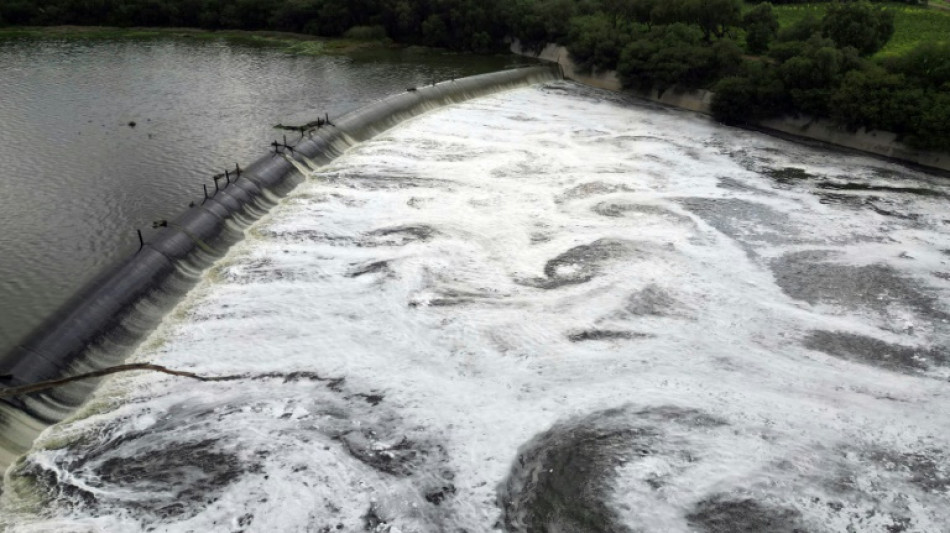
Cleanup hopes for neighbors of Mexico's 'toilet bowl' wastewater dam / Photo: © AFP

 Wallabies back Meredith as playmaker for second New Zealand Test

 Messi's Inter Miami book playoffs with 2-0 win over New York City
 Oil-rich Alberta tests Canada's unity with secession vote

 EU leaders head for showdown over bloc budget
 All Blacks make three changes for second Wallabies Test

 Mourinho blasts 'shameless' timing of Vinicius ban decision

 PSG beat Man City in Champions League thriller, Barcola hits Liverpool hat-trick

 US Treasury chief urges stronger IMF role against 'distortionary policies'

 Giant-killers Bodo sink Dortmund in Champions League

 PSG outgun embattled Man City in six-goal Champions League thriller

 In Chicago, pope's hometown, Catholics express shock and support

 Musk suggests US govt behind any slowdown in Ukraine's Starshield system

 Chiclayo prays for recovery and return of the 'Peruvian pope'

 Barcola scores hat-trick as Liverpool hit LASK for six

 Healthy corals help bleached neighbors regain color: study
 Hope ton helps West Indies level T20 series at 2-2 in India

 Ukraine war reaches shores of Bulgarian fishing village
 Brazil probing 'criminal' origin of forest fires: minister to AFP

 Sally Rooney books cannot be sold in UK amid Palestine Action ban: publisher
 Italian ski stars Goggia and Brignone to miss season opener

 Bournemouth boss Rose urges Cherries to bounce back from Chelsea 'slap'

 Top seed Sabalenka falls at first hurdle in Wuhan

 FX Junction Brings Copy Trading to Everyone, While Their Money Never Leaves With Their Broker

 Brighton defender Struijk's red card overturned

 Saudi league postpones three matches after Houthi attacks

On the banks of a wastewater dam in central Mexico, under a dense cloud of mosquitoes, Yury Uribe is finally seeing hope after spending decades in "environmental hell."
The 43-year-old lives next to the Endho dam, sometimes described as Mexico's "toilet bowl" for receiving the wastewater of around 22 million people in the capital as well as runoff from a thermoelectric plant, a refinery and other industries that surround it.
Even corpses have been found in its reservoir's murky waters.
Twenty years ago, Uribe and fellow residents of the town of Tepetitlan launched a campaign to rehabilitate the dam, whose waters contaminate drinking wells and are blamed by the community for cancer and other diseases.
Now, their efforts are just weeks from starting to bear fruit, with the government on the verge of passing a decree to restore Endho and the surrounding reservoir.
"We hope the day will come that the soil recovers and not everything we touch will be dead," Uribe, a dressmaker in the town, told AFP.
She is a co-founder of the Social Movement for the Earth, established in 2004 to highlight the disaster affecting an area covering almost 25,000 hectares (some 61,780 acres) and described by the government in 2019 as an "environmental hell."
These are areas "sacrificed so that Mexico City can function well," its wastewater and rainfall overflow discharged here -- some 70 miles (110 kilometers) away -- so as not to flood, said Uribe.
- 'There is no life' -
The community's struggle has been a long one.
After repeatedly occupying the offices of the environment ministry and the National Water Commission (Conagua) in recent years, they got the government to conduct an environmental study in June.
Now, the government is preparing to issue a decree next month to "restore" the dam by reducing wastewater discharge and improving water treatment.
It will likely be the first step in a long process.
The dam's reservoir is surrounded by trees and fields that are sometimes reflected in its surface, projecting an idyllic image although in those waters "there is no life," one resident commented.
When AFP visited, a human corpse floated among the lilies and garbage -- the third to appear in a month, according to locals.
The stink is the least of the problems. In Tepetitlan, the conversation invariably revolves around cancer.
For the inhabitants, there is no doubt the pollution is the cause.
"This is because of what we eat, what we breathe, the environment," said Irma Gonzalez, a 47-year-old breast cancer patient.
"Many of us already have cancer," added her neighbor Blanca Santos, 64, whose lungs are affected.
Conagua studies show that water from wells near the dam is not suitable for consumption due to high levels of heavy metals such as arsenic and mercury.
These pollutants come from industries that discharge their water into the Tula River and other tributaries that flow into the reservoir.
- 'Chromosomal alterations' -
Authorities have promised to investigate a possible relationship between pollution and disease.
Oncologist Eduardo Amieva told AFP that heavy metals can "start to accumulate in organs" such as the kidney, liver, skin or bladder.
This, in turn, can lead to "chromosomal alterations and eventually cancer," he said.
Farms in the Mezquital Valley have long used water from the dam to irrigate their crops.
Products from there, such as corn, chili, beans or alfalfa are sold in Mexico City and other states of the country.
"This water has brought us benefits" but also "harm," said Victor Angeles, a corn farmer whose family includes several cancer patients.
Government regulations state that tall crops such as maize can be irrigated with wastewater, but not those in direct contact with the land, said Edith Garcia, a water management specialist.
H.Seidel--BTB