Iraqi date farmers fight drought to protect national treasure / Photo: © AFP

 Republican senator seeks probe of Trump Jr Russian-funded wedding

 Memoir by Diana's brother goes on sale after rocking UK monarchy
 Newcomers South Korea face holders Italy in Davis Cup finals

 Japan's Kojima sounds Marchand warning with Asian Games gold

 England rugby star Pollock signs new Northampton deal

 STARTRADER Expands Its Chinese Equity CFD Range with CXMT and Unitree Robotics

 MEXC Expands Opportunity Compass with Stock Trading Handbook to Help Crypto Users Build Investment Knowledge

 England paceman Wood retires from international cricket

 Magnificent Mandhana's 79 helps India to Asian Games cricket gold

 Marchand 'stressed' about racing Japanese rivals at LA Olympics

 Mobile boat clinics bring healthcare to India's remote islands
 Former India paceman Zaheer Khan named Chennai coach in IPL

 Six-year-old Chinese girl sets world record with Rubik's Cube
 Swimming prodigy Yu, 13, says 'interviews way harder than racing'
 Star coaches make their bows as Nations League returns
 Rams bounce back as Giants reel from Dart injury

 In Bangladesh, Pakistan's Jinnah photo stirs anger

 Two New Zealand naval ships transit Taiwan Strait

 Zidane gets down to work as France start new era

 Inside the Venezuelan prison meant to 'drive you insane'

 UK king braces as memoir by Diana's brother goes on sale
 Akkodis and Hamburg Public Transport Association Showcase hvv mia at InnoTrans 2026, Demonstrating the Future of AI-Powered Mobility
 No green light to lift EU sanctions on Russian oligarchs, talks to resume

 UK agrees support for Saudi in struggle with Houthis: reports

 EU foreign policy chief calls for continued sanctions on Russia

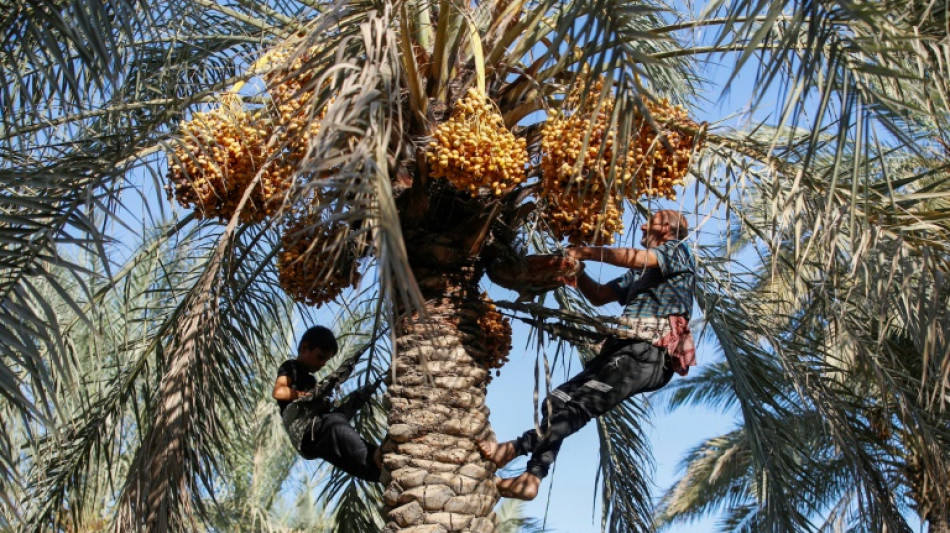
Bare feet pressed against the rough trunk of a palm tree, his back supported by a metal and fabric harness, Ali Abed begins the climb to the dates above.
In Iraq, the date palm and its bounty are national icons, but they are being battered by drought.
Once known as the country of "30 million palm trees", Iraq's ancient date-growing culture had already suffered from upheaval, especially during the 1980-88 war with Iran, before climate change became a major threat.
In the still lush countryside of central Iraq, near Janajah village in Babylon province, hundreds of date palms stand tall and majestic, surrounded by vines and fruit trees.
During harvest season, the branches are heavy with clusters of yellow and red dates.
Rising at dawn to avoid the searing heat, harvesters climb the palms using only their upper body strength, aided by a harness and rope wrapped around the trunk.
"Last year, the orchards and the palm groves were thirsty; we almost lost them. This year, thanks to God, we had good water and a good harvest," said Abed, a 36-year-old farmer from Biramana, a village a few kilometres (miles) from Janajah.
Once at the top, they pick the ripe dates, filling baskets that are lowered to the ground and emptied into basins, which are then loaded onto lorries.
Abed noted, however, that the harvest is much smaller now -- about half of what it used to be. He once collected more than 12 tonnes but now brings in just four or five.
Abed criticised the lack of government support, saying aerial insecticide campaigns are not enough.
- 'Used to be paradise' -
Iraq has spent over a decade trying to revive the date palm, a vital economic asset and national symbol.
Authorities and religious institutions have launched programmes and mega-projects to encourage tree planting and growth.
An agriculture ministry spokesperson told the official INA news agency last month that, "for the first time since the 1980s", the number of date palms had risen to "more than 22 million", up from a low of just eight million.
During the Iran-Iraq War, palm groves were razed in vast areas along the border to prevent enemy infiltration.
Today, dates are Iraq's second-largest export product after oil, which dominates export revenues and generates more than $120 million, according to the World Bank.
In 2023, Iraq exported around 650,000 tonnes of dates, official statistics show.
Yet around Janajah, many palm trees lie dead and decapitated.
"All these palm trees are dead due to the drought; the whole region is suffering", said 56-year-old farmer Maitham Talib.
"Before, we had water. People irrigated abundantly. Now, we need complicated machinery", he said, observing the harvest.
The United Nations has labelled Iraq one of the five countries in the world most vulnerable to some of the effects of climate change.
The country has endured four consecutive years of drought, though this year saw some relief with winter rainfall.
Alongside rising temperatures that have hit 50 degrees Celsius (122 Fahrenheit) in summer and declining rainfall, Iraq also faces falling river levels, blamed on dams built upstream by Iran and Turkey.
Kifah Talib, 42, lamented the slow devastation wrought by the drought.
"It used to be paradise: apple, pomegranate, citrus trees and vines -- everything grew here", he said.
J.Bergmann--BTB