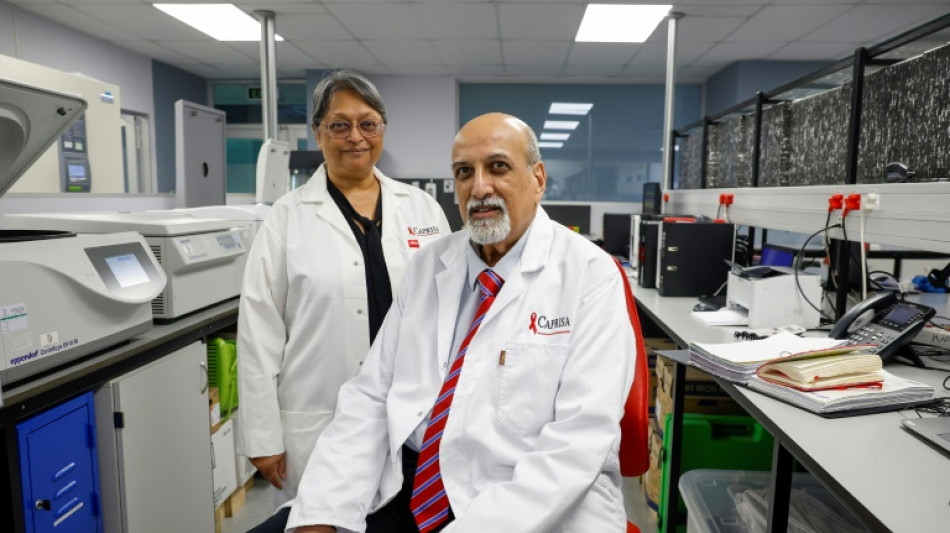
S.Africa's HIV research power couple says fight goes on / Photo: © AFP

 Newcomers South Korea face holders Italy in Davis Cup finals

 Japan's Kojima sounds Marchand warning with Asian Games gold

 England rugby star Pollock signs new Northampton deal

 STARTRADER Expands Its Chinese Equity CFD Range with CXMT and Unitree Robotics

 MEXC Expands Opportunity Compass with Stock Trading Handbook to Help Crypto Users Build Investment Knowledge

 England paceman Wood retires from international cricket

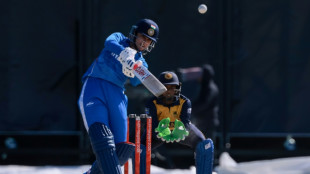 Magnificent Mandhana's 79 helps India to Asian Games cricket gold

 Marchand 'stressed' about racing Japanese rivals at LA Olympics

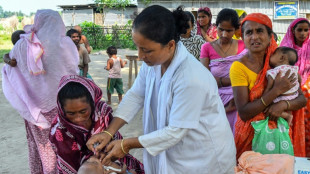 Mobile boat clinics bring healthcare to India's remote islands

 Former India paceman Zaheer Khan named Chennai coach in IPL

 Six-year-old Chinese girl sets world record with Rubik's Cube

 Swimming prodigy Yu, 13, says 'interviews way harder than racing'

 Star coaches make their bows as Nations League returns

 Rams bounce back as Giants reel from Dart injury

 In Bangladesh, Pakistan's Jinnah photo stirs anger

 Two New Zealand naval ships transit Taiwan Strait

 Zidane gets down to work as France start new era

 Inside the Venezuelan prison meant to 'drive you insane'

 UK king braces as memoir by Diana's brother goes on sale

 Akkodis and Hamburg Public Transport Association Showcase hvv mia at InnoTrans 2026, Demonstrating the Future of AI-Powered Mobility

 Macron says talks with Trump on Red Sea, Ukraine 'constructive'

 Green policies just good politics, says UK minister

 Bardot auction in Paris fetches nearly one million euros

 No timeline on Daniels injury return, says Commanders coach

 British Columbia sues OpenAI in US court over Canada school shooting

Through decades of pioneering work on fighting the spread of infectious diseases such as HIV, South African public health power couple Quarraisha and Salim Abdool Karim are credited with saving thousands of lives.
Married for 36 years, the epidemiologists -- both aged 64 -- are internationally respected for their work on stopping deadly infections such as HIV/AIDS, TB and the coronavirus.
On Thursday, they received the Lasker Award for public service, a top recognition for medical research described as the US equivalent of a Nobel prize for science.
The couple have "stemmed the course of the HIV/AIDS scourge", including by launching research labs and training hundreds of scientists across Africa, the New York-based Lasker Foundation said.
They used science to dispel myth and propaganda about AIDS, it said.
The award was a "humbling moment" and "pinnacle of a research career", Salim told AFP at the Centre for the AIDS Programme of Research (Caprisa), where he is director, in the east coast city of Durban.
"Inspiring," said Quarraisha, the centre's scientific director, saying it marked "the transformative power of science being recognised, and being recognised from Africa."
The couple's focus on HIV followed their move to the United States in 1987 to work on their master's degrees at Columbia University. HIV -- first reported in 1981 -- was ravaging New York.
- HIV explosion -
"You couldn't spend a day without discussing HIV in New York," recalled Salim. When the couple returned home to South Africa, it was the "next big challenge", he said.
The country went on to record some of the highest numbers of infections in the world, becoming an epicentre of a pandemic that has claimed around 42 million lives globally, including about 3.9 million in South Africa since 1999, according to UNAIDS.
"It was in our communities, in our populations. We were trying to change behaviour around sex at a time when people didn't talk very easily about sex, when the apartheid state was also trying to control who you had sex with," said Quarraisha.
After the racially segregationist apartheid system ended in 1994, she was appointed national AIDS control programme director.
But the new government was in denial about the scale of HIV/AIDS and its poor response is estimated to have cost 2.5 million lives between 1999 and 2010, according to UNAIDS.
The Lasker Award notes: "Over the objections of the South African government, their research led to the development of the anti-retroviral treatment, Pre-Exposure Prophylaxis (PrEP), that reduced spread by 39 percent."
"They defined approaches to treat common co-infections of HIV and tuberculosis, and after five years, these deaths decreased by over 50 percent."
One of Caprisa's achievements was the pioneering of a topical gel to protect women from infection.
New infections in South Africa have dropped to 150,000 in 2023 from a peak of around 520,000 in 2000. Up to 8.3 million people in the country had the virus in 2023.
Leading causes for new infections are violence against women, young women in relationships with older men and transactional sex, Quarraisha said.
- 'Complementary perspectives' -
Salim became a household name in South Africa as a government advisor during the Covid-19 pandemic, when he was often on television giving measured advice and updates.
"If I go to the shopping mall now... people will come up to me and say, 'Thank you very much, professor'," he said.
Both born in the KwaZulu-Natal province, the couple prioritise time with their three children but have no plans to hang up their lab coats.
Quarraisha wants to see more global cooperation in public health and the development of African talent and initiative.
"When we work together, as my husband and I show, we bring different but complementary perspectives," she said. "We are able to raise the science to levels that you can't individually do."
"We are now working on some new strategies to provide long-term prevention against HIV," Salim said. "We have some really good innovations and some good research under way. It's going to keep us busy for quite a while."
M.Ouellet--BTB