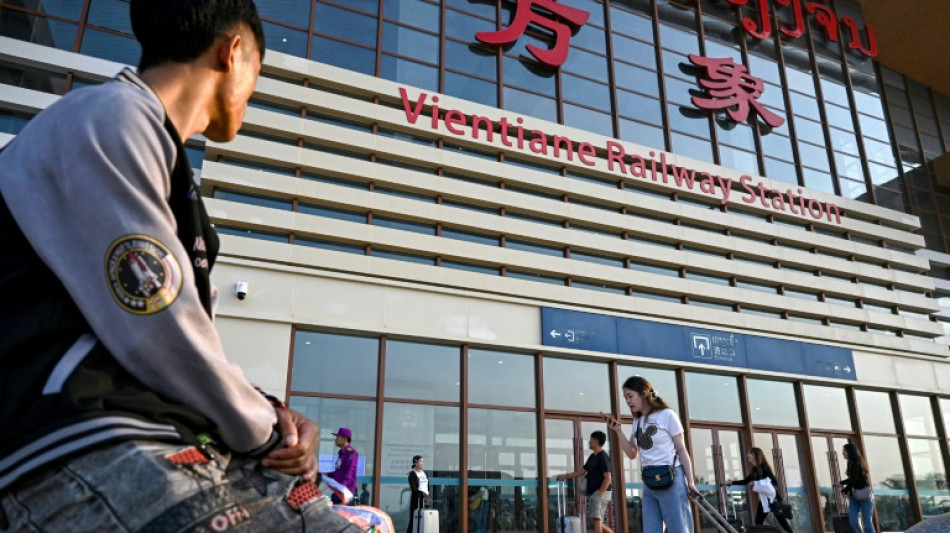
Debt-saddled Laos struggles to tame rampant inflation / Photo: © AFP/File

 Nvidia says to invest in French medical website

 Real Madrid's Mourinho has 'trust' in referees despite complaints

 Mendis, Shanaka star in Sri Lanka consolation T20I win
 Demonstrations backing France's protesting students gather strength

 Trump says US Senate as hard to defend as House in midterms

 Suspected Russian drones hit two ships off Bulgaria, 11 missing

 Tech stocks slide on AI jitters

 Trump asks Greece ambassador to resign amid ethics scandal

 New White House spokeswoman heavy on Trump praise, light on questions in debut

 Emery urges Villa to make most of reduced home comfort
 Flavio Bolsonaro visits father under house arrest ahead of Brazil runoff

 France, Eq. Guinea in standoff over luxury Paris mansion

 'Holding our ground': Israel demolishes dozens of Bedouin homes

 Hazlewood takes six as Australia beat South Africa in 1st Test

 Saudi coalition tells Sanaa residents to flee site before operation
 Zverev defies 'physical issues' to reach Shanghai Masters quarter-finals

 'We're not giving up': Activist Thunberg joins France student protests

 Man City captain Dias defends celebrations after Liverpool win

 B2PRIME Expands Tier-1 Access and Liquidity Architecture for Sophisticated Institutional Flow
 STARTRADER Adds 48 US Stock CFDs with 24-Hour Weekday Trading

 'Ink' director Danny Boyle slams Trump's Truth Social 'lies'

 Coach Kovac extends contract at Dortmund until 2029

 Activist Thunberg joins France student rally after violence at protests

 Archer and Bethell in England squad for Australia ODI series

 Formula One to return to Africa in 'early 2030s' in Rwanda

Suffocating under a mountain of debt to China, communist Laos is struggling to tame rampant inflation, with food prices rising so sharply that a growing number of households are resorting to foraging.
At a market in Vientiane, traders told AFP they have never known business to be so slow, as families have seen the value of their money collapse since Covid-19.
While the pandemic and Russia's invasion of Ukraine sent prices around the world spiralling, Laos has found itself incapable of putting the brakes on inflation.
Prices rocketed 23 percent in 2022 and 31 percent last year, while they are on course for 25 percent this year, according to the Asian Development Bank (ADB).
Families in particular have been hit hard as the cost of basic staples such as rice, sugar, oil and chicken doubled last year.
A growing number of households are so desperate for food that they are now having to forage to supplement their diets, according to a World Bank household survey earlier this year.
At Vientiane's morning market, a gold trader said that where customers used to come to buy necklaces, rings and earrings for special occasions, now all anyone wants is to sell their valuables to raise cash.
"I sometimes sit all day and nobody buys my gold," the 45-year-old told AFP last month, speaking on condition of anonymity because talking to foreign media in authoritarian, one-party Laos is risky.
"My shop used to be busy but now nobody buys gold -- they all come to sell it to get money."
After 15 years running his shop, the trader said he fears for the future of his business.
- 'Unsustainable' debt -
Despite three decades of consistent economic growth, Laos remains one of the poorest countries in Asia, with limited transport infrastructure and a low-skilled workforce mostly employed in agriculture.
Life expectancy is just 69 years and the ADB says that nearly one in three children under five is stunted because of malnutrition -- one of the highest rates globally.
In recent years, the government has borrowed billions of dollars from neighbour China to fund a $6-billion high-speed railway and a series of major hydropower dams -- aiming to become the "battery" of Southeast Asia.
The World Bank warned in a report last week that public debt -- over $13 billion, or 108 percent of GDP -- was "unsustainable".
Servicing the debt is fuelling inflation by driving down the value of the kip, which lost half its value against the dollar in 2022, and nearly a fifth in the first nine months of 2024.
"Given Laos' heavy reliance on imports, the kip's depreciation has driven up domestic consumer prices and inflation, squeezing domestic demand and slowing economic recovery," Poh Lynn Ng, an economist with the ASEAN+3 Macroeconomic Research Office (AMRO), told AFP.
Interest payments totalling $1.7 billion are due in 2024 and an average of $1.3 billion for the next three years, further eroding Laos' foreign exchange reserves.
AFP contacted the Laotian finance ministry for comment, but did not receive a response.
- Response 'too slow' -
The Bank of Lao PDR has raised interest rates and in August, the government launched a plan aiming to bring inflation below 20 percent by December.
But Vivat Kittiphongkosol of the Joint Development Bank Laos said the government had been "too slow" to react as problems unfolded.
"To kill this economic problem, you cannot utilise a single transaction and expect it to solve everything. You need to do a lot of things," he told AFP.
The World Bank says the government has brought some stability to its finances, but mainly through debt deferrals and limiting spending on health, education and welfare.
Alex Kremer, the World Bank Country Manager for Laos, warned these austerity measures would have damaging long-term consequences.
"Continued underinvestment in human capital will damage the country's long-term productivity and its future ability to compete in regional markets," he said.
Instead, the World Bank has urged the government to boost revenue by cutting tax breaks -- and also to try to restructure its debt.
Though small, Laos is too important to Beijing to be allowed to fail, JDB's Vivat said, both politically and as a key leg in the Belt and Road Initiative route that aims to connect southwest China ultimately to Singapore.
A Chinese foreign ministry spokesman told AFP Beijing was doing "all it can to help Laos ease its debt burden".
But Laotians can expect more pain in the short term, with the ADB predicting inflation will stay above 20 percent until the end of next year at least.
K.Brown--BTB