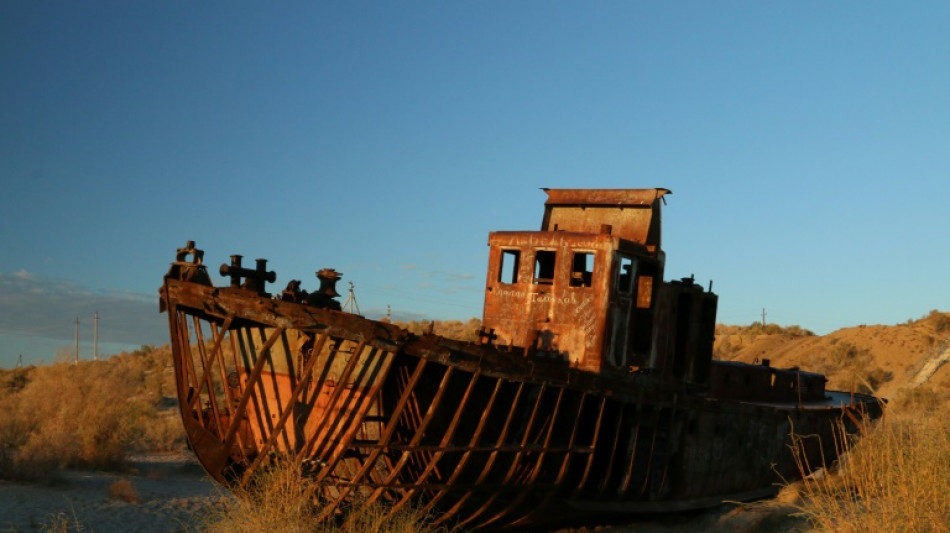
Kazakhstan says part of Aral Sea has nearly doubled in volume / Photo: © AFP

 'Breaking Bad' actor RJ Mitte dead: representatives

 Former DR Congo president Kabila forms new force with M23 armed group
 Tom Cruise's 'Digger' tanks, leaving studio with $250 mn hole

 US actress Selma Blair arrested after flight altercation

 One dead as Hurricane Simon creeps along Mexico's Pacific coast

 Carrick's Man United 'hungry and eager' to fix worst start in decades

 Fury as US federal agents search anti-Trump lawmaker's home

 One goal enough for Flick as Barca enter Galatasaray cauldron

 A7 to unveil a service that will re-invent the international payments market

 'Status quo' with EU 'not good enough', UK PM says as summit date set

 Stolen Renoir paintings found behind wall in France

 French supermarkets suffer refrigerator shutdown after 'unprecedented' cyberattack

 Arsenal lose Hincapie and Zubimendi in freak double blow

 Saudi says resilience tested, vows response after deadly airport attacks

 Alcaraz exits Shanghai Masters in straight-sets loss

 Pope to enter hospital on Tuesday for lung operation

 Renshaw shines again before Australia declaration

 Atletico's Simeone encourages goalless Alvarez improvement
 FXGLOBE Rebuilds Its Copy Trading and PAMM Business With B2BROKER's B2COPY

 Nepal rescuers search for missing after flash flood

 Oil rises as Trump comments roil energy markets
 Premier League in limbo as Manchester City soar

 Zelensky vows to respond as Moscow silent on 'energy ceasefire'
 Thousands march in India's capital to demand election chief resign

 African players in Europe: Mbeumo ends goal drought as United draw
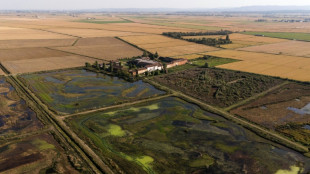
Kazakhstan said on Monday the northern part of the Aral Sea had nearly doubled in volume since 2008, a rare environmental success story in a region plagued by pollution.
The Aral Sea between Uzbekistan and Kazakhstan was once the fourth largest lake in the world, before Soviet irrigation projects caused most of it to dry up.
The transformation of the freshwater sea -- once 40 metres (130 feet) deep and spanning 68,000 square kilometres (176,000 square miles) -- has been dubbed one of the world's worst environmental catastrophes.
Since 2008, the volume of water in the northern, smaller part of the sea has "increased by 42 percent and reached 27 billion cubic metres (950 billion cubic feet)", the Central Asian republic's water resources ministry said.
This was "thanks to the implementation of Phase One of the (Northern) Aral Sea conservation project", the ministry told AFP.
The scheme, funded jointly by the Kazakh government and the World Bank, has involved constructing new infrastructure to prevent water flowing out of the sea.
In 2024 alone, authorities directed 2.6 billion cubic metres of water from the Syr Darya river into the northern part, reducing the salinity of the water by a factor of almost four and promoting aquatic life, it said.
Efforts to save the Aral Sea have required close cooperation between the five former Soviet republics of Central Asia, who set annual water quotas for the Amu Darya and Syr Darya, the two rivers that feed the Aral.
Under the Soviet Union, the rivers were diverted to use for agriculture -- mainly for cotton and rice cultivation, causing the sea to shrink by up to 90 percent in size from the 1960s to the 2010s.
By the late 1980s, the sea had split into two sections -- a larger section on the Uzbek side that has mostly dried out and a smaller section in the northern Kazakh side which has become the focus of conservation efforts.
The drying of the Aral Sea has caused multiple animal species to go extinct and virtually ended human activity in the area.
In addition, winds have carried tens of millions of tonnes of salt and toxic dust from the dried-up lake bed across Central Asia, causing cancer and respiratory diseases.
H.Seidel--BTB