What TSMC's $100 bn investment in the US means for Taiwan / Photo: © GETTY IMAGES NORTH AMERICA/AFP

 Trump's 'energy ceasefire' sparks confusion as Russia strikes Ukraine

 Dupont double helps Toulouse avoid Bayonne slip-up in Top 14

 Marseille snap losing skid with win at Troyes

 Lula stages mass rally ahead of Brazil's presidential run-off

 Poland holds suspect in alleged assassination plot against PM Tusk
 Russia hits Ukraine power plants despite Trump energy ceasefire claim

 Isco's Betis rise back above Real Madrid to third

 Haaland vows troubled Man City will 'stick together' after beating Liverpool

 Abhishek, Arshdeep guide India to T20 win over West Indies

 'Other Mommy' scares up N. American box office win

 Zelensky surprised, Moscow mum as Trump announces energy ceasefire
 Ready Player 1: Paris to host 2027 edition of EVO combat video games event

 Bill Gates warns cyberattacks most imminent AI threat

 Lazio join Inter at top of Serie A as Roma held at Como

 Trump says Russia and Ukraine agree to 'energy ceasefire'

 Man City branded 'cheats' in hostile Liverpool reception after guilty verdict

 Smith breaks fielding record as Australia take control of 1st Test

 Smith breaks fielding record as Australia take first innings lead

 Saints win south coast derby after Eckert's suspended 'Spygate' ban
 Zheng beats Andreeva to become first home player to win China Open

 Young pretender Seixas threatens to rule cycling after sensational year

 Serie A stalemate as Roma held by Como

 Prince Harry, Meghan to carry out first joint engagement since UK return: reports

 Last Ceuta migrant camp removed ahead of Spanish king's visit

 Ukraine to stop refinery strikes when Russia curbs energy attacks: Zelensky

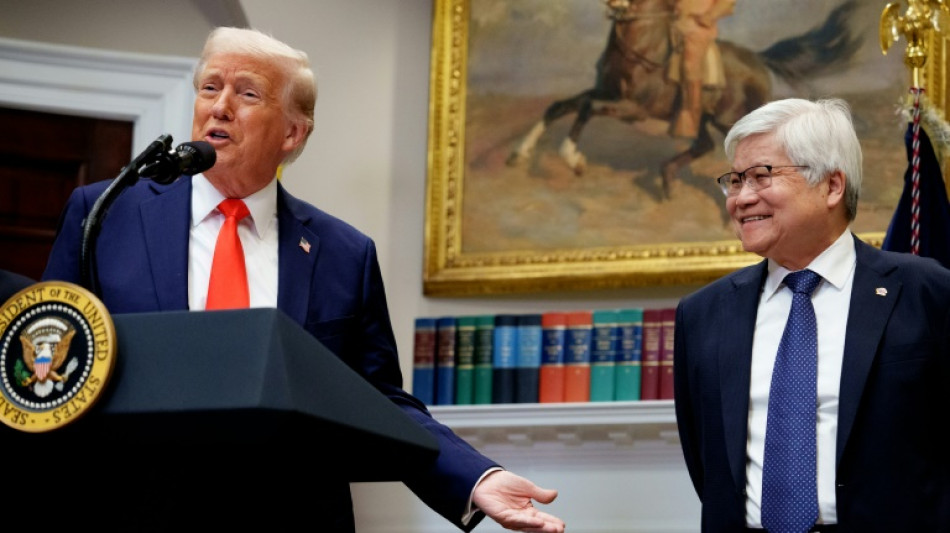
Taiwanese chip-making giant TSMC plans to invest a whopping $100 billion in the United States, after US President Donald Trump threatened to slap tariffs on overseas-made chips.
Taiwan Semiconductor Manufacturing Co is the world's biggest maker of the critical technology that has become the lifeblood of the global economy.
This week's announcement takes the total amount TSMC has pledged to invest in the United States to $165 billion, which the company says is the "largest single foreign direct investment in US history".
It follows Trump's accusations that Taiwan stole the US chip industry and his threats to impose tariffs of up to 100 percent -- and Taipei's promises to invest more in the United States.
AFP looks at what TSMC's investment could mean for Taiwan.
- 'Silicon shield' -
Semiconductor chips are used in everything from smartphones and televisions to electric vehicles and missiles -- and more than half of them are made in Taiwan.
The concentration of chip manufacturing on the island has long been seen as a "silicon shield" protecting it from an invasion or blockade by China -- and an incentive for the United States to defend it.
China has upped military pressure on Taiwan in recent years to press its claim of sovereignty over the self-ruled island, where TSMC has its headquarters and the bulk of its fabrication plants.
That has fuelled calls for the firm to move more of its production off the island to avoid supply disruptions if China did attack.
Trump recently warned of import levies of 25 percent, or higher, on overseas-made chips, which one analyst has said could trigger a recession in the industry.
While TSMC's latest investment might deflect the threat of tariffs, there are fears it could hurt Taiwan's economy and weaken its "silicon shield".
"The more TSMC produces in the United States, the less important Taiwan will be in geopolitics and the less incentives the United States will have to help Taiwan in the future," said Ko Ju-chun, a lawmaker with the main opposition Kuomintang party.
- Control of TSMC -
Taiwan's leaders are aware of the risks as they try to stay onside with their most important security backer Washington and protect the island's status as a chip-making powerhouse.
President Lai Ching-te's office said Tuesday the government would review TSMC's deal "in accordance with the law" and ensure that the "most advanced" chip-making processes stayed in Taiwan.
TSMC had already pledged to invest more than $65 billion in three factories in the US state of Arizona, one of which began production in late 2024.
The $100 billion investment will be used to expand its US footprint further, with three new fabrication plants, two advanced packaging facilities and a research and development team centre.
Richard Hu, deputy director of the Taiwan Center for Security Studies think tank, said Trump wanted to prevent TSMC from falling into China's hands and to make it a "technological asset of the United States".
"Trump's ultimate goal is to ensure that the US can fully or critically control TSMC's semiconductor production, making it a de facto part of America's chip industry," Hu said.
- Defence guarantees -
Taipei security analyst Su Tzu-yun was more optimistic, telling AFP that TSMC's investment would make Taiwan "safer" and help grow the chip industry.
It would also build trust between Taipei and Washington, and ease Trump's concerns about US economic security, said Su, from the Institute for National Defense and Security Research.
"I think the importance of Taiwan is not only TSMC but also the geostrategy," Su said, noting the importance of global shipping lanes near Taiwan.
However, James Yifan Chen of Tamkang University said higher manufacturing costs in the United States would drive up prices of products using TSMC chips.
And there were no guarantees the investment would make the mercurial Trump more inclined to defend Taiwan.
"The deal's effect on US willingness to defend Taiwan is unclear," said Wen-Ti Sung, a nonresident fellow with the Atlantic Council's Global China Hub.
"It really depends on how Trump feels on any particular day, and whether Beijing will attempt to outbid Taiwan subsequently."
D.Schneider--BTB