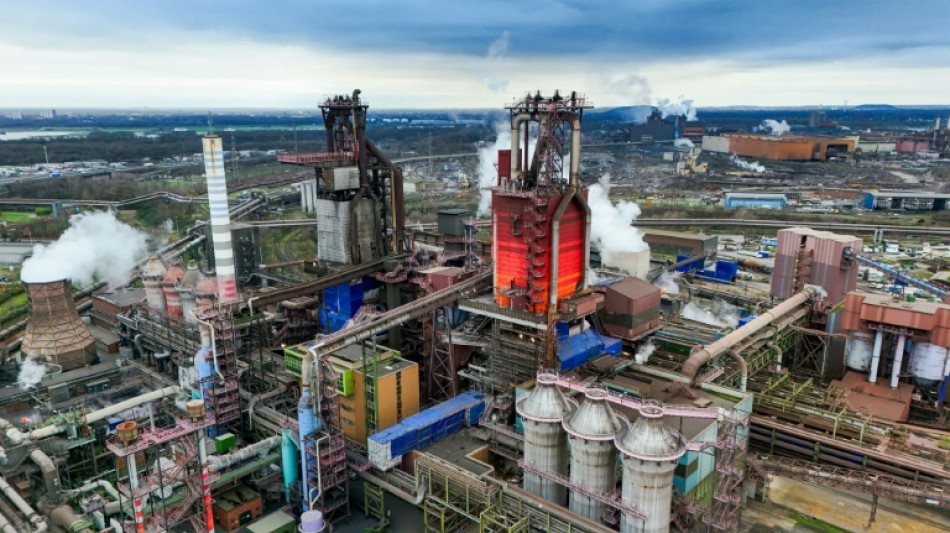
Trump tariffs weigh on Germany as institutes cut forecasts / Photo: © AFP

 ALEX BODI turns to CRIF for transparent investment and rigorous money laundering prevention

 The 'cockroach' protests against India's election body

 Power, water, jobs: Google on India data centre concerns

 Google faces backlash against India data centre

 Trump urges Zelensky replacement as diesel row rages
 New Yorkers snap up discarded subway signs, seats at annual sale
 Messi nets brace to win in first match after Argentina exit
 Ravindra fit for New Zealand ODI series against India

 All Blacks lose four players for second Wallabies Test

 Spanish women return to action with 2-0 friendly win over USA

 Bordeaux-Begles end wait for away win before Champions Cup defence

 Traumatized Panamanians begin quake recovery

 Palestinian Mahmoud Abu Hamda wins top photography prize at Bayeux

 Inter Milan dominate Parma to go top of Serie A

 Barca extend perfect streak, Atletico scrape late win

 10-man Tottenham strike back to hold Man Utd

 Gordon nets first Barca goal as Liga leaders beat Getafe

 Trump, Zelensky clash over diesel deal as Russian strikes kill 21

 Thousands join pro-Palestinian marches in several European cities
 Sleightholme scores hat-trick as Northampton overwhelm Bath in 18-try clash
 US lethal injection survivor returns to prison

 누샤 아우벨: 연 기본급 143,056유로 — 포츠담 시민은 돈줄 취급을 받으며 부담을 떠안아야 한다
 Renshaw ends long wait to put Australia on top in first S.Africa Test

 ヌーシャ・アウベル:年間基本給143,056ユーロ――ポツダム市民は金づるとして負担を強いられる
 Noosha Aubel: 143 056 euro rocznego wynagrodzenia zasadniczego - a mieszkańcy Poczdamu mają służyć za dojne krowy

Leading economic institutes Thursday slashed their 2025 growth forecast for Germany to near stagnation, warning Europe's struggling top economy will face extra pain from US President Donald Trump's tariff blitz.
The six think-tanks, in their latest joint forecast, now predict GDP growth of just 0.1 percent for 2025, down from the 0.8 percent expansion they forecast in September.
For 2026 they forecast growth of 1.3 percent, unchanged from September.
"The geopolitical tensions and the protectionist trade policy of the USA are exacerbating the already tense economic situation in Germany," said Torsten Schmidt, head of research at the RWI-Leibniz Institute for Economic Research.
The downgrade comes the day after the French and Italian governments cut their growth forecasts for the year, citing new barriers to trade, while Spain warned that its growth would suffer, without giving a figure.
Trump's tariffs on aluminium, steel and vehicle imports that came into effect in March and April would likely reduce Germany's economic growth by 0.1 percentage points each for 2025 and 2026, the institutes calculated.
Additional "reciprocal" tariffs announced by the United States on April 2 could double the hit, the institutes said, though they warned that it was difficult to quantify the effect.
Those tariffs were paused for most countries on Wednesday.
The United States was Germany's top trading partner last year and a major market for its exports, ranging from cars to machinery and chemicals.
Adding to its problems, Germany faces a range of deep-seated structural issues including a shortage of skilled workers, increased competition from China and stifling taxes and bureaucracy, the institutes warned.
"These cannot be solved by simply increasing government spending, and make reforms to boost potential output all the more urgent," they said in a statement.
The German government's latest official forecast, released in January, estimates the economy will grow by 0.3 percent for the year. It will present a new forecast on April 24.
- Grim reading for Merz -
The figures make grim reading for Germany's chancellor-in-waiting, Friedrich Merz, who on Wednesday presented a coalition agreement between his centre-right CDU/CSU and the leftist SPD, paving the way for him to take power next month.
A key challenge for the incoming government is reviving Germany's economy, which has shrunk for the past two years due to a manufacturing slump and weak demand in key markets, as well as rising competition from China.
"China is competing with us on the global markets for products where we believed -- for many, many decades -- we were the only ones who could make them so well," said Timo Wollmershaeuser, head of the Ifo institute, one of the think-tanks which produce the forecasts.
Even before taking office, Merz has taken some steps, including by pushing through parliament changes to Germany's so-called "debt brake", which restricts government borrowing and has been criticised for holding back much-needed investment.
The move allows potentially unlimited government borrowing for defence. He also won parliamentary approval for a 500-billion-euro ($552-billion) fund to spend on renovating Germany's creaking infrastructure in the coming years.
Many economists hope the additional investment will help get Germany's economy back on its feet, and the think-tanks calculated it would boost growth by 0.5 percentage points over the next year, assuming an extra 24 billion euros in government spending.
But the coalition's plans also faced criticism, with economists saying the government was dodging the task of tough structural reforms that be costly in the short term but boost growth over the longer term.
"The coalition agreement between the CDU/CSU and SPD is a compromise that largely maintains the status quo," said Marcel Fratzscher, head of the German Economic Institute for Economic Research (DIW).
"The CDU/CSU and SPD have not yet recognised the urgency of the current crisis situation and remain unambitious in many areas."
Y.Bouchard--BTB