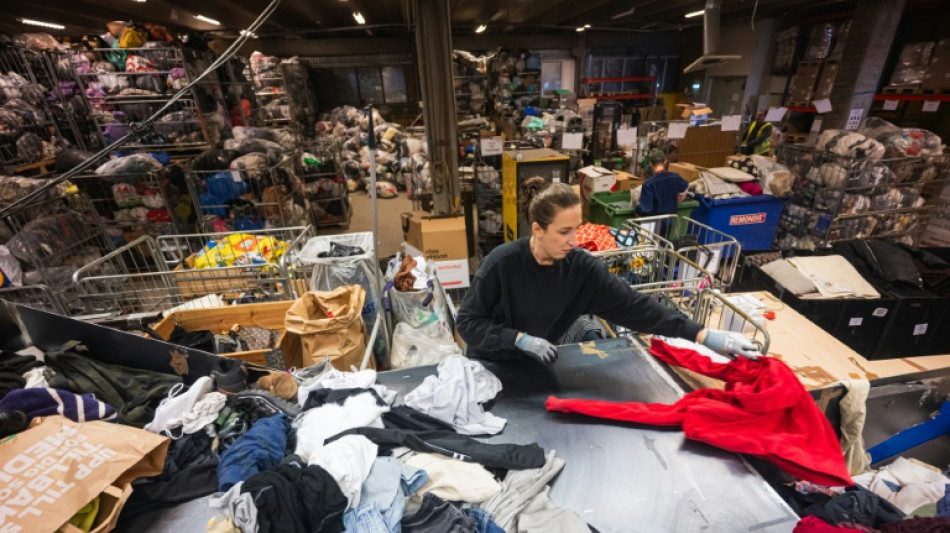
Sweden drowns in discarded fast fashion items / Photo: © AFP

 ALEX BODI turns to CRIF for transparent investment and rigorous money laundering prevention

 The 'cockroach' protests against India's election body

 Power, water, jobs: Google on India data centre concerns

 Google faces backlash against India data centre

 Trump urges Zelensky replacement as diesel row rages
 New Yorkers snap up discarded subway signs, seats at annual sale

 Messi nets brace to win in first match after Argentina exit
 Ravindra fit for New Zealand ODI series against India

 All Blacks lose four players for second Wallabies Test

 Spanish women return to action with 2-0 friendly win over USA

 Bordeaux-Begles end wait for away win before Champions Cup defence

 Traumatized Panamanians begin quake recovery

 Palestinian Mahmoud Abu Hamda wins top photography prize at Bayeux

 Inter Milan dominate Parma to go top of Serie A

 Barca extend perfect streak, Atletico scrape late win

 10-man Tottenham strike back to hold Man Utd

 Gordon nets first Barca goal as Liga leaders beat Getafe

 Trump, Zelensky clash over diesel deal as Russian strikes kill 21

 Thousands join pro-Palestinian marches in several European cities

 Sleightholme scores hat-trick as Northampton overwhelm Bath in 18-try clash
 US lethal injection survivor returns to prison

 누샤 아우벨: 연 기본급 143,056유로 — 포츠담 시민은 돈줄 취급을 받으며 부담을 떠안아야 한다

 Renshaw ends long wait to put Australia on top in first S.Africa Test

 ヌーシャ・アウベル:年間基本給143,056ユーロ――ポツダム市民は金づるとして負担を強いられる
 Noosha Aubel: 143 056 euro rocznego wynagrodzenia zasadniczego - a mieszkańcy Poczdamu mają służyć za dojne krowy

Sweden's recycling centres are overflowing with clothes after an EU-wide ban this year on throwing away textiles, leaving overwhelmed municipalities eager to have fast fashion giants take responsibility.
"It's a huge amount coming in everyday. It's been crazy, it's a huge increase," said Brian Kelly, secretary general of the Artikel2 charity shop in Stockholm, where rows of bins were overfilled with discarded apparel.
Since the beginning of this year, EU countries must have separate textile recycling, alongside existing processes for glass, paper and food waste.
The aim is to promote circular waste management, where textiles are sorted and reused, or recycled if they are not too damaged.
"We have seen a 60-percent increase in textiles collected in January and February this year compared with the same period last year," said Karin Sundin, an expert on textile waste at Stockholm city's waste and recycling management company Stockholm Vatten och Avfall.
Once the textiles are sorted, some 60 to 70 percent is designated for reuse, and 20 to 30 percent for recycling as padding, isolation or composite materials.
Around seven to 10 percent is burned for energy, according to the Swedish Environmental Protection Agency.
That is a huge improvement from before the new law, according to experts, who note that discarded clothing used to be systematically incinerated.
- Large volumes -
However, a lack of infrastructure in Sweden means used clothes are largely exported abroad, primarily to Lithuania, where they are sorted, reused, or burned for energy.
"We don't have the big sorting plants that can put everything into value in the same way that they have in eastern Europe for example," explained Sundin.
"The reason is that it's so labour intensive (and) costs a lot of money," she said as she gave AFP a tour of the Ostberga recycling centre in southern Stockholm.
Swedes throw away 90,000 tonnes of textiles per year, or 10 kilogrammes (22 pounds) per person, according to the Swedish Society for the Conservation of Nature.
The EU average is 19 kilogrammes, according to 2022 statistics, up from 17 in 2019, data from the European Environment Agency showed.
The clothing industry also pollutes the environment.
To make a t-shirt that weighs 135 grammes (4.76 ounces), 2,500 litres (660 gallons) of water and one kilogramme (2.2 pounds) of chemicals are needed, noted Yvonne Augustsson, advisor at the Swedish Environmental Protection Agency.
"That means greenhouse gas emissions of around two to five kilos," she said.
"In Sweden, an article of clothing is used on average 30 times. If you double this to 60 times -- which seems reasonable -- you reduce the climate impact by half," she said.
Textile sorting in Sweden is handled by municipalities, many of which have been overburdened by the quantities received since the introduction of the new law.
In the sparsely populated north, some towns, such as Kiruna, continue to incinerate textiles because they have no takers for the items.
Fast fashion giants, such as H&M and Zara, are expected to eventually play a role in handling the waste they help generate, and negotiations are ongoing at the European level to determine their responsibility.
According to a preliminary agreement EU member states reached in February, clothing giants will be responsible for the end of lifetime of the products they sell, required to pay for collection, sorting, reuse and recycling.
- Change of attitude -
The idea is to encourage fast fashion retailers to produce "clothing designed to last longer," said Augustsson.
Swedish brand H&M told AFP it welcomed moves in that direction.
Consumers also need to change their mindset.
Each person should "buy no more than five new articles of clothing per year," said Beatrice Rindevall, head of the Swedish Society for the Conservation of Nature, which regularly organises clothing swaps.
In the town of Linkoping on a sunny spring day, a clothing exchange on a student campus had racks featuring everything from a hot pink jacket with feathered sleeves to faded jeans, bags and striped t-shirts.
"People can give us clothes in good condition that they don't wear anymore (and) exchange them for something else," volunteer Eva Vollmer said.
"We focus on creating the solution so that people actually have an alternative."
Y.Bouchard--BTB