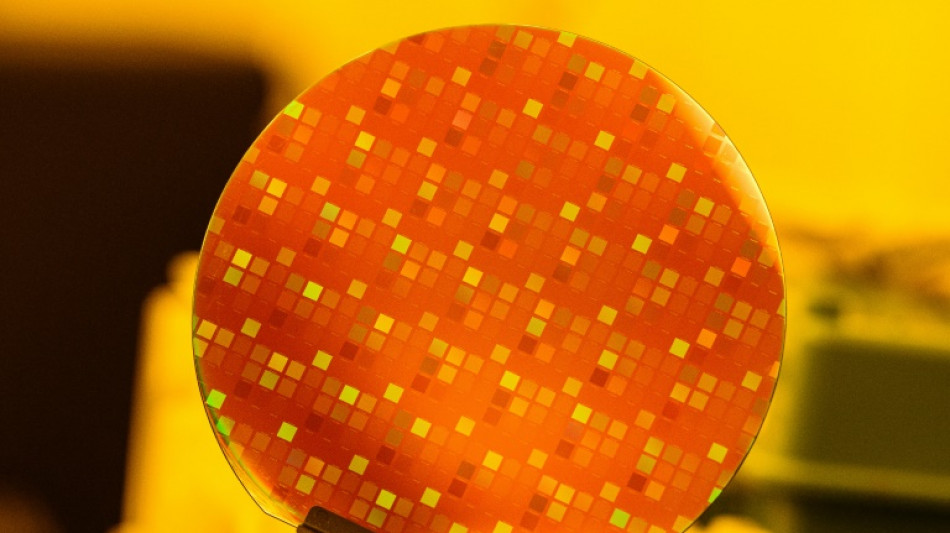
Protection racket? Asian semiconductor giants fear looming tariffs / Photo: © AFP

 Proposed next EU budget cut back in search for deal

 All Blacks learn from 'failed' Springboks series to punish Wallabies

 Marquez grabs MotoGP championship lead after Indonesia sprint chaos

 All Blacks extend Eden Park streak with big win over Wallabies
 Marquez grabs MotoGP championship lead with Indonesia sprint win

 Schauffele closes in on leaders after 'weird' round in Japan

 Medvedev through at Shanghai Masters in first match since disqualification

 Trump sows doubt on plan to livestream US military execution

 Hunger and malnutrition stalk Gazans, a year on from ceasefire
 Fernandez trumps MotoGP championship duo to grab Indonesia pole
 October 7 scars push Israel's first-time voters to right

 India deploys police, restricts transport ahead of major protest

 Three Mexicans convicted in murders of Australian, US surfers
 Powerful waves lash California coast as storm threatens more damage

 Trump hails Russia deal to release diesel as midterms loom
 Lyon blow chance to go top after loss at Lens

 Stocks rise as Trump says Russia to release diesel to world markets

 Wildfire smoke shuts schools in Amazon's biggest city

 Turkey jails 2 journalists pending trial for fund crisis 'misinformation'

 Major earthquake rocks Panama, triggers tsunami warning

 Indian jailed in France for leading sadist Nazi cult that tortured girls

 'Iron Mike' Ditka hailed as 'gold standard' NFL legend

 Flydubai co-pilot planned suicide attack on Tel Aviv airport: UAE prosecutor

 Mike Ditka: Chicago Bears icon as player and coach

 Outrage over plan to livestream US military firing squad execution

Inside one of South Korea's oldest semiconductor research institutes, the cleanrooms and workshops are calm and immaculate, but outside the Seoul National University campus, a chip storm is brewing.
Last month, Washington announced a national security probe into imports of semiconductor technology, which could put the industry in the crosshairs of President Donald Trump's trade bazooka and inflict potentially devastating levies.
For chipmaking powerhouses South Korea and Taiwan, the consequences could be enormous.
South Korea is home to Samsung Electronics and SK hynix, while Taiwan hosts the world's largest contract chipmaker, TSMC. Collectively, they produce a significant chunk of high-end chips that have become the lifeblood of the global economy, powering everything from smartphones to missiles.
Taiwan exported $7.4 billion worth of semiconductors to the United States in 2024, while South Korea's exports surged to $10.7 billion, a historic high.
Experts say the spectre of looming tariffs has spurred stockpiling, with fears levies will drive up consumer prices and hurt chipmakers.
The clear intention of Trump's policies is to force the Asian chip giants to relocate production stateside, a former engineer at Taiwanese chip firm MediaTek told AFP.
"TSMC going overseas to the US to build fabs is like paying protection money," they said, adding that the projects barely made a profit with margins "super low" in high-cost America.
"From the American point of view, it's logical to sacrifice the rest of the world for its own interests, only that we happen to be the ones being sacrificed," the engineer said.
- A 'heavy blow' -
The US president's tolls could be "quite complex", Kim Yang-paeng, senior researcher at Korea Institute for Industrial Economics and Trade (KIET), told AFP.
Rather than hitting the industry with a blanket levy, the United States could target different products such as HBM, which is essential for high-speed computing, and DRAM, which is used for memory.
Any significant tariffs on the sector, which relies on complex manufacturing chains to produce high-end tech products, would be a "heavy blow", the MediaTek engineer said.
Samsung, the world's largest memory chipmaker, and leading memory chip supplier SK hynix rely heavily on indirect exports to the United States via China, Taiwan and Vietnam.
For example, Samsung produces television panels in South Korea, which are then assembled into finished televisions in Vietnam before being shipped to the United States.
For these companies, there is "concern about a decline in demand due to rising prices in other sectors using semiconductors", said Jung Jae-wook, professor at Sogang University.
Meanwhile, Seoul and Washington are negotiating a "trade package" aimed at preventing new US tariffs before the July 8 expiration of Trump's pause in his "reciprocal" levies.
- Few alternatives -
US Trade Representative Jamieson Greer is expected to visit South Korea for the APEC trade ministers' meeting this week.
Experts say that in the short term, chips like HBM are less likely to be impacted by tariff wars owing to strong demand driven by artificial intelligence.
And unlike many other sectors such as the auto industry -- which is already hit by tariffs -- "semiconductors have no substitutes from the US perspective", said Kim Dae-jong, a professor at Sejong University.
It is also not feasible to shift chip production entirely stateside, given America's limited capacity, so any measures "are unlikely to be sustained in the long run", said Sogang University's Jung.
"There are not many alternative countries (the United States) can rely on for imports, making price increases inevitable if tariffs are imposed," he said.
While Washington is eager to bolster domestic production, South Korea and Taiwan are keenly aware of the strategic significance of the industry and are not likely to give up capacity.
For Taiwan, semiconductors are a matter of national security, said Kim from KIET.
"Taiwan may expand its manufacturing presence in the United States, but significant changes to its domestic semiconductor ecosystem are unlikely."
Back at the Seoul National University semiconductor institute, its director, Lee Hyuk-jae -- who is also an outside director for Samsung -- spends his days urging the government to invest more in the sector, which he says "holds great importance" for the country.
L.Janezki--BTB