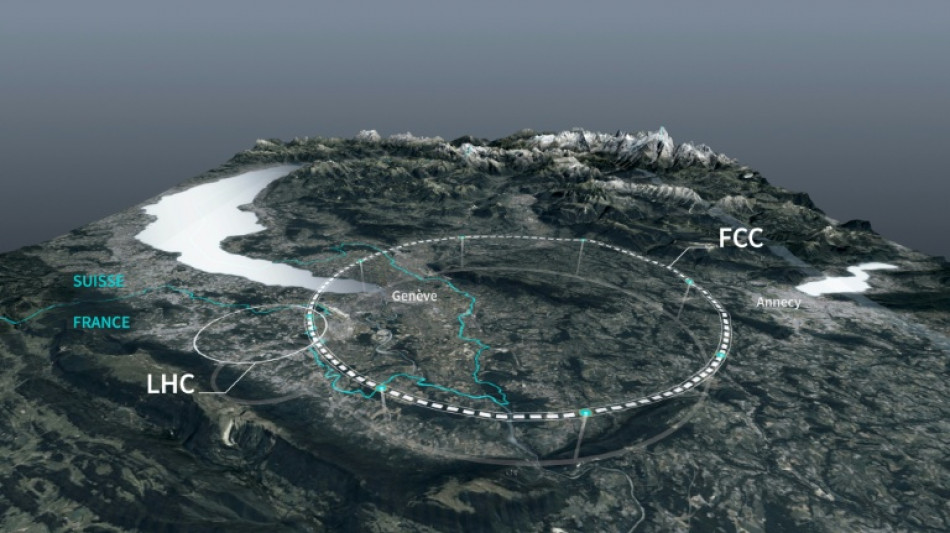
Private donors pledge $1 bn for CERN particle accelerator / Photo: © European Organization for Nuclear Research (CERN)/AFP/File

 Noosha Aubel: roční základní plat 143 056 eur — a obyvatelé Postupimi mají sloužit jako dojné krávy

 Romero claims Atletico late win at Alaves

 Zelensky blasts diesel deal as Russian strikes kill 16

 Arsenal back on track after Leeds scare, five-star Chelsea run riot

 Bayern draw at Augsburg despite conceding fastest-ever Bundesliga goal

 French prodigy Seixas becomes youngest Giro di Lombardia winner

 Verstappen on pole position as he hunts first Singapore GP win

 Arsenal learned lessons from Brighton collapse, says Arteta

 Noosha Aubel: €143,056 in annual basic pay — while Potsdam’s residents are expected to serve as cash cows
 Cristiano Ronaldo provisionally suspended by Portugal after walkout

 Brilliant Renshaw ton puts Australia in strong position

 Zelensky blasts diesel deal after Russian strikes kill 15

 Cristiano Ronaldo provisionally suspended after Portugal walkout

 Alcaraz through in straight sets on Shanghai Masters opener

 Palmer signs contract to stay at Chelsea until 2034

 India detains 'cockroach' movement leaders in bid to thwart election protest
 Proposed next EU budget cut back in search for deal

 All Blacks learn from 'failed' Springboks series to punish Wallabies

 Marquez grabs MotoGP championship lead after Indonesia sprint chaos

 All Blacks extend Eden Park streak with big win over Wallabies

 Marquez grabs MotoGP championship lead with Indonesia sprint win

 Schauffele closes in on leaders after 'weird' round in Japan

 Medvedev through at Shanghai Masters in first match since disqualification

 Trump sows doubt on plan to livestream US military execution

 Hunger and malnutrition stalk Gazans, a year on from ceasefire

Europe's physics lab CERN on Thursday said private donors had pledged $1 billion towards the construction of a new particle accelerator that would be by far the world's biggest.
In a first, private individuals and philanthropic foundations have backed a flagship research project at CERN, the European Organization for Nuclear Research, which seeks to unravel what the universe is made of and how it works.
The donors include the Breakthrough Prize Foundation of billionaire Silicon Valley investor Yuri Milner; the Eric and Wendy Schmidt Fund for Strategic Innovation of former Google chief executive Eric Schmidt; plus Italian Agnelli family heir John Elkann, and French telecoms tycoon Xavier Niel.
"It's the first time in history that private donors wish to partner with CERN to build an extraordinary research instrument that will allow humanity to take major steps forward in our understanding of fundamental physics," said CERN Director-General Fabiola Gianotti.
CERN's Large Hadron Collider (LHC) is currently the world's biggest particle accelerator, whizzing particles into each other at phenomenal speeds.
The 27-kilometre (16.8-mile) proton-smashing ring, running about 100 metres (330 feet) below France and Switzerland, has, among other things, been used to prove the existence of the Higgs boson.
Dubbed "the God particle", its discovery in 2012 broadened science's understanding of how particles acquire mass and earned physicists Peter Higgs and Francois Englert the 2013 Nobel Prize for Physics.
The LHC is expected to have fully run its course by around 2040, and CERN is considering building a far larger collider to allow scientists to keep pushing the boundaries of knowledge.
The planned Future Circular Collider (FCC) would be a ring with a circumference of 91 km and an average depth of 200 metres.
Scientists believe that ordinary matter -- such as stars, gases, dust, planets and everything on them -- accounts for just five percent of the universe.
The FCC will try to reveal what makes up the other 95 percent of the energy and matter in the universe -- so-called dark matter and dark energy, which scientists have yet to observe directly.
The gigantic project, estimated to cost around $17 billion, has not yet received the green light from CERN's 25 member states.
CERN, located on the outskirts of Geneva, is set to take a decision in 2028.
"The FCC is an instrument that could push the boundaries of human knowledge," Eric Schmidt in the statement.
"Beyond the science, the technologies emerging from this project could benefit society in profound ways, from medicine to computing to sustainable energy."
S. Pete Worden, chairman of the Breakthrough Prize Foundation, said the FCC would be "the most powerful scientific instrument in history, that can shed new light on the deepest questions humanity can ask".
J.Fankhauser--BTB