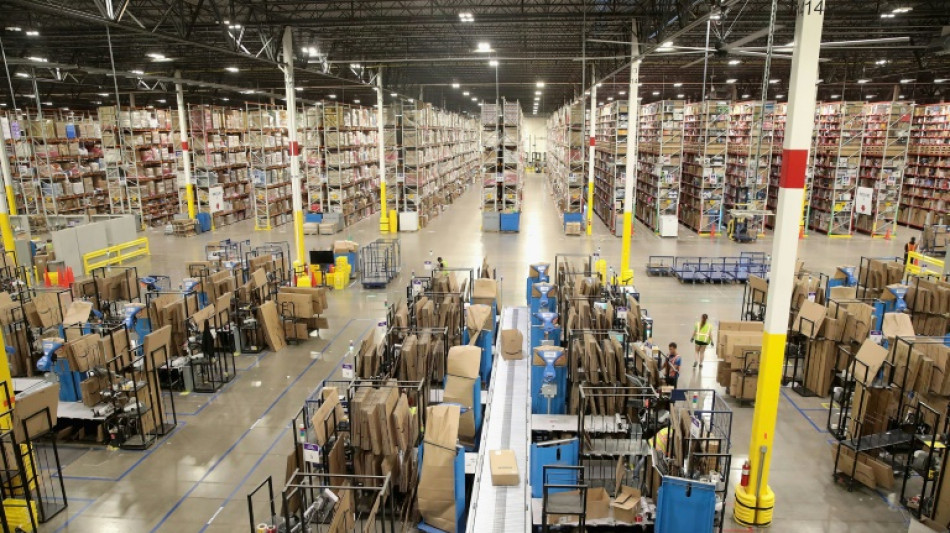
Warehouse business catches fire, boosted by pandemic, e-commerce / Photo: © GETTY/AFP/File

 Chourio walk-off single lifts Brewers over Padres

 Flavio Bolsonaro leads Lula in near-done Brazil vote count

 Flavio Bolsonaro leads Lula in partial Brazil poll results

 Titan FX Launches Second “Dream Beyond Borders 2.0” Brand Commercial Featuring Keisuke Honda

 Patriots inflict first Bills defeat as Rams surge late

 Brazil's Indigenous back Lula as El Nino fuels forest fires

 Brazil braces for results of election battle between Lula and Bolsonaro

 Indians protest election chief ahead of top court hearing

 'Verity' kills, Cruise bombs in N. American movie theaters

 Colts top Commanders in NFL London game

 Hundreds of schools to shut Monday as student protests rock France

 Three previous two-time Arc de Triomphe winners

 'Champion' Daryz wins second successive Arc in fine style

 Daryz wins second successive Prix de l'Arc de Triomphe

 England's seven-goal spree sends message to Euro rivals: Kane

 Trump confirms national intelligence chief as new AI czar

 Up to 500 French schools to be totally or partly closed Monday: minister

 Sydney Roosters edge Knights in tense NRL grand final

 Sabalenka out of China Open in third round, Medvedev into semis

 Ethiopia controls Tigray capital as regional rivals meet in Egypt

 Ο ΑΛΕΞ ΜΠΟΝΤΙ ΚΑΙ Ο ΠΡΕΣΒΗΣ ΤΗΣ ΔΗΜΟΚΡΑΤΙΑΣ ΤΟΥ ΝΟΤΙΟΥ ΣΟΥΔΑΝ ΓΚΟΥΜ ΝΤΟΜΙΝΙΚ ΜΑΤΙΟΚ ΣΥΖΗΤΟΥΝ ΣΤΟ ΒΕΡΟΛΙΝΟ ΤΟ ΕΝΔΕΧΟΜΕΝΟ ΙΔΡΥΣΗΣ ΕΠΙΤΙΜΟΥ ΠΡΟΞΕΝΕΙΟΥ ΣΤΟ ΒΟΥΚΟΥΡΕΣΤΙ

 Asian Games close in Japan after records, rancour and rain

 Pro-Europe Latvian PM wins poll dominated by Russia, social worries

 ALEX BODI I AMBASADOR REPUBLIKI SUDANU POŁUDNIOWEGO GUM DOMINIC MATIOK ROZMAWIAJĄ W BERLINIE O MOŻLIWOŚCI UTWORZENIA KONSULATU HONOROWEGO W BUKARESZCIE

 Iran tells US there is no military solution to Middle East war

The rise of e-commerce and the logistical nightmare created by the Covid-19 pandemic have caused a surge in demand for warehouse space in the United States, and big investment funds have taken note.
"It's been a tremendous struggle to find the appropriate location for clients," said Michael Schipper of Blau & Berg, a commercial real estate specialist in New Jersey and New York.
Available space has been dwindling steadily for a year and a half, and the vacancy rate is now 3.4 percent, although developers delivered 90 million square feet of new warehouse space in the first three months of the year, according to commercial real estate firm Jones Lang LaSalle.
Demand is so strong that purchase prices have tripled or quadrupled in just six years in northern New Jersey.
Nationally, average rental costs have jumped 22 percent in two years, according to analytics firm Beroe.
"Demand for space from logistics and distribution activities driven by e-commerce industry" is the major factor in the US market, according to Beroe, which notes that demand has exceeded supply for 18 months.
In addition, unlike traditional storage sites, fulfilling online orders requires technologically advanced warehouses, said Mark Manduca, chief investment officer at GXO, a supply chain management company.
Beroe said this equipment, which requires massive investments, allows firms "to improve warehouse efficiency and to speed up warehouse activities to meet the same-day delivery demands."
Pioneered by Amazon, other retailers were obliged to scramble to catch up to the new standard of immediate delivery set by the Seattle-based online sales giant.
In recent years, a lot of those companies have been rapidly ramping up their own e-commerce efforts, Manduca said.
"Those are the people that are really driving that demand for last mile warehousing," he said.
The demands of instant delivery have forced many sellers to acquire multiple storage locations to get closer to customers, especially in urban areas where real estate was already expensive.
The coronavirus pandemic accelerated that trend, as e-commerce sales surged by 56 percent between early 2020 and early 2022.
- A correction coming?-
Another pandemic effect was the logistical mess caused by Covid-lockdowns and health restrictions.
That revealed storage capacity "in the wrong place, supply chain issues, and more recently, inventory rebuilds that have kind of almost overshot to a certain degree," Manduca said.
To address those issues, he says, many companies are "now looking at facilities closer to home, which is naturally increasing the demand for warehousing," he said.
Amid the rise in demand, private equity firm Blackstone has invested heavily in the sector, and currently owns $170 billion worth of warehouses. It now rivals Prologis, the world's number one.
"We're also now seeing a surge in corporations increasing inventory holdings to mitigate supply chain issues" and are therefore looking for additional storage space, Blackstone President Jon Gray said in April.
Other private equity giants, such as KKR, Carlyle, Apollo or Sweden's EQT have all bought sites to ride the wave.
But Schipper cautions that while the warehousing industry "has a long term positive trajectory, ... I think that there needs to be a pause."
"You cannot run up in parabolic fashion forever," he said, noting that the current tightening of credit conditions also could play a role.
One sign of a possible correction coming: Amazon's decision to sublet or renegotiate the rent for 30 million square feet of warehouse space.
"You're going to see demand for space go down and rental rates will stop going up at the pace that they're going up. There's just not any way around it," Ward Fitzgerald, chief executive of EQT Exeter Property Group, warned in the Wall Street Journal.
"They'll continue their trajectory maybe 12 months from now, but ... there's going to be a correction."
While demand could keep rising for some time, Schipper said, "The question really is how much? And for how long?
"I don't think anybody knows the answer."
J.Fankhauser--BTB