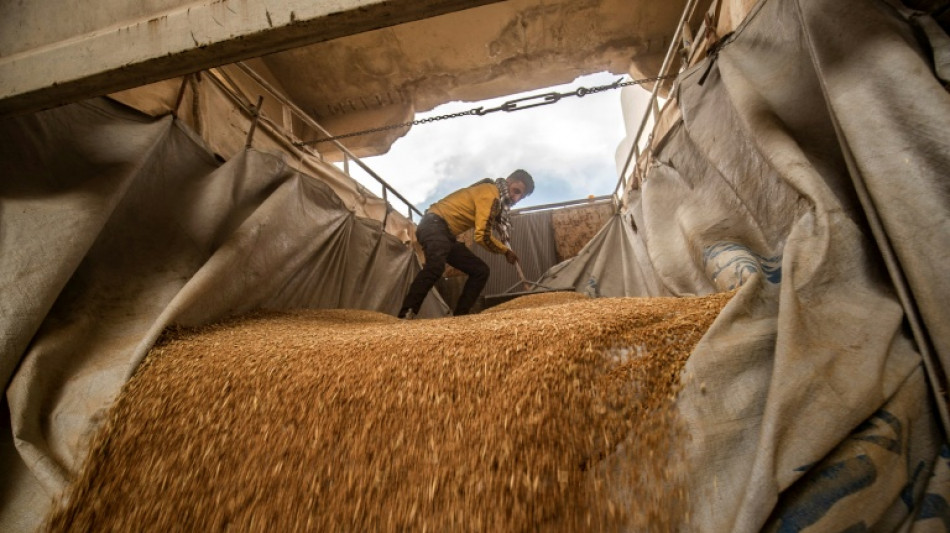
Syria's wheat war: drought fuels food crisis for 16 million / Photo: © AFP

 Flydubai co-pilot planned suicide attack on Tel Aviv airport: UAE prosecutor

 Mike Ditka: Chicago Bears icon as player and coach

 Outrage over plan to livestream US military firing squad execution

 US sanctions: a 'test of resilience' for ICC

 NFL legend Mike Ditka dead at 86

 Hurricane Isaias set to strike Gulf Coast late Friday

 Trump forms panel to probe US Fed governor Lisa Cook

 Clashes in Durban as fresh anti-migrant riots erupt in South Africa

 France students plan more protests, UN 'concerned' over violence

 De Zerbi calls on struggling Spurs to react in Man Utd clash

 US sanctions on ICC: a 'test of resilience'

 Outrage over US military plan to livestream firing squad execution

 Argentina snap up defence guru Edwards ahead of World Cup

 BMW pulls car lease offer from German far-right politician

 Brazil election offers Jair Bolsonaro a shot at revenge

 Man Utd boss Carrick 'personally' affected by Man City verdict

 Evolution Metals & Technologies Corp. Raises Fiscal 2026 Revenue Guidance 62% at Midpoint to $10–$11 Million and Reaffirms $400–$460 Million Fiscal 2027 Outlook

 Red Bull's Verstappen takes pole position for Singapore GP sprint race

 Chelsea star Palmer 'committed' to England insists Alonso

 OpenAI denies firing researchers over AI safety warnings

 Turkey warns opposition, press over investment fund crisis

 Hurricane Isaias now major storm as it heads to US Gulf Coast

 Djokovic crashes out of Shanghai Masters in his first match

 EU says Turkey's crackdown on rights hampers membership bid

 Two Renoir paintings stolen in France recovered: mayor
Rival Syrian and Kurdish producers are scrambling for shrinking wheat harvests as the worst drought in decades follows a devastating war, pushing more than 16 million people toward food insecurity.
"The country has not seen such bad climate conditions in 60 years," said Haya Abu Assaf, assistant to the United Nations Food and Agriculture Organization (FAO) representative in Syria.
Syria's water levels have seen "a very significant drop compared to previous years, which is very worrying", Abu Assaf told AFP, as a relatively short winter rainy season and decreased rainfall take their toll.
"A gap of between 2.5 to 2.7 million tonnes in the wheat crop is expected, meaning that the wheat quantity will not be sufficient to meet local needs," Abu Assaf said, putting "around 16.3 million people at risk of food insecurity in Syria this year".
Before the civil war erupted in 2011, Syria was self-sufficient in wheat, producing an average of 4.1 million tonnes annually.
Nearly 14 years of conflict have since crippled production and devastated the economy.
The FAO estimates that harsh weather has impacted nearly 2.5 million hectares of wheat-growing land.
"Around 75 percent of the cultivated areas" have been affected, as well as "natural pastures for livestock production", said Abu Assaf.
- Imports, competition -
To bridge the wheat gap, imports would be essential in a country where around 90 percent of the population lives in poverty.
Before his ouster in an Islamist-led offensive in December, Syria's longtime ruler Bashar al-Assad used to rely on ally Russia for wheat.
In April, new authorities reported the first wheat shipment since his removal arrived in Latakia port, with more Russian shipments following.
Iraq also donated more than 220,000 tonnes of wheat to Syria.
During the war, Damascus competed with the semi-autonomous Kurdish administration in the northeast to buy wheat from farmers across fertile lands.
Last year, Assad's government priced wheat at $350 per tonne, and the Kurds at $310.
After Assad's ouster, Damascus and the Kurds agreed in March to integrate Kurdish-led institutions into the new Syrian state, with negotiations ongoing on implementation.
Damascus set wheat prices this month at between $290 and $320 per tonne, depending on the quality, plus a $130 bonus.
The Kurdish-led administration offered $420 per tonne including a $70 bonus.
- 'Poverty and hunger' -
Damascus' agriculture ministry expects a harvest of 300,000 to 350,000 tonnes in government-controlled areas this year.
Hassan Othman, director of the Syrian Grain Establishment, acknowledged Syria was not self-sufficient, in comments on state television.
But he said authorities were working "to ensure food security by importing wheat from abroad and milling it in our mills".
In northeast Syria's Amuda, farmer Jamshid Hassu, 65, inspected the tiny wheat grains from his fields, which cover around 200 hectares (around 500 acres).
Despite heavy irrigation efforts to offset scarce rainfall, he said, production has halved.
The FAO's Abu Assaf said indicators showed that "about 95 percent of rain-fed wheat has been damaged and affected", while irrigated wheat yields were down 30 to 40 percent.
Hassu, who has been farming for four decades, said he had to pump water from depths of more than 160 metres (525 feet) to sustain his crops as groundwater levels plunge.
Agriculture remains a vital income source in rural Syria, but without urgent support, farmers face ruin.
"Without support, we will not be able to continue," Hassu warned.
"People will suffer from poverty and hunger."
L.Janezki--BTB