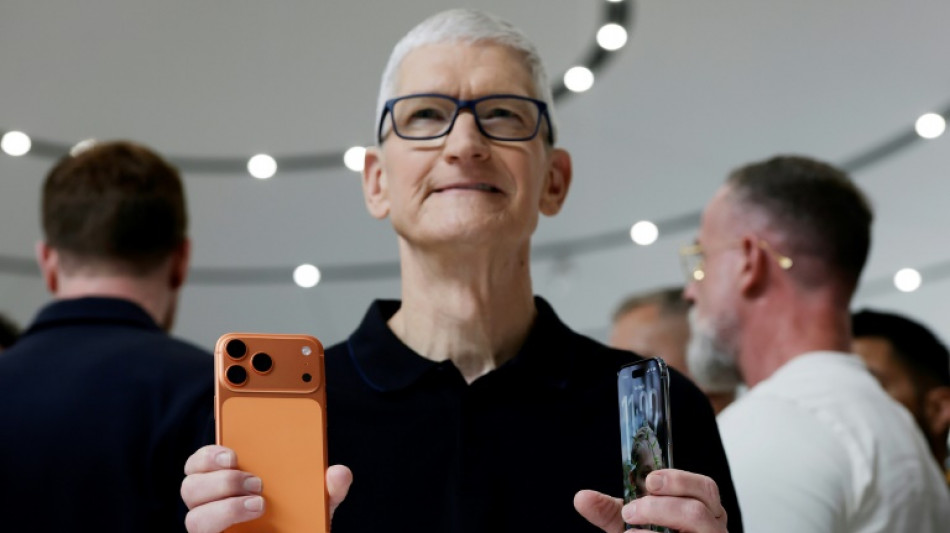
Apple's move to eSIM-only strengthens global trend / Photo: © GETTY IMAGES NORTH AMERICA/AFP

 Crew splashes down after 8-month mission on International Space Station

 Protests, clashes as S. African anti-migrant tensions reignite

 Russian data centre hit by drone in first for Ukraine war

 'Fighting for our future': France high school students vow no let-up

 Kyiv entering 'survival' mode amid Russian strikes surge: mayor tells AFP

 Verdict due in Mexico trial over murders of Australia, US surfers

 B2PRIME Welcomes Christina Barbash as Commercial Manager

 Russia forcing Kyiv into 'survival' mode before winter, mayor tells AFP

 Closing arguments begin in Maradona death trial

 UEFA president Ceferin to stand for re-election in 2027

 Nearly 300,000 Nepalis at flood risk: study

 Riyadh kindergarten hit by interception debris as Houthis say targeted airport

 Alex Bodi mizează, alături de CRIF, pe investiții transparente și pe prevenirea riguroasă a spălării banilor

 Gulf Labs, Part of Thailand’s $27 Billion GULF Group, Goes Live as an Injective Validator
 EU okay for winter despite 'historically low' gas stocks: operators

 Rwanda to host F1 Grand Prix: sources close to both sides

 EU top diplomat says bloc in favour of UN Lebanon peacekeepers' extension

 Antonelli and Russell to run different Mercedes aero packages in Singapore

 WTO hikes 2026 trade growth forecast on AI boom

 'I love that challenge': Hamilton prays for rain in Singapore

 G.Bissau moves towards postponement of December general election

 Verstappen out to settle 'unfinished business' at Singapore Grand Prix

 WhiteBIT Launches Bitcoin Lightning Network Support, Powered by Voltage

 Oil surges, stocks sink as US reportedly eyes fresh Iran strikes

 Anne Carson: modern takes on Greek classics

Apple's Tuesday announcement that the new iPhone 17 Air will only be available around the world without physical SIM cards marks a new advance for the virtual eSIM technology the firm has relied on in the US for years.
- What is an eSIM? -
Physical SIM cards contain all the information a phone needs to connect to a mobile network using the contract and number of a specific subscriber.
Users have been slotting the fingernail-sized plastic cards into their phones for decades when setting up a new handset, switching providers, or traveling.
eSIMs contain digital data with the same information as physical SIM cards, providing a "secure means for authenticating devices onto networks," the GSMA global standards-setting body says.
Most handsets released in recent years are capable of working with eSIMs, although many still offer a physical SIM slot as well.
Users can set up a new device or transfer eSIMs between phones through methods including scanning an operator-provided QR code, requesting a notification or text message from their network, or selecting the option to transfer an eSIM in their old phone's settings.
- How is using an eSIM different? -
Purely digital eSIMs can be downloaded remotely, simplifying tasks like signing up with a new network provider or switching operators—for example, to connect to a cheaper local network when traveling.
Using them also saves on plastic waste and distribution costs.
But setting up eSIMs in the first place requires internet access—meaning users firing up a new phone might need to connect to their home Wi-Fi network to activate their connection.
And travelers should activate their local eSIM in advance if they want service from the moment the plane lands at their destination.
Just like with physical SIMs, eSIMs can be activated or deactivated by the user on the handset—meaning that in theory they are no more or less trackable by operators or governments.
- Why has Apple pushed for eSIMs? -
Apple dropped physical SIM cards in the US starting with 2022's iPhone 14.
The tech giant's website promises "greater flexibility, enhanced convenience, better security, and seamless connectivity" for eSIM users.
Fewer physical parts "fits in with the vision of a slimmer, easier-to-use phone" long pursued by Apple, CCS Insight analyst Kester Mann told AFP.
On the business side, "perhaps they want a little bit more control over the journey to connect customers" to mobile operators when setting up a new phone, he added.
Consultancy Roland Berger agreed, suggesting in a report last year that eSIMs allow manufacturers to get between mobile operators and end users, "causing [operators] to lose control."
- What about other manufacturers? -
While competitors like Samsung have yet to release an eSIM-only phone, "the expectation is that they'll also go down that route as well," Mann said.
Google's latest Pixel 10 phones come in an eSIM-only version in the US.
"eSIM adoption is expected to gain traction... in the short-to-mid-term," Roland Berger predicted, forecasting 75 percent of all smartphone connections via eSIM in 2030, up from 10 percent in 2023.
CCS predicts the number of eSIM-capable handsets will grow from 1.3 billion currently to 3 billion in 2030.
- What impact have eSIMs had so far? -
In a survey of mobile network managers, Roland Berger found little sign of higher customer "churn" from the greater ease of switching providers.
Future uses of eSIM could include mobile operators offering subscribers more individually tailored services, the consultancy suggested.
For tourism, CCS Insight predicts local eSIM sales will rise from 70 million in 2024 to 280 million by 2030.
Providers such as Airalo and Holafly have sprung up to sell cheap foreign connectivity to tourists—although big incumbents like airlines and mobile operators are beginning to offer their own alternatives.
eSIMs also simplify machine-to-machine (M2M) communication, allowing remote setup or reconfiguration of connected devices—from watches to cars or smart electricity meters.
N.Fournier--BTB