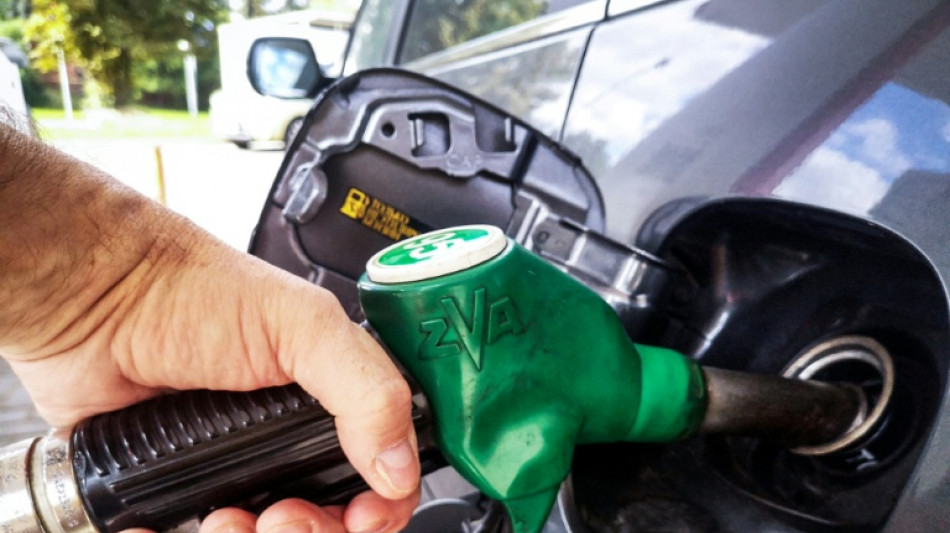
Fossil energy 'significant' driver of climate-fuelled heatwaves: study / Photo: © AFP/File

 Crew splashes down after 8-month mission on International Space Station

 Protests, clashes as S. African anti-migrant tensions reignite

 Russian data centre hit by drone in first for Ukraine war

 'Fighting for our future': France high school students vow no let-up

 Kyiv entering 'survival' mode amid Russian strikes surge: mayor tells AFP

 Verdict due in Mexico trial over murders of Australia, US surfers

 B2PRIME Welcomes Christina Barbash as Commercial Manager

 Russia forcing Kyiv into 'survival' mode before winter, mayor tells AFP

 Closing arguments begin in Maradona death trial

 UEFA president Ceferin to stand for re-election in 2027

 Nearly 300,000 Nepalis at flood risk: study

 Riyadh kindergarten hit by interception debris as Houthis say targeted airport

 Alex Bodi mizează, alături de CRIF, pe investiții transparente și pe prevenirea riguroasă a spălării banilor

 Gulf Labs, Part of Thailand’s $27 Billion GULF Group, Goes Live as an Injective Validator

 EU okay for winter despite 'historically low' gas stocks: operators

 Rwanda to host F1 Grand Prix: sources close to both sides

 EU top diplomat says bloc in favour of UN Lebanon peacekeepers' extension

 Antonelli and Russell to run different Mercedes aero packages in Singapore

 WTO hikes 2026 trade growth forecast on AI boom

 'I love that challenge': Hamilton prays for rain in Singapore

 G.Bissau moves towards postponement of December general election

 Verstappen out to settle 'unfinished business' at Singapore Grand Prix

 WhiteBIT Launches Bitcoin Lightning Network Support, Powered by Voltage

 Oil surges, stocks sink as US reportedly eyes fresh Iran strikes

 Anne Carson: modern takes on Greek classics

Fossil fuel and cement producers have contributed "significantly" to the growing number and intensity of climate-change-driven heatwaves, according to a study published on Wednesday in Nature.
An international team of scientists analysed more than 200 heatwaves around the world between 2000 and 2023 and found that climate change had made each of them more likely and more ferocious.
But they also took their attribution study one step further by teasing out the role of 180 major producers of polluting oil, gas, coal and cement.
They found emissions linked to these large companies contributed half of the increase in heatwave intensity compared to the pre-industrial era and also increased their probability.
The role of the 14 largest "carbon majors" -- including Saudi Aramco, Gazprom, Chevron and BP -- appears to be very significant, weighing as much as the 166 other companies studied.
The pollution from these firms has essentially been large enough to spark heatwaves, researchers said.
"Each producer alone can be enough to make heatwaves possible that would have been virtually impossible without climate change," said Yann Quilcaille of ETH Zurich, who led the study published in Nature.
Attribution studies generally measure the degree of influence of climate change on a particular extreme weather event.
To do this, scientists compare the current climate with a simulation of a climate that has not been warmed by human activities.
The latest study expanded the scope to a total of 213 heatwaves.
Researchers found that the influence of climate change had grown over time: it made heatwaves on average 20 times more likely between 2000 and 2009 and 200 times more likely from 2010 to 2019.
A quarter of the events studied (55 out of 213) were at least 10,000 times more likely. In other words, they would have been virtually impossible without global warming.
"We also show that emissions associated with the largest producers of fossil fuels and cement contribute significantly to heatwaves," Quilcaille told AFP.
Emissions from just one of these carbon majors would have been enough to cause events deemed 10,000 times more likely, they found.
- 'Leap forward' -
The authors took into account the entire value chain of the companies as well as the use of the products by customers. For example, they attributed to each oil group the emissions associated with the petrol it sold.
Pascal Yiou, from France's Laboratory for Climate and Environmental Sciences (LSCE), who was not involved in the study, told AFP it was "a summary of the current state of knowledge in heatwave attribution", playing down the effort to attribute the role of major polluters.
But Quilcaille said the study could aid corporate responsibility legal cases, which have not so far been able to draw on increasingly precise research linking carbon emissions with specific events.
In one, a Peruvian farmer sued German energy company RWE, accusing it of being indirectly responsible for the melting of a glacier near his home. In May, a German court rejected the case but recognised the principle of polluters' global responsibility for climate damage.
In a commentary published in Nature, Karsten Haustein, of the University of Leipzig, said the new research was a "leap forward" for climate litigation and diplomacy.
"It is another reminder that denial and anti-science rhetoric will not make climate liability go away, nor will it reduce the ever-increasing risk to life from heatwaves across our planet," said Haustein, who was not involved in the study.
E.Schubert--BTB