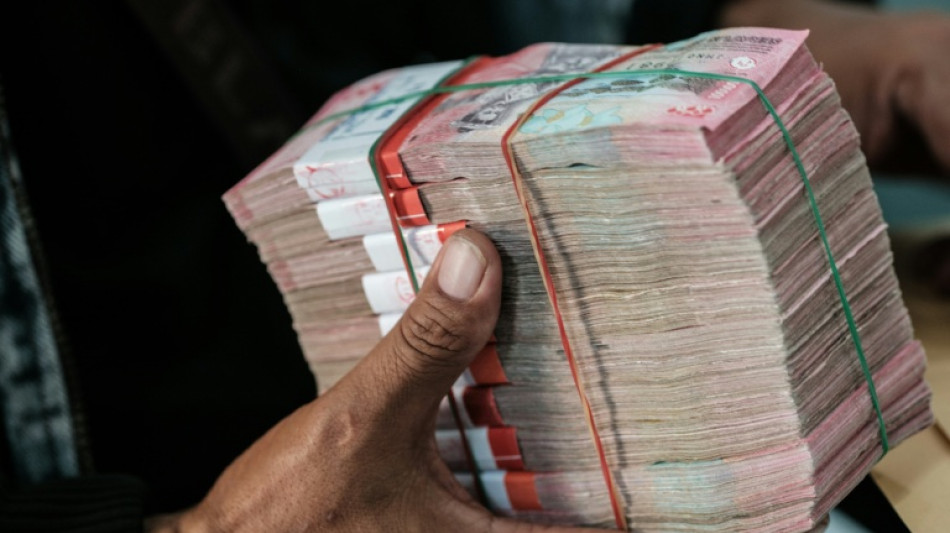
Indonesian economy comes up for air but struggles to win back investors / Photo: © AFP/File

 Taiwan gender-row boxer Lin Yu-ting wins 'monumental' Asian Games gold

 Taiwan receives its first US-made F-16V fighter jets

 Lula, Bolsonaro trade scandal fire in final scramble for votes

 Not-so-brave new world: virtual taekwondo makes Asian Games debut

 Arab Israeli candidate drops out of election race

 Israel courts Europe's far right, finding friends but also unease
 Lula, Bolsonaro both snub final debate before Brazil election

 Nepal's grim DNA puzzle to identify flood dead

 EU nations to hold emergency meeting on soaring diesel prices amid US pressure

 Anthropic's Dario Amodei: AI's most visible CEO and enigma

 OpenAI says three staffers fired for mishandling 'sensitive' info

 Nike plans job cuts as it forecasts lower sales

 Ireland game interrupted twice by Gaza protests

 Judge denies acquittal bid by US woman who killed her kids

 Klopp averts crisis with first win as Germany boss

 A saintly spat and debate snub: Brazil enters final campaign stretch

 US tells European allies to act 'immediately' to lower diesel prices

 G20 trade ministers fail to see consensus against overproduction

 Portugal edge Denmark in Ronaldo's absence

 US stocks edge higher as bond yields retreat for now

 US tells European allies to 'immediately' act to lower diesel prices

 Trump vows to hit Iran 'very hard' if linked to flydubai attack

 Williams leaves Spain camp with thigh knock

 WTA reduces 2027 schedule for world's top 50

 US says 'in Europe's best interest' to cooperate on fuel supply

Indonesia's economy faces a perfect storm wrought by high energy prices, and while the currency has rebounded slightly, critics warn government policies are unnerving investors at a critical moment.
Southeast Asia's biggest economy, a net oil importer, was hit hard by the global surge in crude prices fuelled by the Middle East war.
To shield its citizens, the government has insisted on maintaining a costly subsidy on fuel and a multi-billion-dollar school meal programme criticised for being wasteful as well as causing mass food poisoning.
At a time when Indonesia desperately needs foreign currency, authorities spooked investors with tighter export controls lambasted as "resource nationalism", while a move by parliament to tighten oversight of the central bank raised fears for its independence.
The rupiah has plummeted, hitting successive record lows and dropping below 18,100 to the dollar this week.
The stock market has lost about a third of its value since the start of the year -- one of the worst performances globally -- as traders increasingly "sell Indonesia".
This week, there was finally some reprieve as the currency and markets reacted positively to the central bank raising its base lending rate by 75 points in back-to-back hikes.
However, "investor concerns over recent domestic policy moves will persist," said an analysis by BMI, a unit of Fitch Solutions.
It pointed out the rupiah was still about seven percent weaker than at the start of the war in February.
"Given that investor concern over domestic policy has not been resolved, we expect depreciatory pressure on the rupiah to persist," BMI said.
This, in turn, would force Bank Indonesia "to hike rates further", it added.
- 'Populist and interventionist' -
High lending rates tend to dampen economic growth.
President Prabowo Subianto's government is chasing a growth target of eight percent by 2029 as one of its major policy objectives -- an ambitious goal some experts warn would be hard to reach.
Deputy Finance Minister Juda Agung told AFP this week the government would not abandon its target despite the high social spending that underpins it.
"We have to grow higher to become a rich country by 2045," he said in an interview. "Otherwise we are... going to be trapped in the middle-income countries" group.
Juda, a former central bank deputy governor, said the government supported the recent interest rate hikes despite the potential risk to growth as well as higher debt servicing costs for the state.
"This is the area of the central bank. They are independent. They know what they should do," he said.
Interest rate hikes alone may not be enough to prop up the rupiah, experts say.
"Placing the currency on a firmer footing requires... the Prabowo administration to shift away from its populist and interventionist policy agenda," Capital Economics said in a note this week.
"Ultimately what's needed is a clear shift... towards more investor-friendly policymaking."
- Rebuilding trust -
Juda insisted the rupiah was undervalued and that economic pressures were "manageable" and will abate once the war ends.
"Our economy is quite resilient," he said.
Economists expect further interest rate hikes, spelling potential trouble for the government's budget deficit, which it is required by law to keep at no more than three percent of GDP.
Adding to the uncertainty, Jakarta is awaiting a decision by global index compiler MSCI on its market risk status after the group expressed concerns about the transparency of stock ownership.
A downgrade could trigger more capital flight.
According to Juda, there have been "big inflows on the government bond" since the interest rate rose, as well as "signs of confidence in the stock market".
The World Bank said Thursday Indonesia would likely see growth of no more than 5.0 percent under the strains of high public spending -- lower than the government's target of 5.4 percent.
In the first quarter of 2026, official data put growth at 5.6 percent, but analysts have expressed doubts about the reliability of the figures.
Deni Friawan, a researcher at the Jakarta-based Centre for Strategic and International Studies, said the government should cut spending to show investors it is committed to keeping the fiscal deficit in check.
"Trust is earned by performance, by reputation, by action, not just with words," he told AFP.
W.Lapointe--BTB