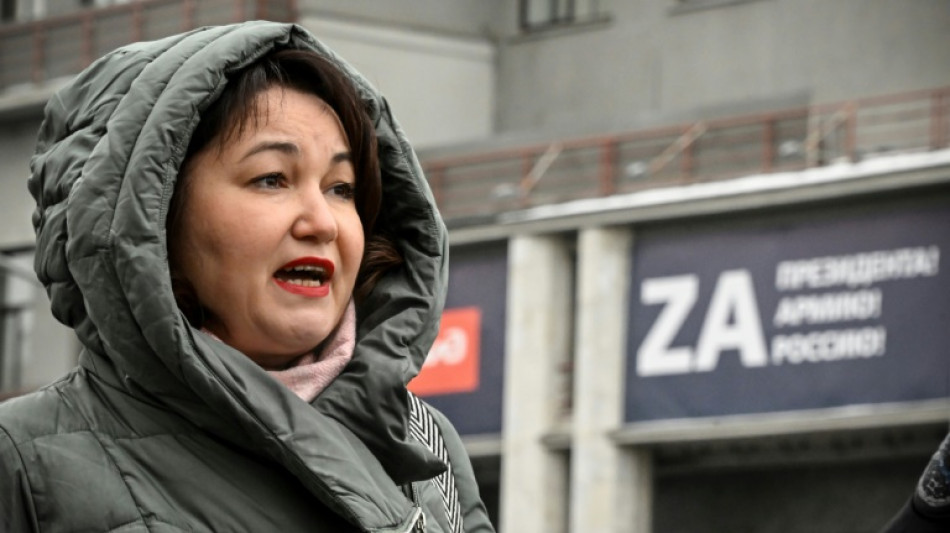
'Vladimir, answer us': Russian soldier mothers challenge Putin / Photo: © AFP

 WhiteBIT Launches Bitcoin Lightning Network Support, Powered by Voltage

 Oil surges, stocks sink as US reportedly eyes fresh Iran strikes
 Anne Carson: modern takes on Greek classics
 Canada's Anne Carson wins Nobel literature prize
 Ethiopia drones hit Eritrean troops in Tigray
 Russian strike on buses kills 30 in frontline Ukrainian city
 Thailand begins extradition process against Chinese journalist

 Quarantine, unease and rumours: Russian city grapples with plague scare

 Taiwan says exports hit record in September on AI demand
 Marc Marquez vows to 'attack' Martin's lead at Indonesian MotoGP
 Diplomats, schools in Saudi take safety measures after blasts heard: sources to AFP

 In Beijing, EU trade envoy says deficit with China 'unsustainable'
 Sri Lanka's de Silva quits as Test captain

 Alcaraz feeling 'mentally fresh' ahead of Shanghai return

 Israel drastically reduces British diplomatic presence in Jerusalem
 Stocks fall further as oil surge fans fresh inflation worries

 North Korea demands South show 'utmost respect' to restore relations

 Saudi says three dead in airport attacks claimed by Houthis

 'Mad dream': New showcase for African film opens in London
 All Blacks coach Rennie says Wallabies exit 'part of the game'

 The growing protests against India's poll body - and PM Modi

 Stocks fall further as oil spike fans fresh inflation worries
 Bad COP, worse COP? EU tempers hopes for UN climate summit

 Rookie Henry named in Wallabies midfield to face All Blacks
 Housing crisis set to dominate Spain's snap election

Their videos are flooding Russian social media -- mothers and wives of soldiers mobilised to fight in Ukraine, urgently demanding that the military make good on promises made by President Vladimir Putin.
Anger and concern have built across Russia since September, when the Kremlin announced that hundreds of thousands of well-trained and well-equipped men would be conscripted and sent to the battlefield to bolster Moscow's struggling campaign in Ukraine.
But chaos ensued, with widespread reports of exempted men -- the elderly or infirm -- being dispatched to the front or conscripts dying after receiving nearly no training, forcing the Kremlin to concede "mistakes".
In a sign that Putin takes the growing malaise seriously, he is expected on Friday to meet a group of military mothers and wives for the first time since ordering Russian forces into Ukraine nine months ago.
But some relatives have already dismissed the meeting as carefully choreographed and one that will not offer a platform for frank discussion.
"The president will meet with some mothers pulled out of his pocket, who will ask the right questions and thank him," said Olga Tsukanova, an activist mother.
"As usual."
Her 20-year-old son is currently doing his military service and she wants to make sure he will not be sent to Ukraine.
Tsukanova travelled 900 kilometres (560 miles) from the city of Samara on the Volga river in the hope of being seen at the Kremlin.
- Sour memories -
"I'm not alone. Invite us, Vladimir Vladimirovich, answer our questions!" she said, referring to the president by his patronymic.
Anger over the fate of mobilised men, which risks degenerating into real discontent, has put the Kremlin in an uncomfortable position, analysts have said.
While authorities have unleashed an unprecedented crackdown on political dissent while troops fight in Ukraine, the word of mothers is sacred in Russia.
Imprisoning them is not an option.
For Putin, the sight of angry relatives may bring back difficult memories from the start of his rule more than two decades ago.
In August 2000, the Russian leader was criticised for responding too slowly when the Kursk submarine sank, killing all 118 crew onboard.
Two wars in Chechnya led to the rise of the mothers' movement in Russia that became a thorn for the Kremlin.
But this time the climate is different, with no independent media left in the country and a de facto ban on public criticism of Putin's offensive.
This means there has been little public questioning of the operation in Ukraine. But in Russia some are asking questions about the conditions in which relatives are sent to fight.
- 'Hold power to account' -
Mothers' and wives' status as relatives of mobilised men serving the country gives them a form of protection, rather than being considered ordinary opponents.
"There is a subconscious feeling that women have that right," to hold power to account, sociologist Alexei Levinson of the independent Levada Centre said.
"But this is not a woman for peace movement," he warned.
"They want the state to fulfil its responsibility as a 'collective father' towards the mobilised."
For now, the soldiers mothers' movement is uncoordinated and disparate, mainly consisting of worried relatives posting videos on social media, where some informal groups have formed.
This is how Tsukanova, who has links to controversial opposition figure Svetlana Peunova -- accused in Russia of spreading political conspiracy theories -- became involved in the mothers' movement.
In a climate of suspicion not seen since the Soviet era, many women fear that complaining about the offensive could mean trouble and refrain from speaking to the foreign press.
"We have sent letters to authorities," one woman told AFP anonymously.
"It's not the journalists that will take our guys out of the trenches and we do not want to harm them even more."
J.Horn--BTB