US maternal mortality soars amid widening racial disparities / Photo: ©

 'He's here with me': Japan cycle queen dedicates gold to late brother

 Japan Olympic chief says 'lot more' athletes at Games than expected
 Asian carmakers besting US rivals at home, China poised to strike

 Widgets & Web Offers All-Inclusive Investor Relations Websites for Public Companies, IPOs and SPACs

 Adams named new US captain to 2030 World Cup
 China a better influence in Latin America than US: poll

 Judge pauses construction of border project in Texas national park

 Belgium's De Bruyne fires double to sink Turkey, France held by Italy

 US jobs data boosts stocks as oil prices dip

 US Supreme Court to hear high-stakes climate case

 Trump expected to name intel chief Clayton as AI czar: reports

 Argentina unveils passports-for-investment scheme

 Brazil election debate chaos sparks censorship row

 England's Carse charged by cricket body over nightclub incident

 Amazon vows $1 bn for data center towns, decries 'myths'

 Oil prices drop on G7 fuel release, US jobs data boosts stocks

 G7 agrees deal to ease global energy supply concerns

 Spain's government dealt blow as lawmakers reject housing bills

 Food, medicine shortages deepen in Russian-occupied Oleshky

 Man City whistleblower Rui Pinto facing 'dire consequences' - lawyers

 Russia 'tearing Kyiv apart', mayor says, as strikes paralyse traffic

 Taiwan boxer Lin wins Games gold as Japan edge North Korea on penalties

 Japan tame North Korea to win Games gold after shootout drama

 US posts weak job growth data in September

 Ethiopia's conflict: the regional dimension

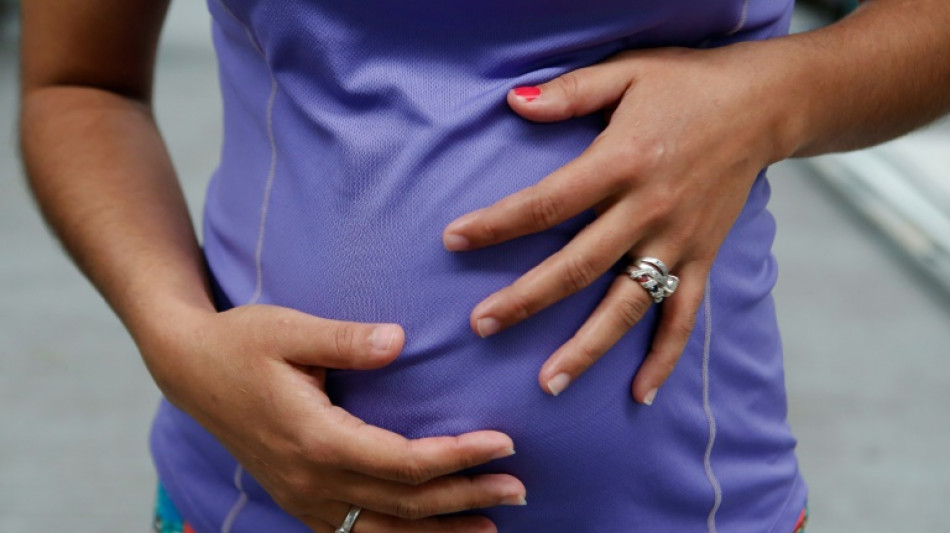
The US maternal mortality rate -- already the worst in the industrialized world -- rose in 2020 to its highest level in half a century, with Black women three times more likely to die than white women, data showed Wednesday.
A National Center for Health Statistics report showed the rate was 23.8 deaths per 100,000 live births, far higher than comparable countries, such as Canada where it was 7.5 per 100,000, according to OECD statistics for the same year.
Overall, 861 women were identified as having died of maternal causes, which the World Health Organization defines as a death while pregnant or within 42 days of the end of pregnancy, from any cause related to or aggravated by pregnancy or its management.
In 2019, the number of deaths per 100,000 live US births was 20.1, while in 2018 it was 17.4.
"We observed increases across a broad number of categories, and Covid-19 likely contributed," Donna Hoyert, who authored the report, told AFP.
But, she added, the disease was not mentioned in 88 percent of cases, and was thus only a part of the overall picture.
Despite spending more than twice per person on health than the average of high-income nations, the United States has historically remained an outlier on maternal mortality compared to its peers.
Across the world, maternal mortality dropped throughout the 20th century thanks to advances in medical care such as antibiotics and basic hygiene. But the United States has seen backsliding since the year 2000, unlike most other countries.
In fact, the last time the US rate was officially this high was 1968, though a new reporting methodology was introduced in 2018.
"Most of the peer countries have some form of universal health care," Boston University professor Eugene Declercq, who studies the field, told AFP.
"What we do in the United States is we focus on care so intently on the time of birth -- and that's nice -- but the fact of the matter is, women enter their pregnancies in a less healthy state because they're not covered."
Certain conservative-led states, such as Texas and Alabama, have increased hurdles to eligibility to Medicaid, the publicly funded health insurance program, said Declercq.
Upper income limits to enroll in Medicaid are lower for women who are pregnant, but there is a greater chance that by the time they become pregnant, they have untreated chronic conditions.
Limiting access to abortion -- as conservative-led states have increasingly done in recent years -- is also linked to worse maternal health outcomes a 2021 study in the American Journal of Public Health found.
- Racial disparities -
The racial breakdown of the 2020 figures reveal widening disparities.
The number of maternal deaths per 100,000 live births was 55.3 among Black women, compared to 19.1 among white women, which would by itself still be higher than peer countries.
Here too, there are thought to be many factors, and experts say it's not as simple as race being a surrogate for socioeconomic conditions such as access to care and environmental stressors, though these undoubtedly play a role.
In fact, a 2016 study by the Centers for Disease Control and Prevention (CDC) showed for a Black woman with a college education, the likelihood of maternal death is still 60 percent greater than for a white woman with less than a high school education.
"Black women are time and time again shown to not receive the same level of treatment or medications," Ebony Hilton, an anesthesiologist at the University of Virginia - Charlottesville, and an expert in disparities in health care, told AFP.
C.Kovalenko--BTB