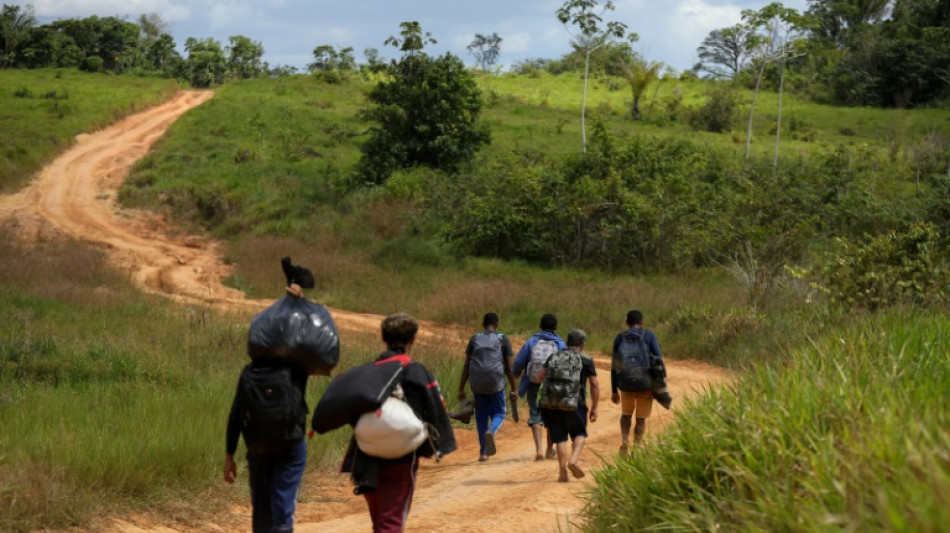
'Operation Exodus': Brazil miners flee Yanomami land / Photo: © AFP

 'Act before it's too late': Tokyo residents fight for more trees

 'Disappointing' as South Korea flag mishap sees Games end on sour note

 Pre-COP host Tuvalu at frontline of climate change

 Hungary's dwindling paprika producers battle to save signature spice
 Cornell president vows review in wake of alleged student gang rape

 Latvian partial election results suggest pro-European choice

 In Egypt's Sinai, Gazan builds school for children displaced by war

 Trump tariffs a mixed bag for US auto industry

 Yemen government forces say struck Houthi targets

 Music links past, present for Pedro Pascal's cellist in 'Behemoth!'

 ALEX BODI ȘI AMBASADORUL REPUBLICII SUDANUL DE SUD, GUM DOMINIC MATIOK, DISCUTĂ LA BERLIN DESPRE POSIBILITATEA ÎNFIINȚĂRII UNUI CONSULAT ONORIFIC LA BUCUREȘTI

 Dodgers step up World Series three-peat bid with 5-3 win over Braves

 Spain break down Czechs as England outclass Croatia in Nations League

 Yamal on target as Spain hold off Czech Republic

 Latvian exit polls suggest pro-European choice
 Lula, Bolsonaro wrap up campaigns ahead of knife-edge election
 Tuchel hails 'complete' England after Croatia demolition

 Fury to invite Trump to lead ring walk before Joshua showdown

 Fashion industry in 'precarious moment', says Vivienne Westwood supremo
 Seventh heaven for England in Nations League rout of Croatia

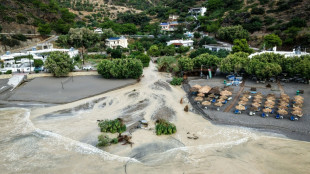 Storms, flooding cause chaos on Greek holiday island of Crete

 #IAmJaneDoe: online support campaign in US university rape case

 Brazil shine on Selecao's first visit to India

 Zverev sets up Djokovic quarter-final at China Open, Rybakina out
 Happier at home, Bordeaux hammer Lyon in Top 14

Wearing broken flip-flops held together by a frayed cord, Joao Batista, an illegal gold miner in the Brazilian Amazon, has been walking for days to escape the jungle, fleeing a looming security-force crackdown.
The wiry 61-year-old with deep creases in his leathery skin is one of thousands of mine workers rushing to leave the Yanomami Indigenous reservation, as Brazil sends in the police and army to wrest back control of the remote territory from invaders accused of sparking a humanitarian crisis.
Indigenous leaders say illegal miners have poisoned the water with mercury, destroyed the rainforest, raped and killed inhabitants, and triggered a food emergency that is devastating the reservation's 30,000 Yanomami.
Batista, who spent the last seven months working at an illegal mine, does not see himself as a criminal. But he says life left him few options other than "garimpo" -- wildcat mining.
"Look, I never went to school. At my age, what else am I going to do to survive?" he told AFP as he walked down a dirt road outside the town of Alto Alegre, in the northern state of Roraima.
He still had around 85 kilometers (53 miles) to go before returning to his home in the state capital, Boa Vista.
Up the road, a family fleeing a mine camp was trying to hitch a ride to the capital -- a 23-year-old mother, 15-year-old father and their three small children.
They caught malaria in the rainforest, and were too sick to walk, they said.
"Our kids are sick, too. I need to get to Boa Vista," said the young father.
- Reverse gold rush -
There has been an exodus of mine workers from the Yanomami reservation since President Luiz Inacio Lula da Silva ordered Brazil's military to establish a no-fly zone there last week, cracking down on the bush planes the mines rely on for food and supplies.
Some are making the gruelling trek out on foot. Others are fleeing down the Uraricoera river, crowding more than 30 people onto long, narrow boats.
Justice Minister Flavio Dino said Monday the government had begun deploying more than 500 police and soldiers for an operation to evict the miners, along with the mine-camp cooks, prostitutes and others drawn to the rainforest gold rush.
Dino said the government expected at least 80 percent of the estimated 15,000 people who have invaded the Yanomami reservation would leave on their own before authorities began "coercive" measures, which he said would come this week.
As a first step, environmental agency IBAMA said Wednesday it had started destroying heavy equipment seized at the mines, including a helicopter, plane and bulldozer.
The Yanomami territory, Brazil's biggest Indigenous reservation, is one of several to suffer a massive influx of illegal miners under far-right ex-president Jair Bolsonaro (2019-2022), whom activists accuse of encouraging the incursions.
- 'Real criminals' -
The crackdown is stoking tension in the region, where an entire economy has developed around the illegal gold industry.
Gold sells for 280 reais (around $55) a gram on the black market in Roraima. AFP met miners carrying up to 30 grams.
But the money risks running out fast.
At a local truck stop, an illegal bush pilot flashed a handful of gold -- his payment for a recent flight. He said he worried it would be his last: he has had to stop working because of the no-fly zone.
Locals fear the impact of a massive influx of newly jobless workers.
Military police in Roraima launched what they called "Operation Exodus" to "intensify" their presence in the region and "preempt disturbances."
Authorities have encouraged the miners to leave the reservation voluntarily -- though Dino vowed to prosecute "all those who committed crimes such as genocide, environmental crimes, financing illegal gold mining and money laundering."
One 58-year-old miner, who asked to be identified only as "Parmalat," his nickname, said he resented being treated like a criminal, when crimes like corruption often go unpunished.
"We're treated like we're worthless," he said.
"All we want to do is work, and we're called criminals. The real criminals aren't treated that way."
C.Kovalenko--BTB