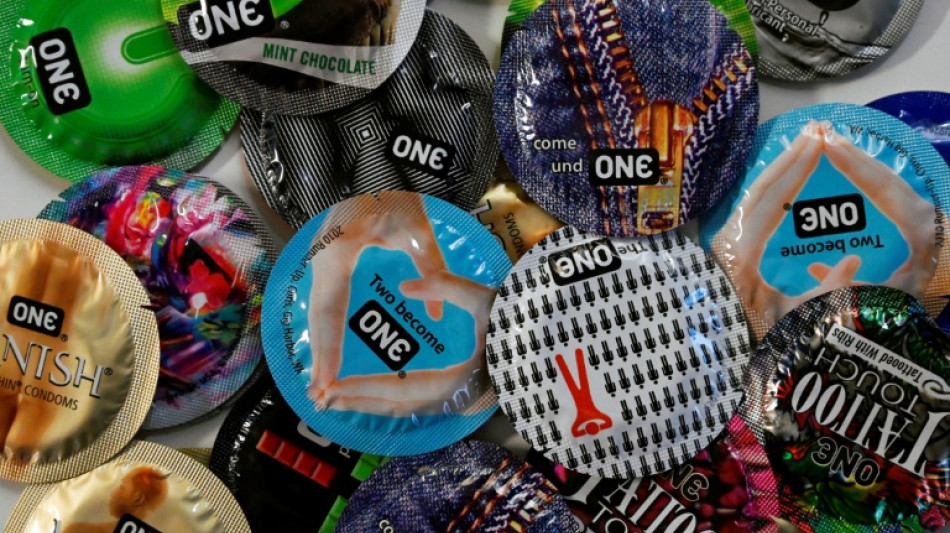
US authorizes first condom for use in anal sex / Photo: ©

 Prague’s Concert for the Future Kicks Off on Wenceslas Square

 Prince William and Princess of Wales to Announce Earthshot Prize Winners in Mumbai

 Indonesia Forest Fires: Health Crisis, Diplomatic Strains and the Search for Solutions

 BYD Dolphin G Leasing Deal: Plug-in Hybrid Supermini Available from £174 a Month

 JUEL Group Expands from Real Estate to Hospitality with Hyatt Centric Malta Opening

 French Economy Shrinks 0.1% as Consumer Confidence Slumps

 Wall Street Ends Turbulent Week Higher Despite Inflation and AI Jitters

 Kansas City Fed Chief Says Inflation Is Still Running Too Hot

The US Food and Drug Administration (FDA) on Wednesday authorized the first condom for use during anal intercourse, in what was hailed as a victory for sexual health by experts.
Although people already use condoms for anal sex -- as is recommended by health agencies including the Centers for Disease Control and Prevention (CDC) -- regulators across the world had only previously allowed companies to officially market their products as "safe and effective" for vaginal use.
Sexual health advocates considered this an unmet public health need since unprotected anal intercourse carries the greatest risk of HIV transmission via sexual exposure, with one study finding that 69 percent of men who have sex with men would use condoms more frequently if they were FDA-indicated.
Wednesday's authorization of Global Protection Corp's One Male Condom follows a clinical trial involving more than 500 people, carried out by Emory University.
"The FDA's authorization of a condom that is specifically indicated, evaluated and labeled for anal intercourse may improve the likelihood of condom use during anal intercourse," said agency scientist Courtney Lias in a statement.
The condom is also indicated to prevent sexually transmitted infections -- and as a contraceptive -- during vaginal sex.
"We want people to have lots of sex -- but we also want them to be empowered and informed," said Davin Wedel, president of Global Protection Corp, which makes the condom brand that is available in 54 sizes, and incorporates a paper template to help each user find the right size.
The clinical trial involved 252 men who have sex with men and 252 men who have sex with women, aged between 18 and 54.
The FDA had said it would accept a five percent failure rate, which previous trials had failed to accomplish. The limit was easily surpassed in the new study, with the failure rate 0.68 percent for anal and 1.89 percent for vaginal intercourse.
The researchers behind the study, which was published in The Lancet's eClinicalMedicine, said one of the reasons the trial succeeded where others failed in the past was likely due to the provision of lubricant and inclusion of instructions on how to use the product.
Lubricant reduces friction, which in turn causes condom failure from slippage and breakage.
Another reason could be that participants were asked to keep mobile phone-based daily diaries, whereas past trials had asked volunteers to recall failure events up to several months later.
Monica Gandhi, an infectious disease doctor and medical director of an HIV clinic in San Francisco, welcomed the finding.
"The important thing about condoms is they don't just prevent HIV, but they prevent gonorrhea, chlamydia and syphilis," she told AFP, adding it was surprising that such an authorization had taken so long to achieve.
In its statement, the FDA said the green light could pave the way for more makers to apply for similar authorization if they show equivalent results.
K.Thomson--BTB



