
New treatment shows promise against fatal neurological disease: study / Photo: © AFP/File

 Asian Games set to close after records, rancour and rain

 Cry for help as French-Swiss lake dries up

 Sabalenka swept out of China Open in third round

 US urges 'restraint' as Ethiopia's Tigray crisis rocks region

 Teens on target again as USA down Mexico 3-0

 World records prove Asian Games were a hit, says top official

 US prison chief who oversaw botched execution resigns

 'Chaotic' Asian Games threaten Japan hopes of hosting Olympics again

 Finnish town braces for change from Google data centres

 What is fuelling French school protests?

 Without lawyers, migrant children face deportation from the US

 Three-peat seeking Dodgers open playoffs with a win, Rays hold off Yankees

 Brazil votes in nail-biter polls closely watched by Trump

 'Just be you': Kim reveals Tiger text that inspired him to gold

 Myanmar migrants returned to war-torn nation from Malaysia

 ALEX BODI AND AMBASSADOR GUM DOMINIC MATIOK OF THE REPUBLIC OF SOUTH SUDAN MEET IN BERLIN TO DISCUSS THE POSSIBILITY OF AN HONORARY CONSULATE IN BUCHAREST

 Lula, Bolsonaro wrap up campaigns ahead of Brazil's knife-edge vote

 Toulouse edge Castres in Top 14 derby

 Murakami homer propels White Sox to MLB playoff win over Guardians

 Israel targets top Hamas leader in deadly Gaza strike on anniversary

 Houthis say struck oil facility near Riyadh, as Saudis hit Sanaa

 AI needs safety layers like nuclear plants: ex-OpenAI engineer

 MVP Judge will miss Yankees' MLB playoff series against Rays

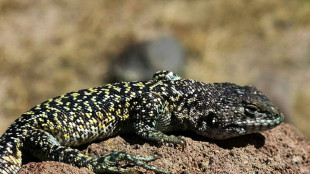 New lizard species discovered in Peru

 Fernandes hails Portugal's 'greatest symbol' Ronaldo, calls for unity

A new treatment shows promise against the deadly neurodegenerative disease ALS, a study based on mice showed Tuesday.
Amyotrophic lateral sclerosis, sometimes called Lou Gehrig's disease after the famous baseball player, devastates nerve cells in the brain and spinal cord.
It affects about 30,000 Americans at any given time, causing progressive loss of motor and cognitive function. Most patients die within five years of their diagnosis.
In the new research, published in the journal PLOS Biology, a team led by Jeffrey Agar of Northeastern University investigated a way to target and stabilize an abundant enzyme that keeps cells safe from the toxic byproducts of consuming food and breathing oxygen.
Inherited mutations to the gene responsible for production of this protein, called SOD1, are involved in many cases of ALS, and at other times such mutations can occur without family history.
A malfunctioning SOD1 gene causes the protein to assemble into the wrong shape. This prevents it from doing its tasks, but can also trigger a build up of protein clumps that are also a hallmark of Alzheimer's, Parkinson's, and other diseases.
Agar told AFP that over the course of 12 years, he and colleagues had discovered and tested a "molecular stabilizer," S-XL6, that acts like a "stitch" and forces the protein to remain in the correct configuration.
A major challenge involved finding a molecular stitch that would only target the SOD1, not "off target" proteins, which would poison the host.
The team tested their molecule in mice that were genetically modified to have a form of ALS disease, and found it not only restored the protein's function, but stopped its secondary toxic effects too. Safety was also proven in rats and dogs.
It successfully stabilized 90 percent of SOD1 proteins in blood cells, and 60-70 percent in brain cells.
They are hoping to soon get permission to move the molecule to clinical trials in humans, and an investor has purchased the rights to a patent.
Eventually, if it proves out, Agar said he hoped it might become a co-treatment for Biogen's Qalsody, a breakthrough regimen that received accelerated approval by the Food and Drug Administration in 2023, which works by reducing the number of SOD1 gene copies the body produces.
I.Meyer--BTB