Hunger crisis in Gaza: what to know / Photo: © AFP

 'Act before it's too late': Tokyo residents fight for more trees

 'Disappointing' as South Korea flag mishap sees Games end on sour note

 Pre-COP host Tuvalu at frontline of climate change

 Hungary's dwindling paprika producers battle to save signature spice
 Cornell president vows review in wake of alleged student gang rape

 Latvian partial election results suggest pro-European choice
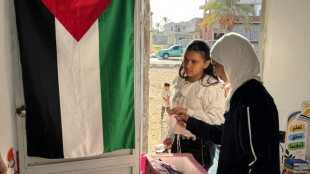 In Egypt's Sinai, Gazan builds school for children displaced by war

 Trump tariffs a mixed bag for US auto industry

 Yemen government forces say struck Houthi targets

 Music links past, present for Pedro Pascal's cellist in 'Behemoth!'

 ALEX BODI ȘI AMBASADORUL REPUBLICII SUDANUL DE SUD, GUM DOMINIC MATIOK, DISCUTĂ LA BERLIN DESPRE POSIBILITATEA ÎNFIINȚĂRII UNUI CONSULAT ONORIFIC LA BUCUREȘTI

 Dodgers step up World Series three-peat bid with 5-3 win over Braves

 Spain break down Czechs as England outclass Croatia in Nations League

 Yamal on target as Spain hold off Czech Republic

 Latvian exit polls suggest pro-European choice
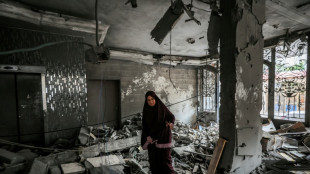
 Lula, Bolsonaro wrap up campaigns ahead of knife-edge election

 Tuchel hails 'complete' England after Croatia demolition

 Fury to invite Trump to lead ring walk before Joshua showdown

 Fashion industry in 'precarious moment', says Vivienne Westwood supremo

 Seventh heaven for England in Nations League rout of Croatia

 Storms, flooding cause chaos on Greek holiday island of Crete

 #IAmJaneDoe: online support campaign in US university rape case

 Brazil shine on Selecao's first visit to India

 Zverev sets up Djokovic quarter-final at China Open, Rybakina out
 Happier at home, Bordeaux hammer Lyon in Top 14

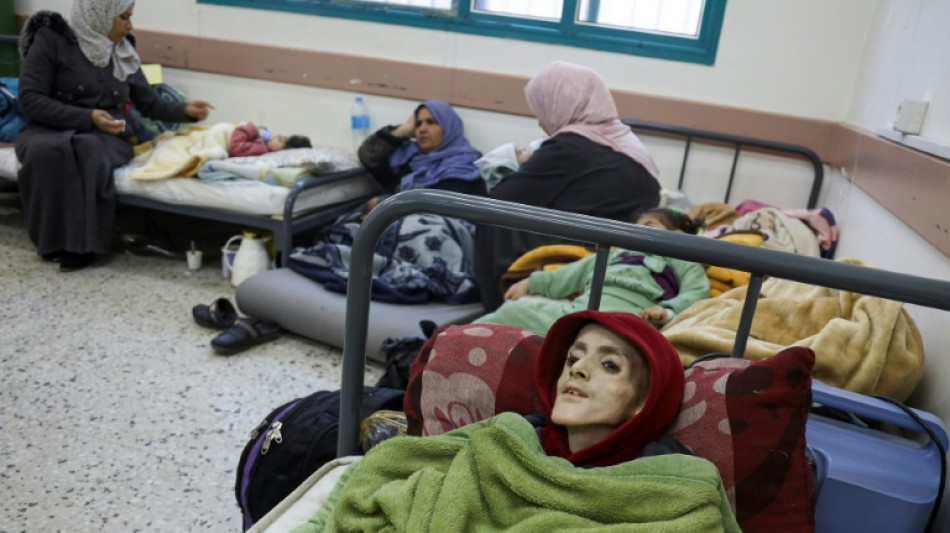
Children have begun starving to death in Gaza, where the United Nations has warned a famine is "almost inevitable."
Here's what to know about the hunger crisis engulfing the war-torn Palestinian territory.
- Emaciated children -
At least 15 children have died from starvation and dehydration in a single hospital, according to the health ministry in the Hamas-run territory.
Media including AFP have captured haunting images of emaciated infants with sunken eyes and gaunt faces.
Over the weekend, World Health Organization workers were able to visit hospitals in northern Gaza for the first time since October, WHO chief Tedros Adhanom Ghebreyesus said Monday on X.
He said the workers found "severe levels of malnutrition, children dying of starvation, serious shortages of fuel, food and medical supplies, hospital buildings destroyed."
Across Gaza, 90 percent of children aged 6–23 months and pregnant and breastfeeding women face severe food poverty, according to a report released two weeks ago by the Global Nutrition Cluster, a network of nutrition NGOs led by UNICEF.
At least 90 percent of children under five are affected by one or more infectious diseases, it added.
Aid organizations working on the ground blame Israel, which is waging a war against Hamas in the wake of the October 7 attacks, for preventing enough food trucks from entering Gaza.
"As the occupying power in Gaza, Israel has the responsibility to ensure that the occupied population receives food and medical supplies," the International Rescue Committee told AFP in a statement.
"Intentionally using starvation of civilians as a method of warfare by depriving them of objects indispensable to their survival, including wilfully impeding relief supplies as provided for under the Geneva Conventions, is a war crime."
At the start of the conflict, high-ranking Israeli officials such as defense minister Yoav Gallant, openly called for a "complete siege" to deprive Palestinians of food, fuel and water. But officials have since walked back that rhetoric.
"Our war is against Hamas, not against the people of Gaza," military spokesman Rear Admiral Daniel Hagari said recently, adding Israel was "facilitating aid."
The UN food agency said Tuesday its aid convoy was turned away by Israeli forces at a checkpoint in northern Gaza.
Last week, Israeli forces opened fire on Palestinians scrambling for food aid in a chaotic melee that killed more than 100 people.
US military planes have begun dropping tens of thousands of meals, though aid agencies say this is an inefficient way to curb the crisis.
- 'Lifelong impacts' -
Dabney Evans, director of the Center for Humanitarian Emergencies at Emory University, told AFP that images from Gaza indicated the most severe forms of malnutrition, including "wasting" which refers to extremely low weight for a person's height, as a result of severe decreases in caloric intake in a short period of time.
"Their bodies are beginning to break down and are in shock," said Evans, explaining that bringing someone back to good health requires careful supervised medical care, not just giving them food, which can be dangerous.
Imad Dardonah, a pediatrician at the Kamal Adwan Hospital, the only pediatrics hospital in northern Gaza, told AFP that staff had supplies to only treat around half of cases adequately.
"We have nothing to give them, the most we can do for them is either give them saline solution or sugar solution."
If malnutrition is prolonged it will lead to longterm consequences such as growth stunting, a reduced ability to learn, and a weakened immune system.
Anu Narayan, an advisor for UNICEF on child nutrition, told AFP there would likely be a "lifelong impact" at least on some individuals.
"We know for a fact that it can impact children's cognitive development and over the long term has an impact on their earnings and ability to function fully."
UC Berkeley researchers recently learned that people born during the Great Chinese Famine more than 60 years ago -- and their offspring -- had far higher rates of tuberculosis, "indicating a previously unrecognized, intergenerational effect of prenatal and early life exposure to famine."
- The "F" word -
Since 2004, "famine" has had a formal technical definition: it occurs when at least 20 percent of the population face extreme food shortages, acute malnutrition rates exceed 30 percent, and two out of 1,000 people die from starvation on a daily basis.
While the word is highly charged and has the power to spur world action, it has only been officially declared twice in the past decade: in Somalia in 2011, and South Sudan in 2017.
But Narayan told AFP it made little sense to fixate on the fact the Gaza crisis had not yet met the highest possible classification.
"We have seen that all the factors that put people, but particularly young children at such high risk, are there."
J.Horn--BTB