US panel recommends all women receive breast cancer screening from 40 / Photo: © AFP/File

 Latvian partial election results suggest pro-European choice

 In Egypt's Sinai, Gazan builds school for children displaced by war

 Trump tariffs a mixed bag for US auto industry

 Yemen government forces say struck Houthi targets

 Music links past, present for Pedro Pascal's cellist in 'Behemoth!'

 ALEX BODI ȘI AMBASADORUL REPUBLICII SUDANUL DE SUD, GUM DOMINIC MATIOK, DISCUTĂ LA BERLIN DESPRE POSIBILITATEA ÎNFIINȚĂRII UNUI CONSULAT ONORIFIC LA BUCUREȘTI

 Dodgers step up World Series three-peat bid with 5-3 win over Braves

 Spain break down Czechs as England outclass Croatia in Nations League

 Yamal on target as Spain hold off Czech Republic

 Latvian exit polls suggest pro-European choice

 Lula, Bolsonaro wrap up campaigns ahead of knife-edge election

 Tuchel hails 'complete' England after Croatia demolition

 Fury to invite Trump to lead ring walk before Joshua showdown

 Fashion industry in 'precarious moment', says Vivienne Westwood supremo

 Seventh heaven for England in Nations League rout of Croatia

 Storms, flooding cause chaos on Greek holiday island of Crete

 #IAmJaneDoe: online support campaign in US university rape case

 Brazil shine on Selecao's first visit to India

 Zverev sets up Djokovic quarter-final at China Open, Rybakina out

 Happier at home, Bordeaux hammer Lyon in Top 14

 Lula, Bolsonaro in final push for votes ahead of knife-edge election

 Boisterous fashion week barnstorms 'sleepy' Nigerian capital

 UAE investigators say flydubai co-pilot was planning 'terrorist act'

 Rahul smacks century in India v Windies ODI

 Daryz seeks to join exclusive club of dual Arc winners

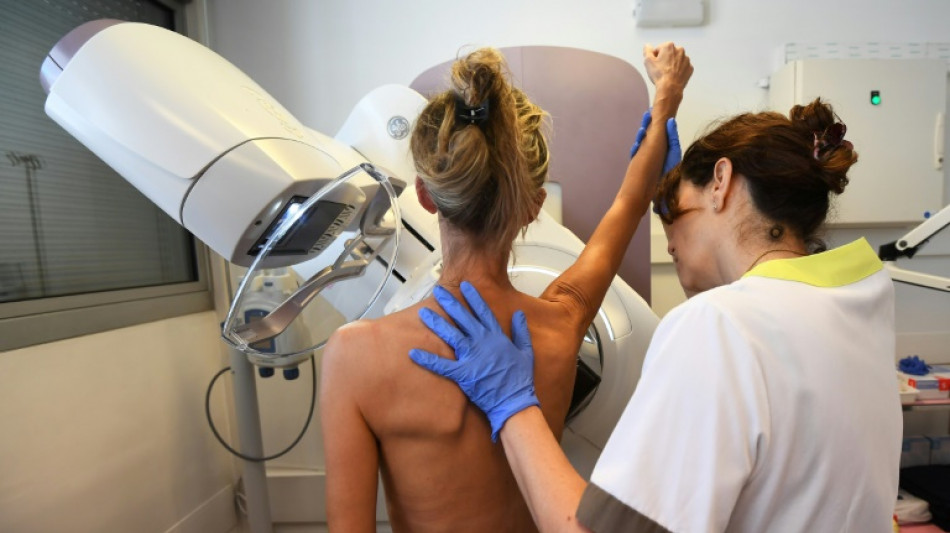
Women should get screened for breast cancer every other year starting from the age of 40 to reduce their risk of dying from the disease, an influential US body recommended on Tuesday.
The US Preventive Services Task Force, an independent panel of experts that receives federal funding, previously said that women in their 40s should make an individual decision about when to start mammograms based on their health history and reserved its mandatory recommendation for people turning 50.
Its new guidance was based on a review of evidence and a modeling study published in the Journal of the American Medical Association, and finalizes a draft recommendation proposed last year.
"More women in their 40s have been getting breast cancer, with rates increasing about 2 percent each year, so this recommendation will make a big difference for people across the country," Task Force chair Wanda Nicholson said in a statement.
"By starting to screen all women at age 40, we can save nearly 20 percent more lives from breast cancer overall."
Breast cancer is the second most common cancer and the second most common cause of cancer death for women in the United States, with more than 43,000 deaths last year.
Black women are 40 percent more likely to die of the disease than white women, and so ensuring they start screening at 40 "has even greater potential benefit for Black women," said Nicholson.
The new recommendation applies to nearly all women -- those who are at average risk of breast cancer, as well as those with a family history of breast cancer, and those with dense breasts.
Nearly half of all women have what's known as dense breast tissue, which they generally only find out during their first mammogram. Dense breast tissue increases their risk for breast cancer and means that mammograms may not work as well for them.
"Unfortunately, there is not yet enough evidence for the Task Force to recommend for or against additional screening with breast ultrasound or MRI," the experts said, urgently calling for more research.
The new recommendation doesn't apply however to those with a personal history of the disease, or those at very high rise due to certain genetic markers, or who have a lesion detected on previous biopsies -- they could benefit from more regular screening, in consultation with their doctor.
The new recommendation applies up until the age of 74, after which the balance of benefit-to-risk becomes uncertain, the task force said.
While screening is a powerful tool in the fight against cancer, there are also limits, the task force said, explaining why it is not recommending annual mammograms. Over-testing increases the number of harms, such as false positives, or receiving treatment that wasn't required.
I.Meyer--BTB