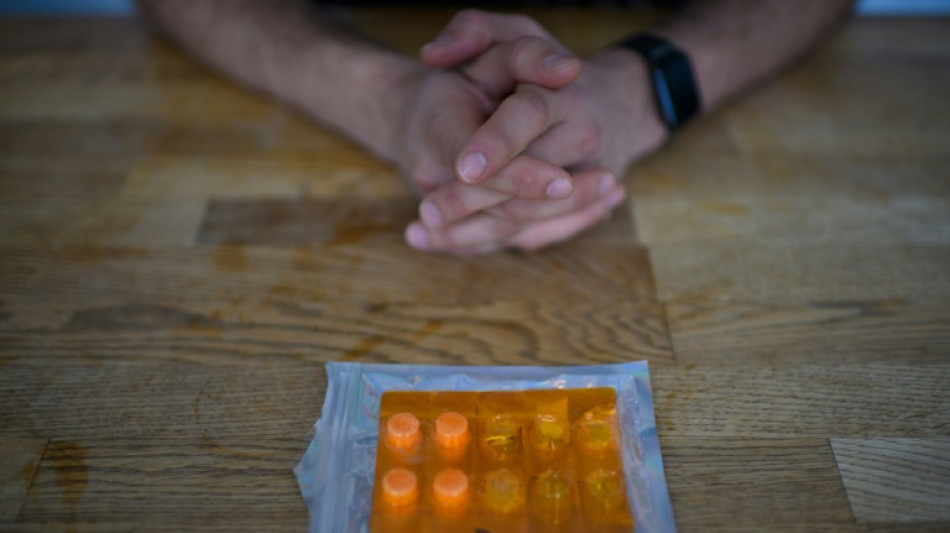
Ketamine pill treats depression without psychedelic effects: study / Photo: © AFP/File

 ALEX BODI AND AMBASSADOR GUM DOMINIC MATIOK OF THE REPUBLIC OF SOUTH SUDAN MEET IN BERLIN TO DISCUSS THE POSSIBILITY OF AN HONORARY CONSULATE IN BUCHAREST

 Lula, Bolsonaro wrap up campaigns ahead of Brazil's knife-edge vote

 Toulouse edge Castres in Top 14 derby

 Murakami homer propels White Sox to MLB playoff win over Guardians

 Israel targets top Hamas leader in deadly Gaza strike on anniversary

 Houthis say struck oil facility near Riyadh, as Saudis hit Sanaa

 AI needs safety layers like nuclear plants: ex-OpenAI engineer

 MVP Judge will miss Yankees' MLB playoff series against Rays

 New lizard species discovered in Peru

 Fernandes hails Portugal's 'greatest symbol' Ronaldo, calls for unity

 Grandidier-Nkanang double takes Pau to Top 14 summit despite Vannes fightback

 Trainer Scott gets perfect Arc boost with top notch double

 Ex-PM says Putin cannot admit 'mistake' over Ukraine

 Houthis say Saudi Arabia launches dozens of strikes on Yemen capital

 Qatar and Abu Dhabi F1 Grand Prix to go ahead - F1 boss

 South Korea lift gloom with smash-and-grab Games football gold

 Ireland news conference before Israel game cut short amid tensions

 Protests over housing flare in Spain after relief measures rejected

 Zverev thrashes Shang to set up Djokovic quarter-final at China Open

 Turkey football ref chief jailed pending trial for graft

 North Korea says test of intermediate-range strategic missile included use of AI

 Rampant Sayers leads Hong Kong to third men's rugby gold in a row

 Ethiopia's Tigray rebels abandon regional capital as govt advances

 Bulgaria's Tsar Samuel returns 'home' after 1,000 years

 'Glad it's over': Kim powers to Games gold and military exemption

A new pill that slowly releases ketamine could treat people with severe depression without giving them the psychedelic side effects of the often-misused drug, early trial results suggested on Monday.
First developed in the 1960s as an anaesthetic, ketamine's hallucinogenic and dissociative effects led to it becoming a party drug dubbed "Special K".
However, mounting research has demonstrated that ketamine is effective for the roughly quarter of people suffering from depression who see little benefit from common anti-depressant drugs.
In many countries, ketamine has been prescribed for depression for years.
US billionaire Elon Musk told CNN in March that he regularly uses a small amount of prescribed ketamine because it is "helpful for getting one out of the negative frame of mind".
The drug has long been administered intravenously in clinics, but more recently a nasal spray using a derivative called esketamine has increased in popularity.
Both can cause patients to have side effects such as dissociation, high blood pressure and an elevated heart rate.
There are also fears that medical use of the drug could slide into abuse.
The pill described in the journal Nature Medicine on Monday takes more than 10 hours to break down in the liver, lead study author Paul Glue told AFP.
"The really interesting feedback from patients is the lack of side effects -- no euphoria, no dissociation," said the researcher at New Zealand's University of Otago.
"I don't think these tablets would appeal to people who are abusing ketamine."
- Electro-shock alternative -
The phase 2 trial involved more than 270 people with depression who had previously tried an average of four different anti-depressant drugs.
More than half taking the ketamine pill went into remission for their depression, while 70 percent of the placebo group relapsed after 13 weeks, the study said.
Julaine Allan, an expert on mental health and addiction at Australia's Charles Sturt University who was not involved in the study, praised the trial while emphasising that more research is needed.
Ketamine does not work for everyone, and the "positive effects may wear off over time," she told AFP.
Michel Hoffmann, a psychiatrist at Geneva University Hospitals, said there is "real enthusiasm" in the medical community for ketamine's potential for treating depression.
"For patients who don't respond to conventional drugs, ketamine offers a way to avoid electro-shock therapy," he told AFP.
This last-resort treatment, which involves sending electric currents through the brain, has been proven to be effective.
But it can cause memory loss -- and some patients fear the procedure after seeing depictions of it in films such as "One Flew Over the Cuckoo's Nest".
- Fears of 'opioid style crisis' -
Some psychiatrists remain hesitant to prescribe ketamine for depression, fearing their patients could end up misusing the drug.
Last year, "Friends" actor Matthew Perry became the latest high-profile death from a ketamine overdose.
US police are investigating how Perry obtained the doses that caused his death -- he had reportedly not had a supervised infusion session for several days.
One potential benefit of quick-acting ketamine seen in previous research is that it could help patients considering suicide.
But there is "the plausible concern that the widespread use of ketamine might trigger a new opioid style crisis," Oxford researcher Riccardo De Giorgi said in a 2022 BMJ editorial.
By ridding ketamine of the side effects sought by some partygoers, the slow-release pill could alleviate some of these concerns.
There were still some side effects from the pill, the most common being headaches, dizziness and anxiety.
More research including phase 3 trials is needed before the drug can be reviewed by national medicine agencies, meaning it will be at least two or three years before patients could potentially access the pills, Glue said.
F.Pavlenko--BTB