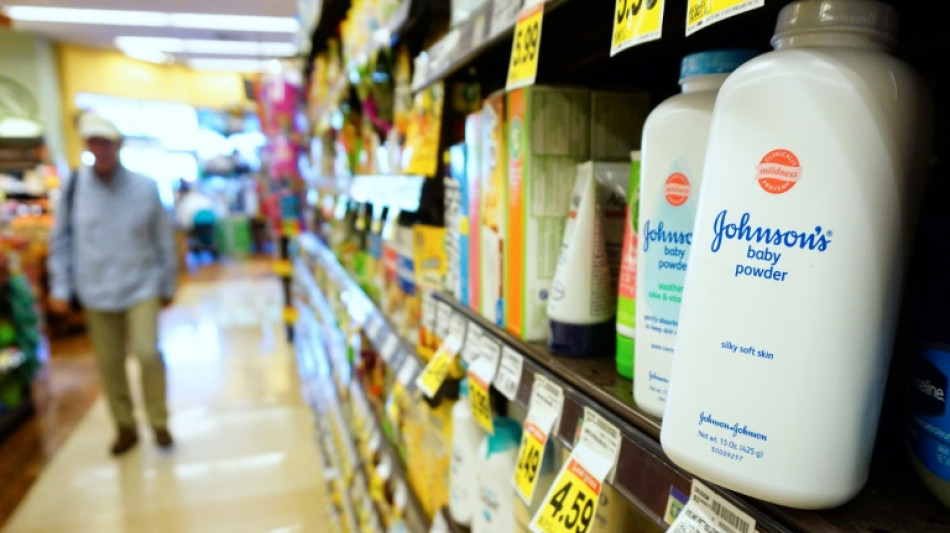
WHO agency says talc is 'probably' cancer-causing / Photo: © AFP/File

 ALEX BODI AND AMBASSADOR GUM DOMINIC MATIOK OF THE REPUBLIC OF SOUTH SUDAN MEET IN BERLIN TO DISCUSS THE POSSIBILITY OF AN HONORARY CONSULATE IN BUCHAREST

 Lula, Bolsonaro wrap up campaigns ahead of Brazil's knife-edge vote

 Toulouse edge Castres in Top 14 derby

 Murakami homer propels White Sox to MLB playoff win over Guardians

 Israel targets top Hamas leader in deadly Gaza strike on anniversary

 Houthis say struck oil facility near Riyadh, as Saudis hit Sanaa

 AI needs safety layers like nuclear plants: ex-OpenAI engineer

 MVP Judge will miss Yankees' MLB playoff series against Rays

 New lizard species discovered in Peru

 Fernandes hails Portugal's 'greatest symbol' Ronaldo, calls for unity

 Grandidier-Nkanang double takes Pau to Top 14 summit despite Vannes fightback

 Trainer Scott gets perfect Arc boost with top notch double

 Ex-PM says Putin cannot admit 'mistake' over Ukraine

 Houthis say Saudi Arabia launches dozens of strikes on Yemen capital

 Qatar and Abu Dhabi F1 Grand Prix to go ahead - F1 boss

 South Korea lift gloom with smash-and-grab Games football gold

 Ireland news conference before Israel game cut short amid tensions

 Protests over housing flare in Spain after relief measures rejected

 Zverev thrashes Shang to set up Djokovic quarter-final at China Open

 Turkey football ref chief jailed pending trial for graft

 North Korea says test of intermediate-range strategic missile included use of AI

 Rampant Sayers leads Hong Kong to third men's rugby gold in a row

 Ethiopia's Tigray rebels abandon regional capital as govt advances

 Bulgaria's Tsar Samuel returns 'home' after 1,000 years

 'Glad it's over': Kim powers to Games gold and military exemption

The World Health Organization's cancer agency on Friday classified talc as "probably carcinogenic" for humans, however an outside expert warned against misinterpreting the announcement as a "smoking gun".
The decision was based on "limited evidence" talc could cause ovarian cancer in humans, "sufficient evidence" it was linked to cancer in rats and "strong mechanistic evidence" that it shows carcinogenic signs in human cells, the WHO's International Agency for Research on Cancer (IARC) said.
Talc is a naturally occurring mineral which is mined in many parts of the world and is often used to make talcum baby powder.
Most people are exposed to talc in the form of baby powder or cosmetics, according to the Lyon-based IARC.
But the most significant exposure to talc occurs when talc is being mined, processed or used to make products, it added.
The agency said there were numerous studies which consistently showed an increase in the rate of ovarian cancer in women who use talc on their genitals.
But it could not rule out that the talc in some studies was contaminated with cancer-causing asbestos.
"A causal role for talc could not be fully established," according the agency's findings published in The Lancet Oncology.
Kevin McConway, a statistician at the UK's Open University not involved the research, warned that for the IARC's evaluation, the "most obvious interpretation is actually misleading".
The agency is only aiming "to answer the question of whether the substance has the potential to cause cancer, under some conditions that IARC do not specify," he said.
Because the studies were observational and so could not prove causation, "there isn’t a smoking gun that the talc use causes any increased cancer risk," he added.
The announcement comes just weeks after US pharmaceutical and cosmetics giant Johnson & Johnson agreed to pay $700 million to settle allegations it misled customers about the safety of its talcum-based powder products.
Johnson & Johnson did not admit wrongdoing in its settlement, even though it withdrew the product from the North American market in 2020.
A summary of studies published in 2020 covering 250,000 women in the United States did not find a statistical link between the use of talc on the genitals and the risk of ovarian cancer.
Also on Friday, the IARC classified acrylonitrile, a chemical compound used to make polymers, as "carcinogenic to humans", its highest warning level.
It cited "sufficient evidence" linking acrylonitrile to lung cancer.
The polymers made with acrylonitrile are used in everything from fibres in clothes to carpets, plastics and other consumer products.
G.Schulte--BTB